Effects of Technological Change on the Human Condition: The Age of Spiritual Machines.
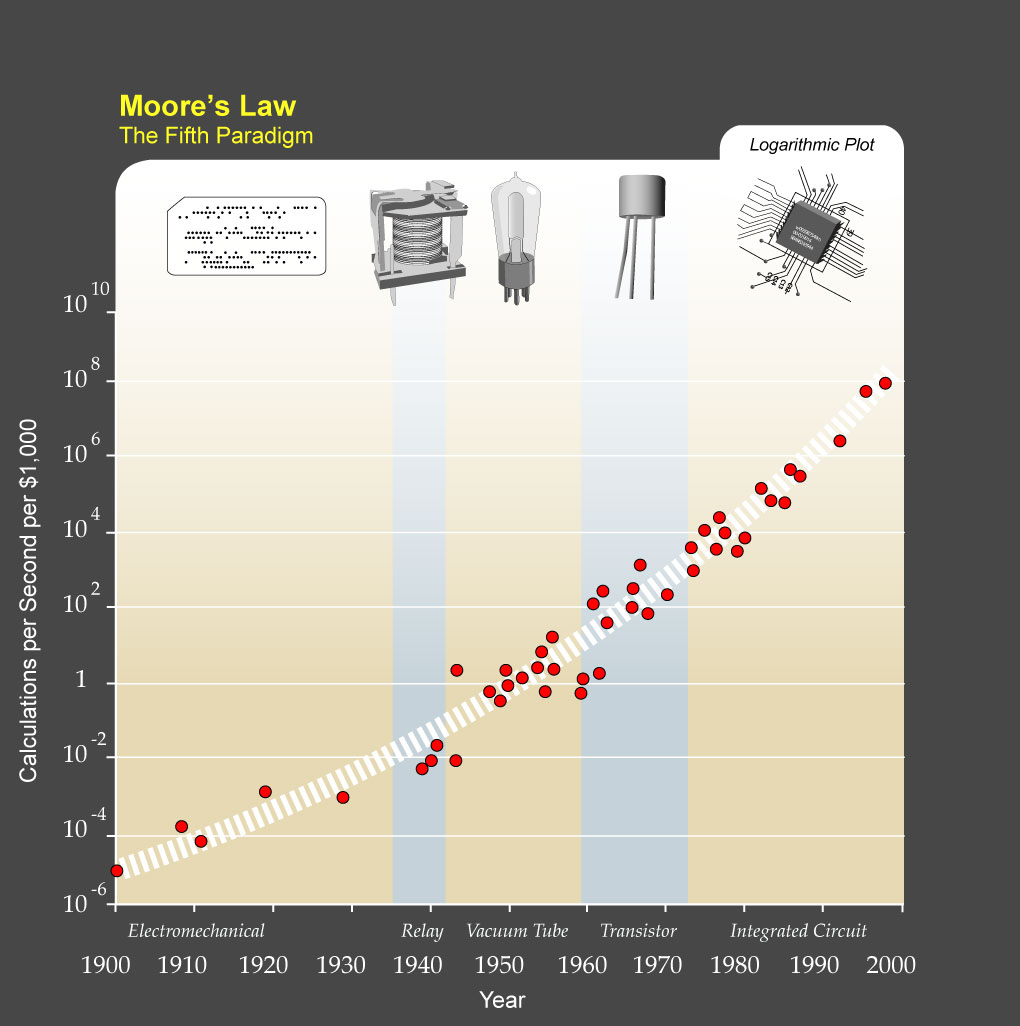
We cannot know the future, but we see trends happening now that can be projected forward. In 1965, Gordon Moore, co-founder of chip maker Intel, put forth an axiom that became known as Moore's Law. Moore stated that every year since 1959 the number of components on a microchip had doubled. Moore predicted that this trend would continue until 1975. . . He was wrong. The computer industry turned Moore's axiom into a general law. Further investigation showed that the law held as far back as the 1940's, if the time frame for doubling is adjusted to 18 months, rather than one year. As 1975 came and went it also became clear that Moore's Law was headed into the future with no signs of failing. The law is now treated as a summary statement that every 18 months a new chip goes on the market that is twice as fast as it's predecessor, has twice the memory, is cheaper, and more compact. Now Moore himself is predicting that Moore's Law is about to end due to the fact that the number of transistors doubling can continue as long as micronization continues. Power consumption was never considered in the original axiom and so without some new kind of power technology Moore's law will stall.(Wired, April 2004) "Every two years more computers are produced than existed on the planet previously." (Andy Grove, CEO, Intel Corporation)
The number of lines of code written for computer programs is doubling faster than 18 months. Microsoft's word processing program had 27,000 lines of code when it was first released. By 1995 Microsoft Word had two million lines of code. The next version will have four million, then eight, sixteen, doubling every 12 to 18 months. The internet is doubling in size every year.(UC Regents Report) World...
More Technology
essays:
Analyzing the Effect of Scientific Advancement on Humanity Advancements in Sciencetific Technology
... new civilizations and since humans have this eagerness to seek out the unknown we have manipulated science and technology to do that. And without scientific advancements such as spaceships and computers ...
Moral aspects of Technology(Case study: Moral Impact of Mobile Phone communication on the society)
... time lag between communications, should actually create involvement in depth. In this case, they are very similar to This apparent paradox is resolved when we analyze the above two premises in depth. While the second statement ...
The Age of Technological Achievement
... time, the airplane has made travel much more efficient and has made countless cultural interactions possible. Changes in design, production, and safety inventions continue to advance this new ...
This essay is about how the to use the new technology to get an education online; compared to the old way, the classroom education.
... a degree that requires a person to log onto a computer and connect to the Internet. Technology has allowed full-time employees to achieve that same four-year degree that every ...
A definition of what Science Fiction is in the 20th Century,
... 'Science fiction not only allows us to escape our assigned space and time and step into other dimensions. It lets us examine our mundane, earthbound ... fiction is able to capitalizes on this by showing the audience entirely new worlds and alternatives to our own. Technology presented in science ...
New Age of Technology
... and computers are increasing factors in the collision repair industry. With time being ... specifications. You can view the whole pulling process, as it happens, live on the colored monitor. When the job is complete ...
Artificial Intelligence and the Human Mind
... Computers move closer to checkmating humans. Christian Science Monitor; Vol.88 Issue 23, p3. Kurzwel, R. (2000). Will my pc be smarter than I am? Time ... at least 20 billion calculations per second which conventional silicon chips are far from realizing (Kurzweil, 2000). Such assumptions indicate that ...
International Business Financial & Management Accounting
... 2000. Manufacturing systems and technological change: The U.S. personal computer industry. Economic Geography 71 (1): 79-102. Ansari, S. L., and ...