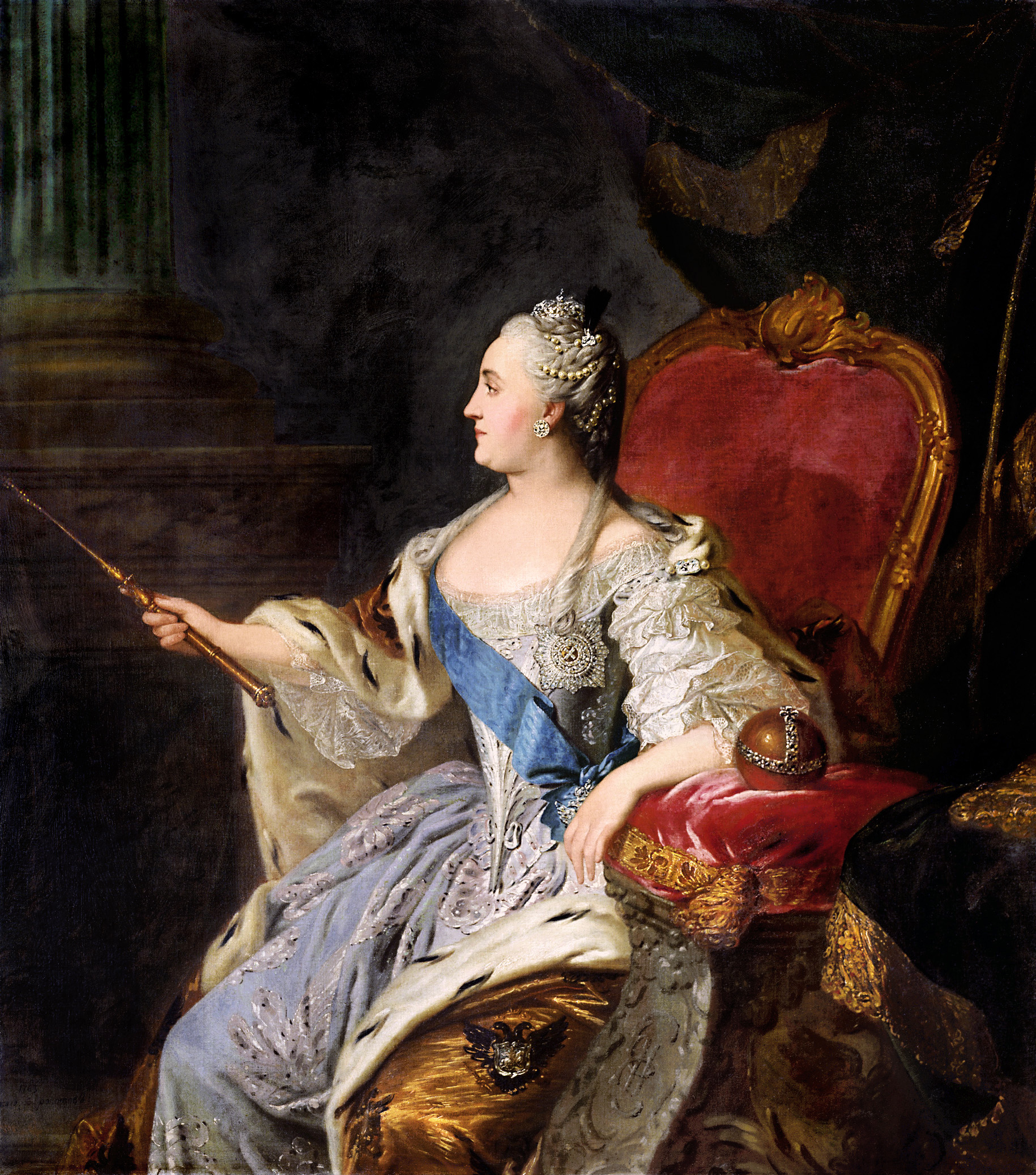
Empress Catherine the Great
Catherine II is remembered as one of the greatest reformers of Russia. Catherine was born a German princess in one of the tiny German states, but nevertheless she turned out to be a powerful and enlightened ruler of the vast Russian Empire. After her coronation on September 22, 1762 at the Cathedral of the Assumption in the Kremlin in Moscow, she quickly began making changes in government and society. She continued the process of Westernization begun by Peter the Great and made Russia a great European power. She built marvelous new monuments across Russia and transformed St. Petersburg into a European city of imperial pretensions. The arts, music, and education where patronized by her, and Catherine pumped millions of rubles into the creation of the modernization of Russia. No other Russian monarch appreciated beauty as much as Catherine. She set the stage for the emergence of a national Russian culture that would emerge as something unique and wonderful in the nineteenth century.
Originally named Sophie Augusta Fredericka von Anhalt-Zerbst, Catherine was born in the Baltic seaport town of Stettin, Pomerania on April 21, 1729 to Christian August, a German military prince of Anhalt-Zerbst, and Princess Joanna Elizabeth of Holstein-Gottorp. At Empress Elizabeth's request, the family left Zerbst on January 10, 1744. They stopped in Berlin to see King Frederick II. A few days later Sophie bid farewell to her father in Schwedt, then she and her mother were on their way to Russia. At the arrival in St. Petersburg they learned that the court was at the time in Moscow. The Empress Elizabeth seemed to have taken an instant liking to Sophie. The Grand Duke was glad to see them, after all Johanna was his father's first cousin. Sophie noticed a certain frailty about Peter, and he was prone to...
More European History
essays:
What obstacles were there to the re-establishment of Jewish life in occupied Germany and in the two German states during the 1950s, and to what extent were they overcome?
... in the year 1959 and this wave of violence washed over to the GDR, especially in the cities of Magdeburg and Leipzig, increasing rapidly in both German states. Several ... Germany. The eastern European Jews had no interest in their German environment or in integration into German society ...
The unification of Germany was achieved through a policy of "Blood and Iron". How did Bismarck go about unifying the German states?
... allot of land and the German unification could now be completed. The South German states joined Bismarck's Confederation and The North German Confederation was now called the German Empire and ... told the Tsar that a successful war with France would allow the Russian fleet to once again enter the black ...
To what extent did the Spanish Civil war represent a microcosm of the polarization of European politics between the right and the left?
... a state of diplomatic congeniality. Inefficient governments with no desire for reform reigned supreme under this system. However this period of political stagnation was blown asunder by the 'Great War'. Following years of death ...
To what extent was the revolution of February/March 1917, in Russia, due to the nature of Tsarism and the policies of Nicholas II (1894-1917)?
... to the loss of the soldiers' loyalty to the Tsar. Certainly the nature of Tsarism has put its mark on Russian history, and as most other European countries ...
What were Peter the Great's westernization policies and how did they help modernize Russia?
... Russia. Peter the Great's absolute rule brought in these significant reforms, thus westernizing Russian society and modernizing the army. His changes allowed for the development of Russian culture and intellectualism. Due to the Tsar ...
Was "Peter the Great", Czar of Russia, actually Great?
... reign. Peter the Great deserves the title of great. Peter did much to increase the size and power of Russia, therefore modernizing Russia. According to a Russian historian, He remade the Russian army on the up to date European armies ...
Peter The Great
... helped Peter I create his Westernized Russian country, and caused Peter I to proceed as Peter the Great. As a result of his successfulness, Peter represents ...
Peter the Great and his reforms: DBQ type essay.
... one of the greatest. As the tsar of Russia, Peter the Great enforced many social reforms. He was very influenced by Western European ideas and incorporated many of them into Russian society ...