Energy future
OUTLINE
General considerations 2
U.S. energy consumption by sectors.& 2
Fossil fuels 4
Oil 4
Non-conventional oil 5
Non-conventional natural gas 5
Coal 5
Nuclear power 5
Renewable energy 7
Energy storage and transportation fuel 9
Speculative 10
General considerations
All the energy we consume is generated by using the four fundamental interactions of nature: gravity, electromagnetism, the weak nuclear force and the strong nuclear force to create work. Fission energy and fusion energy are generated by electromagnetism and the strong nuclear force. Most forms of terrestrial energy can be traced back to fusion reaction inside the sun, with the exception of tidal power, geothermal energy and nuclear power. Geothermal energy is believed to be generated primarily by radioactive decay inside the Earth. Radioactive decay energy is generated by both the weak nuclear force and electromagnetic force. Tidal energy comes from the gravity energy and kinetic energy of the Earth/Moon system.

Most human energy sources today use energy from sunlight, either directly like solar cells or in stored forms like fossil fuels. Once the stored forms are used up (assuming no contribution from the three previous energy sources and no energy from space exploration) then the long-term energy usage of humanity is limited to that from the sunlight falling on Earth. The total energy consumption of humanity today is equivalent to about 0.1-0.01% of that. But humanity cannot exploit most of this energy since it also provides the energy for almost all other lifeforms and drives the weather cycle
U.S. energy consumption by sectors.
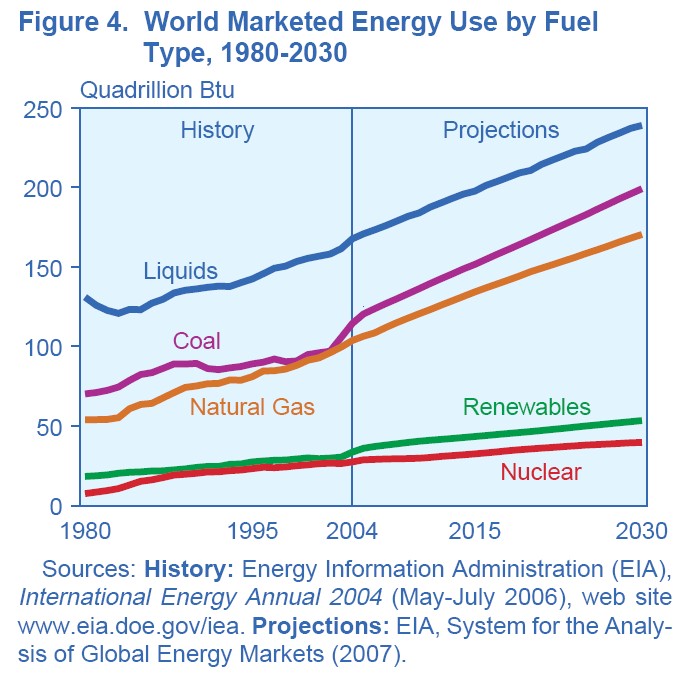
World energy production by source: Oil 40%, natural gas 22.5%, coal 23.3%, hydroelectric 7.0%, nuclear 6.5%, biomass and other 0.7%. In the U.S., transportation accounted for 28% of all energy use and 70% of petroleum use in 2001; 97% of transportation fuel was petroleum
The United...
More Environmental Science
essays:
The Artic National Wildlife Refuge (ANWR) vs. Oil
... percentage of gasoline to create either E-85 or E-95 both considered fuels by Epact (Energy Policy Act) regulations (U.S. Department of Energy 9). Because ethanol is an oxygenated fuel it helps gasoline burn much more cleanly than it ... the ANWR; it’s not ethical. So, why destroy to the ANWR in the pursuit of some selfish “benefit”, when there are other choices available to us? The American public needs to act in favor of alternative energy resources like ethanol ...
The Oil Crisis and Alternative Energy Ideas
... people drove more miles in nicer cars. Steady improvements in U.S. energy efficiency kept world oil demand soft, holding down prices and ... Petroleum consumption: Transportation sector and end-use total, 1949-2001. (2001, March) Energy information ...
Alternative Sources of Energy: Geothermal Power and Solar power
... /2/2007, 7.Sach, J, 'Future of Energy', Project Syndicate [Online], retrieved 14/2/2007, 8.U.S. Department of Energy, Solar, retrieved 14/2/2007, 9 ... ) As fossil fuels become more expensive, such projects will be more considerable.(3) Meanwhile, technology might improve solar power by making it more ...
Alternate Energies And Fuels
... stays for many thousands of years, causing damage to the earth in ways we can't even imagine. "U.S. Department of Energy (DOE) to develop and manage a Federal system for disposing of all spent nuclear fuel from commercial nuclear ... continue to expand with more government initiative. "Wind Energy, energy contained in the force of the winds blowing across the earth's surface. When harnessed, wind energy can be converted into mechanical energy for performing work" Understanding the concept of geothermal ...
U.S. Fisheries and the environment: an alternative view
... must be made, to do so without thoughtful consideration to the impact of such modifications on human communities, cultures and livelihood is amiss. For environmental groups to take swipes at the U.S. fishing industry en mass (without making distinctions in ... excluder devices. Hence, all shrimp caught by U.S. companies is technically "safe" or Turtle free. While the efforts of anyone making an effort and protecting the turtle population should be honored, but serious consideration must take place to address the ...
Impact of Global Warming:
... 84-88. Retrieved October 12, 2008, from Research Library database. U.S. Department of Energy, (2005). Energy Policy Act of 2005 Retrieved August 09, 2008, fromhttp://www ...
Alternative Fuels
... CNG vehicle cost, detailed by Kenneth Derr, CEO of Chevron, in a speech, and estimated by the the U.S. Department of Energy, is $2500 to $5000 more than a "conventional car," (Derr, 31). "Natural gas needs to be highly compressed ... in fuel-flexable vehicles in the U.S., and Brazil which once fueled its vehicles primarily with ethanol, (Moore, 93). Methanol also has a 100% octane rating and results in lower overall emissions and higher energy efficiency than gasoline fueled vehicles ...
Saving Our Earth
... 2005. http://www.earthjustice.org/program/ 2. "EPAact Alternative Fuels". U.S. Department of Energy-Energy Efficiency and Renewable Energy. 15 December 2004. 13 June 2005. http://www.eere.energy.gov/vehiclesandfuels/epact_fuels.shtml?print 3. "Global Warming". National Environmental ...