"Epic Theatre turns the spectator into an observer, but arouses his capacity for action, forces him to take decisions...the spectator stands outside, studies." (Bertolt Brecht. Brecht on Theatre. New York:Hill & Yang, 1964. p37)
The concept of "epic theatre" was brought to life by German playwright, Bertolt Brecht. This direction of theatre was inspired by Brecht's Marxist political beliefs. It was somewhat of a political platform for his ideologies. Epic theatre is the assimilation of education through entertainment and is the antithesis of Stanislavsky's Realism and also Expressionism. Brecht believed that, unlike epic theatre, Expressionism and Realism were incapable of exposing human nature and so had no educational value. He conjectured that his form of theatre was capable of provoking a change in society. Brecht's intention was to encourage the audience to ponder, with critical detachment, the moral dilemmas presented before them.
In order to analyse and evaluate the action occurring on stage, Brecht believed that the audience must not allow itself to become emotionally involved in the story.
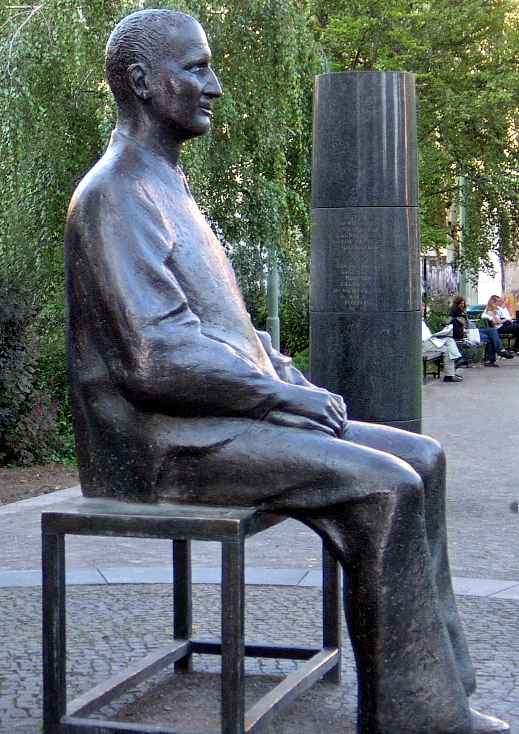 A statue of Bertolt Brecht
 Graves of Helene Weigel and Bertolt Brecht.
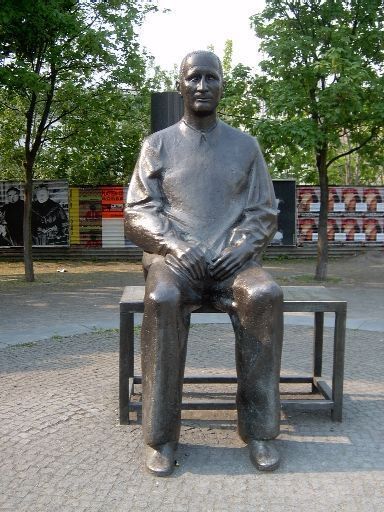 Statue of Brecht outside the Berliner Ensemble's t...
Rather they should, through a series of anti-illusive devices, feel alienated from it. The effect of this deliberate exclusion makes it difficult for the audience to empathise with the characters and their predicament. Thus, they could study the play's social or political message and not the actual events being performed on stage. This process is called Verfremdungseffekt, or the alienation effect, where instead of identifying with the characters, the audience is reminded that they are watching only a portrayal of reality. Several well-known Brechtian plays include Drums in the Night, Edward 2, The Threepenny Opera, Rise and Fall of the Town of Mahoganny, The Life of Galileo, The Good Person of Szechwan, Triple-A Plowed Under, One-Third of a Nation, Mother Courage and her children and the Caucasian Chalk Circle.
A play whose dramatic structure and didactic purposes epitomises epic theatre is The Caucasian Chalk Circle (CCC). The prologue of this play transpires in a Caucasian village of the Soviet Union, where the people of this village are being presented a play called "The Chalk Circle". This play is narrated by a "Singer" and embarks on the story of a servant girl, Grusha, who rescues the governor's son when their city falls under siege. The son, Michael, has been left behind, without so much as a backward glance, by his fleeing mother. Grusha escapes, with Michael in her arms, to the mountains where they live for over a year. Along this journey, countless places and people are encountered, a number that would only occur in epic theatre.
In truly epic fashion, the play then regresses to the beginning of the story and introduces a man, Azdak. By chance this character becomes an amoral and almost absurd judge in Grusha and Michael's former city. The paths of Grusha and Azdak cross when Grusha is summoned to the trial that will determine who is to have custody of Michael. His biological mother or the peasant Grusha who has cared for him the past years? Azdak's ruling results from the outcome of the "Chalk Circle" test. Grusha is awarded the child and hence, though the law has succumbed, justice has prevailed. It is arguable that Brecht's message in this was to the Germans, that in order to uphold justice they must revolt against Hitler's law.
Many components of The CCC brand it to be an epic drama. The Singer narrates what is to occur at the commencement of each scene, so that the audience is familiar with enough of the plot in order for them to refrain from becoming emotionally involved. Thoughts that could only be expressed through soliloquies are also executed by the Singer. This person additionally allows the play to uninhibitedly change place and time by just citing several words. The ability of altering the situation and time is another element of epic theatre. The Singer accomplishes the transition from Grusha's story to Azdak's and this action assists in weakening the audience's engagement with Grusha's plight.
Brecht has calculated the character of Grusha to be one that the audience does not wish to identify with. Her salvation of Michael is not a maternal and noble act but more of a disheartened resignation. Throughout her ongoing struggle for survival she is not 'courageous' but insidious. However, she does ignore her own interests, putting her life in jeopardy, and is thus humane. This action could be evaluated as a further social directive of Brecht's, again aimed at the Germans. It could represent that they can only be humane by striving to thwart Hitler, though they would be endangering their lives by doing so. The existence of a social message in this play further indicates that the CCC is indeed an example of epic theatre.
When performing an epic drama many Brechtian alienation techniques can be incorporated. To illustrate these possible techniques, scene 6 of the CCC will be briefly studied and directed. This scene begins with a narration by the Singer. During this speech the Singer could be finishing erecting the sets up on stage, demonstrating to the audience that the scenery and props are just that and not authentic. In Brecht's time he often used a German theatre called the Theater am Schiffbauerdamn where the auditorium was structured in an extravagant way close to fantasy, while its stage was stark and mechanical. This contrast reminded the audience that, while they were there to be entertained, they were also to think scientifically. Thus, a theatre resembling this layout could be employed.
In Brechtian plays great care is taken to symbolically portray what social class each character belongs to and so the costumes of Grusha and the governor's wife would greatly differ. Soldiers called "Ironshirts" appear in this scene and these characters could speak in mechanical and non-human voices and movements. By doing this the Ironshirts would be symbolic of their characters, rather than realistic, and so the audience would again feel alienated.
Another popular Verfremdungseffekt effect is to flood the stage with a harsh, white light. This induces the audience to remember that again they are only watching a reenactment of reality. It would therefore be most profitable to utilize this technique when there is the threat that the audience is becoming involved. Hence, this device should be implemented at the critical moment of the Chalk Circle test and before Azdak announces his descision.