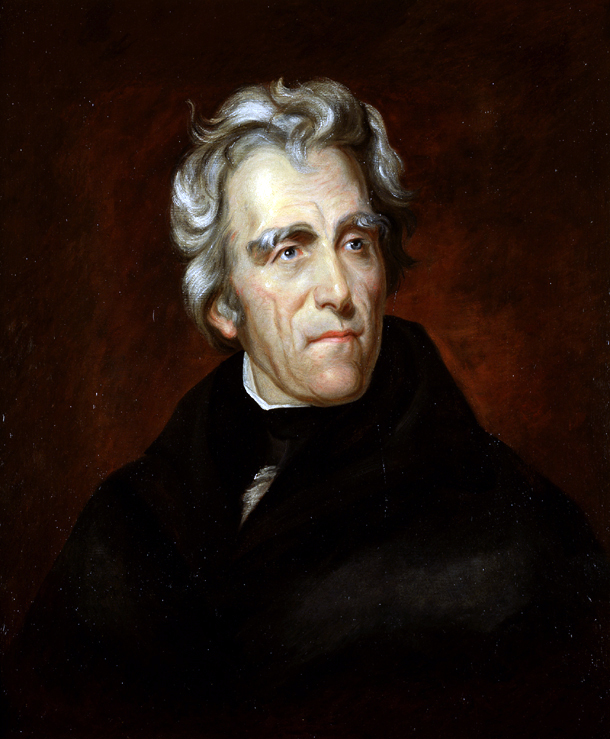
This essasy explores the controversial world of the Jacksonian Era and tries to explain the reasoning behind president Andrew Jacksonian's many bias's.
The 1820s and 1830s in America were times of sweeping change. Jacksonian
democracy brought more power to common citizens, and engendered ideals of wide
spread liberty. Jacksonian democrats believed that they were guardians of the
Constitution, political individual liberty, and economic opportunity. Although
their beliefs did not apply to the Indians that they displaced, they were
correct in their evaluation of themselves.
Jacksonian democrats believed that they were guardians of the Constitution.
Thy believed that they upheld its principles, and defended its ideals of an
"equal" society. They took the Constitution at its face value, without reading
into it. Jacksonians believed that they defended political democracy. They
supported a government that represented all of its people, not just the wealthy.
In their minds, it was important that all white men have the right to vote, not
just the rich white men. They believed that they protected individual liberty.
Locke's natural rights were held in high esteem. Government should ensure these

rights, they thought. They believed that they propagated economic opportunity.
Upward mobility was what the land of opportunity was known for, and they
believed that was one of the better aspects of America, and should be preserved
at all costs.
Jacksonians did a good job of upholding these ideals. In July of 1830, an
act regarding the Bank of the United States was submitted to President Jackson
for signature, he flatly vetoed it on the grounds that it was not "compatible with
justice...or with the Constitution" of the United States. He believed that it was
unconstitutional for a single financial institution to enjoy "a monopoly of the
foreign and domestic exchange." Committed to the ideal of expanding the country,
he worked hard to acquire territory to hold the expanding population. Political
democracy blossomed under Jacksonian democracy. George Henry Evans, a...
More North American Presidents
essays:
This is on the period of jacksonian democracy and how they saw themselves as the guardians of the United States Constitution, political democracy, and individual liberty.
... The Jacksonian democrats saw themselves as the guardians of the United States Constitution, political democracy, individual liberty, and equality of economic opportunity. However, were they really all they claimed to be? They did attempt to increase ...
I will disprove popular belief that Jacksonian Democrats prompted political democracy, equal opportunity, and personal liberty.
... prompting political democracy, equal opportunity, and personal liberty, while in fact, these seeds had already been planted in Americans, and the Jacksonian Democrats had only just come to power when they were ...
Jacksonian Democrats DBQ
... the Jacksonian Democrats. Even though the Jacksonian Democrats did occasionally violate the United States Constitution and the ideals of political democracy, equality of economic opportunity, and individual liberty they did so in order to protect ...
Populism and the Jacksonian Democrats Answer to a past FRQ (Free Response Question) for an AP US History class.
... and Indians, keeping these "dangerous" elements from the politic body to keep the white-male democracy they valued in preservation. Carrying on the Jacksonian legacy, the Populists were mostly farmers and industrial workers; they were the common man. They believed that ...
President Report: Ronald Reagan, How did this president address/attack the social, political, economic, religious, and moral issues of the time?
... sincerely believe that limiting the right of abortion violates the freedom of choice of the individual. But if the unborn child is a living entity, then there are two individuals, each with the right to life, liberty, and ...
Jeffersonian Republicanism vs. Jacksonian Democracy
... his Indian Removal Act, thus showing his hatred for the Native Americans (Brands, H. W.). Jacksonians opposed programs such as educational reform and the establishment of public education. They believed that schools restricted individual liberty by ...
The "Era of the Common Man", through the 1820's and 1830's is also known as the "Age of Jackson".
... The Jacksonian Democrats thought of themselves as saviors of the common people, the constitution, political democracy, and economic opportunity. To the extent that they attempted to support equal economic opportunity and ...
The social changes of jacksonian period and WW1.
... land. They dodged the question of slavery in order to prevent quarrel among northerners and southerners and in effect ultimately supported slavery by doing nothing. Jacksonian Democrats gave the right to vote to white, property-less men for ...