Sunday morning, October 14, 1962, two U-2 surveillance spy planes took flight over Fidel Castro's Cuba. After taking numerous pictures of the area, the United States did their routine analyzes of the photographs. After months of suspicion of Russian nuclear weapons installation, it was proven that the Soviet Union was installing nuclear weapons in Cuba. The photographs suggested that two types of missiles were being installed. "The first was medium-range ballistic missiles, capable of traveling about 1100 nautical miles. The second type was intermediate-range ballistic missile, capable of traveling about twice the distance of the first. Most major American cities, including New York, Washington, Los Angeles, and Chicago were within the range of these missiles and would have been likely targets."
Faced with an immediate problem, President John F. Kennedy immediately decided that the missiles would have to be removed anyway possible. Doing so, he called his most trusted advisers together to serve as an Executive Committee of the National Security Council, or ExComm.
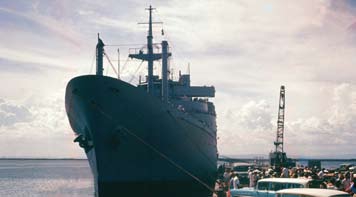 English: Civilian employees and dependents boarded...
 U.S. reconnaissance photograph of soviet missile s...
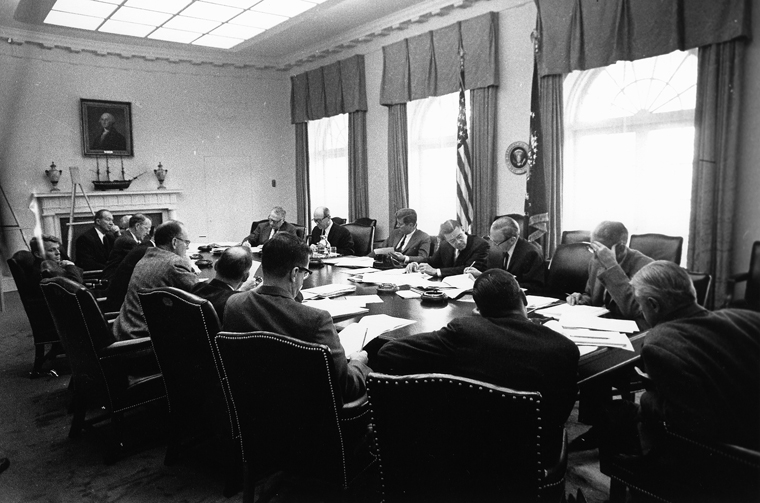 EXCOMM meeting at the White House Cabinet Room dur...
Their jobs were to develop any possible motive to the installation of missiles in Cuba, and also any possible consequences that the missiles pose. The group also provided intelligence briefings, edited Kennedy's letters to foreign leaders, and deliberated over the best course of action. Some statutory members were Vice President Johnson, Secretary of State Dean Rusk, Secretary of Defense Robert McNamara and Attorney General Robert Kennedy. United States forces around the world were alerted and four air squadrons were readied for air strikes over Cuba. 100,000 or more U.S. troops were sent to Florida for a possible invasion of Cuba. The U.S. Navy dispatched more than 180 vessels into the Caribbean Sea for any possible war, and also B-52s loaded with nuclear weapons were in the air at all times.
Despite Kennedy's numerous warnings, the...