Essay on "The forest of forgetting"
There once was a time where mankind cherished the land and valued, even nurtured, its natural existence. This was a time before steel and concrete and before silicon and copper wire. Many people resent that era as being pre-civilized, overrun by savagery and disorganization. Now we are an industrialized people, we tear apart the Earth to make room for our parking lots and condominiums. The incredible irony, however, is that no matter how civilized we are, we still need the Earth in the same way we did thousands of years ago. The wood that builds our houses comes from the same trees that once helped discover fire; no matter how advanced we become we will always need the nature to provide us with the material to grow. Everything from food to industry is dependant on nature still, but we somehow choose to ignore that fact and continue to bite away at the proverbial hand that feeds us.

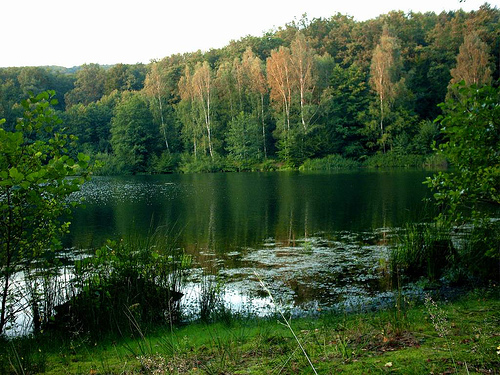
In "Forest of Forgetting", this exact scenario is summed up in one concise example. The original inhabitants of the Scotland Highland Forest embraced the nature around them. They took only what they needed and were very aware of their dependence on the land and because they were aware they consciously took care of it, and preserved it. By doing so, the natives were able to in a sense become one with the nature. They left nature the way it was and adapted around it.
The British, however, sought to civilize these savages and teach them the modern way of life. This, of course, meant razing the forests and establishing a proper city ecosystem. With the invention of the steel saw this modernization transformation took no time at all. Before the natives knew it their forest was completely leveled but a few patches.
The...
More Environmental Science
essays:
Has Lomborg taken a reasonable stand on the issue of a global environmental crisis?
... the Earth. To imagine that the Earth exists to satisfy human desire and that humanity can calculate how best to regulate ... not an ever worsening problem. In fact under any reasonable scenario of technology change and without policy intervention, carbon emissions will ...
A short essay on the Impacts of Tourism on the Environment.
... related to tourism. For example, in very hot or cold conditions, tour buses often leave their motors running while the tourists go out on excursions so that the ... small fish to feed. Also, less experienced bushwalkers sometimes like to pursue activities such as washing their hair in small creeks and ...
An essay on the features of a topographic map, include a in depth description of colours, contours, legend, area references, and grid references
... high the land is above sea level. Mount Florence, for example, is more than 400 metres above sea level. The map also shows that some contour lines are close together while other contour lines ...
An essay on the Australian pattern of climate and vegetation
... area dominated byhigh pressure for most of the year. High pressuresystems drift from west to east across the continentbringing dry, stable, sinking air. Thisresults in atmospheric conditions that are notfavourable for rainfall (see the weather map onthis page). CLIMATE AND RAINFALLPRESSURE ...
Environmental Report: Tidle power in the Bay of Fundy
... column that gives rise to horizontal forces, causing water motion that causes two bulges in the sea surface. One immediately under the earth, and ...
Exploring a Change in Views on the Inheritance of Acquired Characteristics.
... respect to environment, exactly the way Darwin describes it. However, the recently studied phenomena of adaptive mutation, epigenetic inheritance, and behavior inheritance show us that the ...
An essay on the flora and fauna of the Daintree forest
... birds, mammals and insects. · Flying foxes or fruit bats commonly feed onblossoms and establish camps. · They protect the coastline from strong windsand erosion. · They trap sediments that would otherwise bewashed into the sea, thus protecting manyfragile marine ...
The History of the Forest and the Temagami Debate
... own hands? The answer is simple. Our birthright as natural creatures, citizens of the earth, gives us the right to uphold and defend the laws of nature.' ---Watson (TALOS 23) Civil Disobedience According to Abbie ...