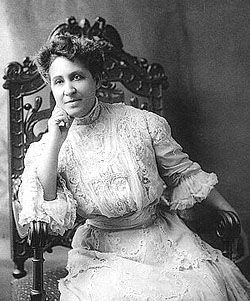
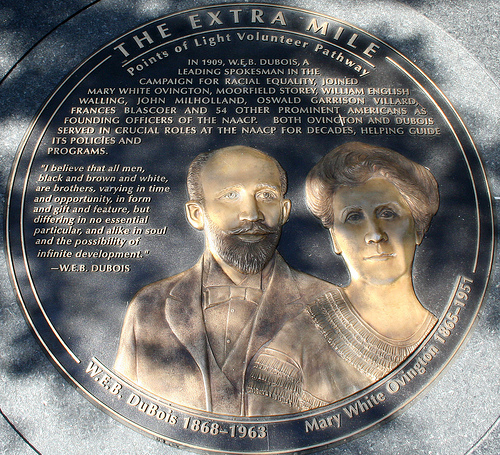
This is an essay about Mary Church Terrell.
Mary Church Terrell
Mary Eliza Church was born in Memphis, Tennessee on September 23, 1863 to Louisa (Ayres) Church and Robert Church, both former slaves. The Church family, however, soon settled into the black middle-class. After the Civil War, Robert opened a money making saloon and during the yellow fever outbreak of 1878-79 he, unlike many of Memphis residents, did not abandon his property. Rather, he bought as much land and property as he could and became the first black Memphis millionaire. Louisa Church owned a successful hair salon, the monies from which provided the family with its first home and carriage. When Church Terrell was about three years old her parents divorced. Her mother was granted custody of the two children, Mary and Thomas. Her father continued to see and support his family and ensured that Mary obtained the best education available to a black woman in the nineteenth century.

In 1891 Church married Robert Terrell, a young lawyer she had met while working at the Colored High School in Washington, DC. Robert Terrell worked for many years in education and law and became the first black judge for the District of Columbia, a post he held for over twenty years (1902-25), through Republican and Democratic presidents. Terrell and Church had one child, Phillis, named after the eighteenth-century poet Phillis Wheatley. In addition to Phillis, the couple adopted the daughter, Mary, of Church Terrell's brother Thomas. After both Robert Terrell's and Thomas Church's death, Church Terrell also raised her brother's son, Robert. Church Terrell attended Antioch University's Model School, where she excelled. She, like many other young black women of this era, obtained a Bachelor's degree in 1884 from Oberlin College, which was run by abolitionists and had admitted blacks in 1835. Instead of taking the Literary or "ladies'...
More Black Awareness & Racism
essays:
Interracial Families in Family Relations: history, strengths & benefits, challenges.
... servants. In the nineteenth century, most of the eminent people of mixed parentage were the "West Indian-born 'mulatto' offspring of well-to-do white men" (Black White ...
Frederick Douglass And Slavery
... about the Civil War to get more people to help save and free the slaves. The writings of Douglass were a significant record of the struggles of African-Americans in the nineteenth-century United ...
What We as African Americans can do to Increase the Unity and Progress in the Black Community.
... lives to violence every year, and it is up to the people in the community to help keep them safe. Residents should build more ... on the different aspects mentioned, it is obvious that we have come a long way since the 20th Century. With ...
Iinfluence of african americans in the 20th century.
... American economy, and refined notions of freedom and equality in American politics. In the African American Century, Gates says, "On a deeper level, black reflections on the human condition, in this land of sentimental aims and romantic dreams injected tragicomic sensibilities ...
What America would be like if African Americans were not cohabitants.
... literature in the nineteenth century. Mark Twain made great use of it in Huckleberry Finn. Without blacks, that book would not exist. Blacks were the inspiration of many literary writers such as Faulkner, Stephen Crane and Hemingway. Blacks put a spin ...
1 page response to "incidents in the life of a slave girl" by harriet Jacobs
... was a brave and dedicated woman, who was willing to sacrifice her own life, just to be free, and to give inspiration to others in the same ...
This paper is about racism and how it is portrayed in the following poems: "Jasper Texas 1998," "A Party Down at the Square," and "Night, Death, Mississippi."
... on a true story. In the year 1998, a black man was brutally murdered in east Texas by three young white males. Bragg states, "Whites and blacks in Jasper ...
Incidents In the Life of A Slave Girl
... strong moral character in many ways. When she was a young girl, and pre-teen, she was offered many of the same things that the mistress's ... happy. In the other sense, she felt like she was hurting her son and wished he had died in infancy. She felt this because he had been born a slave. Born subject ...