The Essential Nile
The Essential Nile
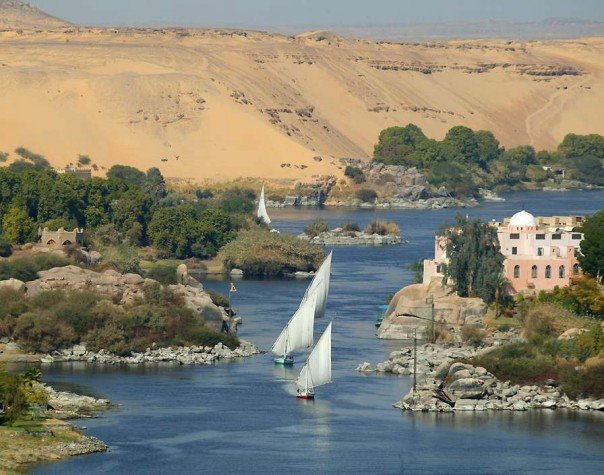
Many features of civilization have evolved over time to become what one commonly thinks of as 'civilized society.' The development of government and writing in the classical civilization of Egypt can be credited to the reliability of the Nile River. The Nile was a source of unification and centralization in the Egyptian society, helping in the development of government and writing with the growth of surpluses.
The Nile River, because of its predictable cycles, 'unified and centered' the Egyptian society. Because of its predictability , the Nile 'created a stable agriculture.' All the Egyptians needed to do was to 'put seeds in the mud, have pigs trample the seeds down into the ground, and when the time came, harvest the crop.' Essentially, the river was important to the well-being of the cities, and was a vital source for irrigation. Not only did the river provide a steady flow of water, its flooding also provided fertile silt. Planted in this fertile soil, crops grew abundantly and allowed for the facilitation and development of surpluses.
Beginning about 5000 B.C.E., farming had already been instituted along the banks of the Nile. But it wasn't until later (3200 B.C.E.) that real agricultural advances occurred. Encouraged by the stability of their farming, the Egyptians were able to develop surpluses in the area. This abundance (which allowed for the evolution and advancement of culture because it encouraged more people to specialize in crafts other than farming) led to a division of labor, and then to social stratification. The improvement of agricultural methods also led to the enlargement of cities. This enlargement then led to the need for bureaucracy and administration, and eventually toward the advent of writing. Writing, a 'very important' aspect of daily life, was a pre-condition for a more formal government.
More Ancient Egypt
essays:
Ancient Egypt, the Nile River, sub-Saharan Africa, the Middle East and their relationship.
... powerful Egyptian society compared to that of its neighbors [ Bentley 65 ]. The Nile River is the world's longest river, it is approximately 4,160 miles long and flows from the highlands in Central Africa ...
The pyramids of Egypt
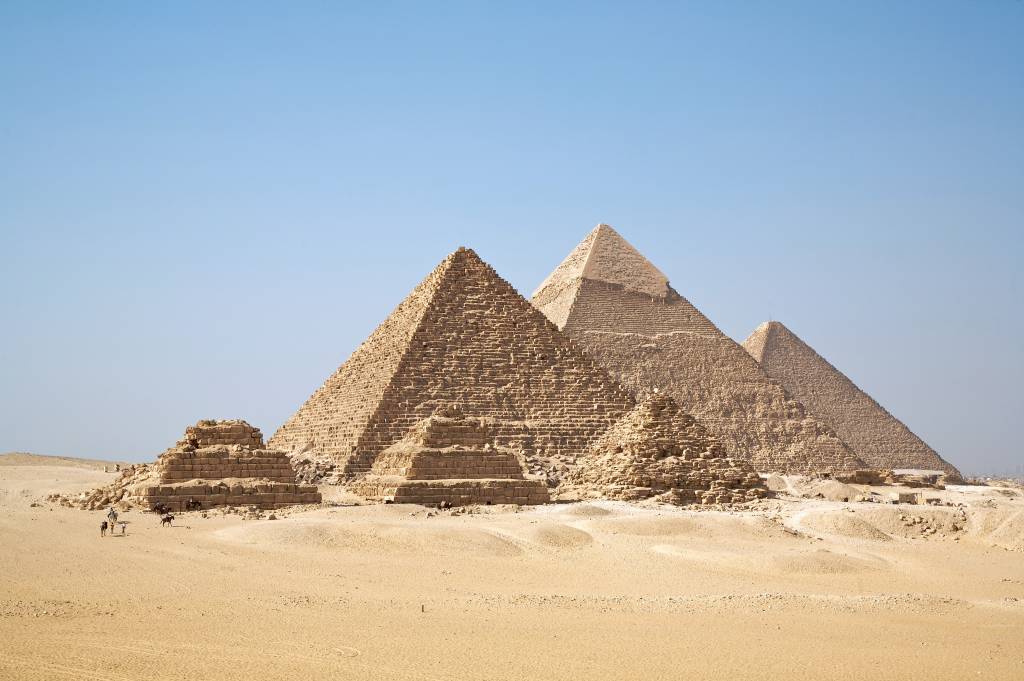
... 35 pyramids still stand near the Nile River in Egypt. These pyramids were built to protect the bodies of Egyptian kings and other royalty ... beautiful furniture, clothing, musical instruments, even sacred vases containing a pharaoh's vital organs. All these items were common items found inside a burial ...
Report on Ancient Egypt
... future society. First of all, all the Egyptian had many advances in the math and sciences. Each year after the floods by the Nile River, farmers ...
EGYPTIAN CIVILIZATION
... The Egyptian pyramids are the most famous of all the ancient monuments, the only remaining wonder of the seven wonders of the ancient world. Just as life arose from the waters, the seeds of civilization were ...
Ancient Egypt
... their society. Throughout the ages known as the Old Kingdom, Middle Kingdom, and New Kingdom, there has been alterations to their religion, art, and architecture. Internal forces, as well as outside influences, have molded ancient Egyptian civilization. This ...
EGYPT--Description of Egyption culture, mummification, government and religion of ancient egypt--also a comparison with modern Egypt
... fascinating museums in Cairo and many modern landmarks. Today the Nile is a big source of wealth for the Egyptians and other people of this region just like it ... very hot and dry dessert. The Nile stretches for 4,145 miles. It is the longest river in the world. It flows from the South to the North. ...
Comparing ancient Sumer and Egypt
... on Egyptian society. Ancient Sumer's geography was completely different than that of its neighbor Egypt. The few natural barriers were not nearly as difficult to cross as Egypt's. Instead of just one river, in ...
Sumerian and Nile Valley civilizations and the comparison between both.
... The Egyptians were a polytheistic society. The most important God of ancient Egypt was Amon, the sun God. The people also loved Osiris, god of the Nile River, and ...