The Honourable Madam Justice Claire L'Heureux-Dube of the Supreme Court of Canada said, "equality isn't just about being treated the same, and it isn't a waiting to be solved. Rather, it is about equal human dignity, and full membership in society. It is about promoting an equal sense of self-worth. It is about treating people with equal concern, equal respect, and equal consideration. These are the values that underlie equality. These are the values that are offended when we discriminate, consciously or not." Her Justice's word is entirely true. Identical treatment may not lead to equality in all cases, nor does differential treatment always cause inequality. This can be seen through the Canadian Bill of Rights and the judgements concerning discrimination and human rights passed under it, and within the wording of the Canadian Charter of Rights and Freedoms, as well as from Supreme Court of Canada judgements passed under it.
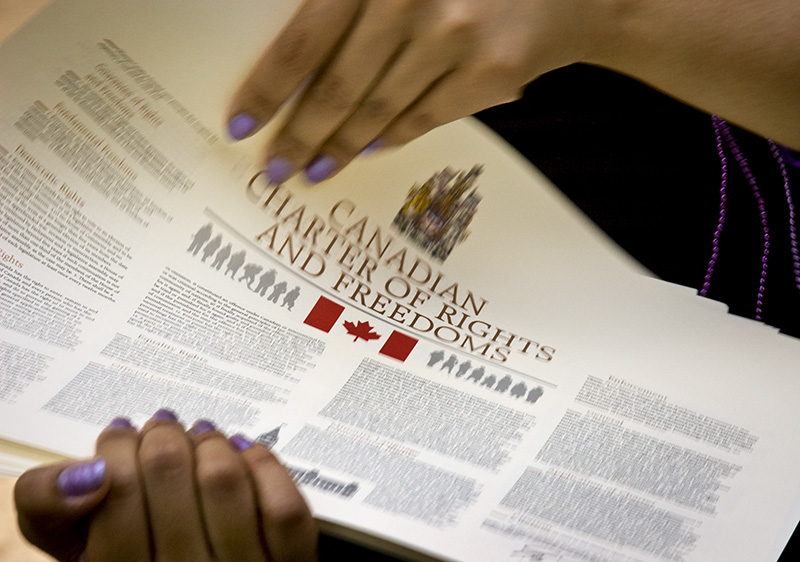 Distributing copies of the Canadian Charter of Rig...
 "March of Hearts" rally for same-sex marriage in C...
 Supreme Court of Canada
In certain cases, differential treatment can help maintain, if not promote further equality.
In 1960, under the Diefenbaker government, the Canadian Bill of Rights was enacted. Parliament did enact an equality guarantee in the Canadian Bill of Rights in 1960; however, the equality guarantee only worked in theory. In practice, social inequality occurred, primarily due to the way the statue was interpreted (Wikipedia, 2008). This was primarily due to the fact it was simply another statute and lacked the authority of a constitution, or constitutional document. In particular, two Supreme Court of Canada Cases exemplify how narrow and arbitrary the document was. In the case of Bliss v. Attorney General of Canada, [1979] 1 S.C.R. 183, the Supreme Court found that denying benefits on the "basis of pregnancy was not sex or gender discrimination, since the distinction was based on the fact that the women were pregnant,
Excellent
This is a very impressive paper. You took a position and argued it perfectly, though I see you didn't really acknowledge some of the controversy concerning the right way to uphold the rights of all individuals. The unique challenge to this approach to justice is that it depends almost entirely on the Judicial branch to make the "right" decision on matters that aren't well defined legally. This can lead to a court system based on personal ideology rather than on interpretation of already existing law. Admittedly, the court must make decisions in areas where the law is ambiguous, but it must be careful to stay clear of attempting to change the law or force social change through wild interpretations of already ambiguous laws. This leads to the hyper-politicizing of the judicial system that often exists in the United States.
However, it is undeniable that identical treatment is not always justice as you eloquently point out in your essay. Good job.
3 out of 3 people found this comment useful.