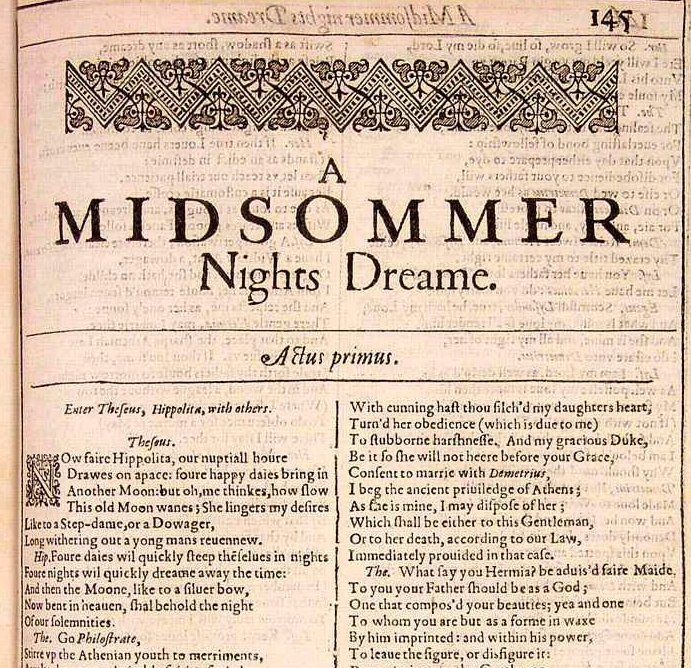
An examination of two modern interpretations of Shakespeare's `A Midsummer Night's Dream.'
Modern theatres and audience expectations are very different to the expectations of Shakespeare's time. Shakespeare's Globe Theatre was rediscovered on the South Bank in 1989 which, at the time, was an entirely different experience of any theatre we know today. There was no roof, no cushioned seats, and most of the audience would be standing in a circular space on the floor, whilst cheering on the actors, like fans at a football match. Modern theatre audiences watch the play silently in respect to others and sit comfortably, admiring a radiant stage with professional actors dressed up to scratch and realistic props which take the audience into another world. Whereas, at The Globe, theatre expeactations were very different. The audience depended upon good weather and sunlight to enhance the enjoyment of watchting the play. Only the affordable would sit in the tiers surrounding the edge of The Globe, onlooking the stage with very few props basic costumes and no background. However, the audience were still taken away, but by the visualative words which created a sense of escapism.
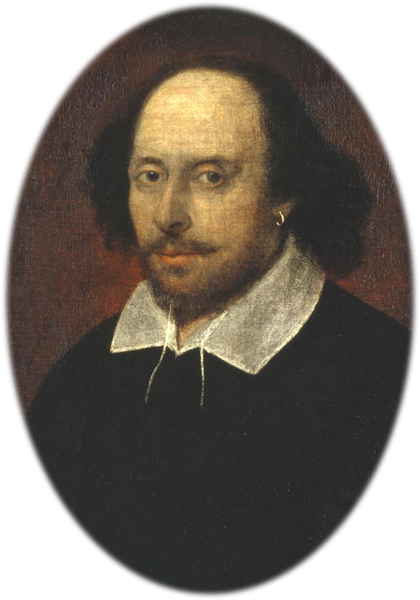
In Shakespeare's Globe, the audience expectation was very different from todays. The audience did not expect realism from the props and believed anything. For example when Oberon states, `I am invisible,' which is how Shakespeare painted the scenery with his words without the use of camouflaged costumes or blending backdrops. These days, the audience expect much more than just words.
Other detail such as stage directions also affect the audience expectations of today. A modern playwright brings much more detail compared to Shakespeare's stage directions. This can be seen from the play `Death of a Salesman,' written by Arther Miller. The first page of the play is filled with stage directions. For example, `the flute plays on. He hears it but is not...
More A Midsummer Night's Dream
essays:
An explication of William Shakespeare's "A Midsummer Night's Dream"
... idea, audience members can easily draw their own interpretations of the play. Audience members can choose to believe that Shakespeares ... the knowledge of love that Hermia holds and just how comfortable and normal she feels their love is. As big of ...
Analysis of Puck from Shakespear's "A Midsummer Night's Dream" in the Form of a Letter to a Play Director
... the play. Without him nobody, not the mortals, not the audience, not you, nor me, would ever have this dream, a ... Publishing Inc., 1998. 369-400. Howard, Jean E. "Feminist Criticism." Shakespeare: An Oxford Guide. Eds. Stanley Wells and Lena Cowen Orlin ...
'The play seems to set out to make fun of love and lovers.' Do you agree with this comment on A Midsummer Night's Dream?
... the time as a light comedy and nothing more, but audiences and those studying the play have since discovered that the play is more dramatically complex than first thought. Shakespeare explores ...
In a production of 'A Midsummer Night's Dream', how would you highlight the difference between the mortal and immortal worlds? Refer particularly to Act 3 scene 1 and 2 and the film.
... their play unnoticed. For this to be obvious to the audience I would sit Puck on an over-hanging tree branch ... actor who plays Bottom sings the song in lines 103-111 he should sing it in a raucous, braying voice that reflects the humour of him having an ass' head without realising. As a costume ...
What is one of the three most important scenes in "A midsummer Night's Dream?" Why?
... and replies, "Four days will quickly steep themselves in night; Four nights will quickly dream away the time." Here it is possible for the audience to think that she does not love Theseus, but she follows this with a pretty description ...
To what extent does 'A Midsummer Night's Dream' present love as a kind of madness?
... have different views on love that they express, and throughout the play, Shakespeare portrays a general attitude about it. He did not portray love ... Oberon, on whom they were doubtless focused at some earlier point in time as well. Bottom and Oberon both do a wonderful job of steadily ...
The Comic view of Love in "A Midsummers Night's Dream" by William Shakespeare.
... to be a dream, when in fact for the first time it is reality. Happiness for all is achieved. Puck wants to end on a kind note so then to the audience ... Dreamland is a place we all love to go to. Shakespeare creates for us a dream within reality. Maybe the things ...
A Midsummer Night's Dream' by William Shakespeare. This is an essay about how Shakespeare enables to convey theme through the characters of Hermia, Helena, Demetrius and Lysander.
... How Characters Convey Theme In 'A Midsummer Night's Dream', Shakespeare uses his characters, as well as plot to convey theme ... occurs when Helena loves Demetrius but at that point of time, he didn't love her. As a whole, 'A Midsummer ...