An explication and commentary on Poe's "Premature Burial"
"The Premature Burial" by Edgar Allen Poe is a brilliant work of true rhetorical mastery. Poe utilizes such strategies as vivid description and aims this passage at a wide array of readers.
Poe's purpose is quite exceptional. He directs the essay mostly towards the non-believers of premature burial. He has developed this composition in order to argue his views about the topic and to persuade others into accepting them. Another and possibly more significant intention is to suggest to physicians that closer observations need to be performed before declaring someone has died.
Poe's purpose appears to tie in to his audience in this case. Nonbelievers of premature burial are sure to read his passage, as well as anyone that has an interest in the subject. Physicians and other scientists are probable targets for this essay also because at the time, people did not have extremely deep knowledge when it came to the life processes. They could use all the help that they could get, so they would most likely view this essay with open eyes.
The strategies employed by Poe are skillful. He gives both facts and opinions from credited doctors to assist in strengthening his argument. His utilization of vivid description is by far the most valuable rhetorical tool. He describes the woman's appearance while still in the hospital with details such as, "pinched and sunken outline," "lips of marble pallor," "lusterless eyes," and, "the cessation of the pulse and any signs of warmth."
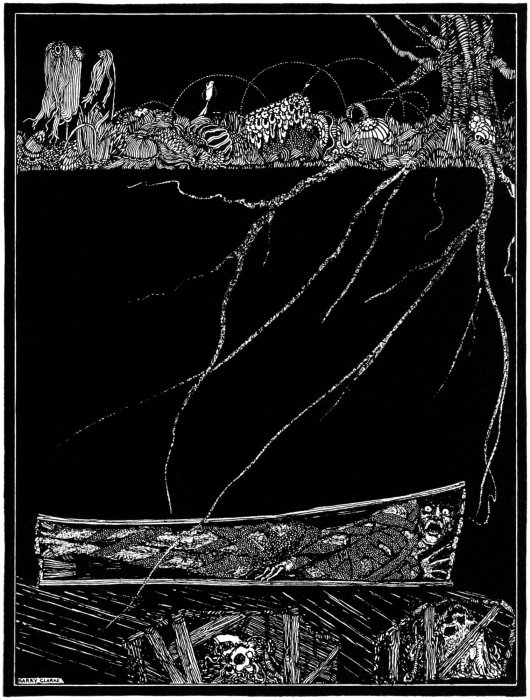
Poe again exercises figurative portrayals when illustrating the scene of the investigation. He assisted the reader in visualizing her struggle to break free of the coffin and then her futile efforts to escape the ironwork inside the tomb. He truly paints a picture in the psyche of the reader.
Edgar Allen Poe is an accomplished...
More Poetry
essays:
Critical Anaylsis of Edgar Allen Poe's "The Bells"
... followers than a thief to the gallows" The writings of Edgar Allen Poe will, for generations to come, entice and disturb those who ... or at fire stations were made of at one time. Descriptive words, such as "clanging", and "shrieking" are used throughout this ...
Analysis of 'Alone' by Edgar Allen Poe
... Theme: Edgar Allan Poe is known as the man who is mostly 'remarkably incapable of analysis'. His poems are dark and brooding, and reflect his gloomy life. The obvious theme in this poem is difference. Poe is saying in a descriptive ...
Analysis of Edgar Allen Poe's poem "Alone".
... actually being isolated from other humans. In the poem "Alone," Edgar Allan Poe talks about being alone in terms of not being able ... well by others. In this poem he writes more about life than about love, and incorporates nature frequently. He incorporates water ...
Explication of 'Bridge of Sighs' by Edgar Allan Poe includes an excerpt of the poem
... by Edgar Allan Poe to the extent that he would include it in his personal explanation of poetry should be exceptional, but 'Bridge of Sighs' by Thomas Hood is with certainty the best poem I have ever read. A reflective work ...
Poe's influence on evolution of horror story
... uses his own methods to create horror but ever since Poe, the genre of horror has changed from a make believe world of demons and ghosts to a realistic Connolly 2 ...
Poe As A Romantic
... in Poe's works. Poe dealt with death in many different ways, using the fear of it to drive many of its' characters insane. In 'The Premature Burial,' the ... Edgar Allen Poe was a romanitc living in a Pre-Romantic literary period ... stories, Poe traces the loss of love in his life. The first time Poe ever ...
A comparison of Alfred Hitchcock and Edgar Allan Poe. For both madness exists in the world
... the audience understands fully the disturbed state of the main characters and the twisted plot of their stories. There are many similarities between Edgar Allan Poe and ...
Contradictions on the "Tell-Tale Heart' by Edgar Allen Poe
... the life of the old man" (Poe 290). This contradicts the previous quote. First, he says that it was not his decision, but in the latter quote, the narrator tells the audience that ... that he is not a madman. In explaining everything, he believes that he is in fact rational. The story, though, full of ...