Failed Farm and Labor Organizations in the Late 19th Century
In the period of 1870-1900, labor unions and organizations were rarely successful in achieving their goals primarily because of problems with being able to organize large numbers of American Workers. The rare victories for labor were isolated incidents because there were no labor organizations on a national or even state-wide basis. The problems with organization arose because of five major factors - differences in union leadership, divisions between skilled and unskilled workers, ethnic and racial tensions, and employer, and government and public hostility.
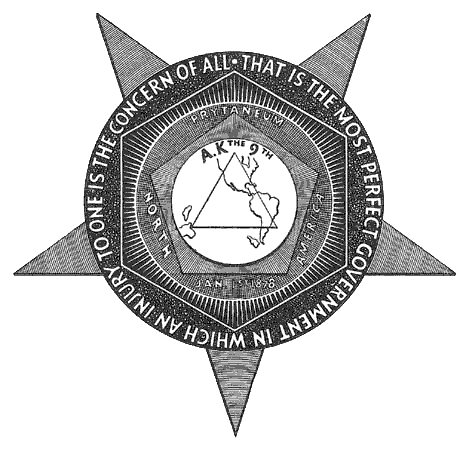
The leader of the Knights of Labor, Terence Powderly, believed that the best means of organization was pooling a mass membership from unskilled and skilled workers. He stated, "The Knights of Labor extended the hand of fellowship to all mankind." Document A mentions the Haymarket riot in Chicago on May 4, 1886, but what it does not mention is that Albert Parson, a member of the Knights of Labor who was tried and hung for his involvement with the riot. This event linked the Knights of Labor to an unacceptable level of violence in the minds of the public. The American Public, feeling that the Knights of Labor did more harm than good, reacted with a feeling of mistrust. Reflecting the public's opinion is a sarcastic cartoon that appeared in Puck Magazine in 1886.

The divisions in skilled and unskilled workers also caused racial tensions. The different grouping of the AFL and Knights of Labor reflect the divisions between unskilled and skilled workers which contributed to the difficulty of organizing unions. Skilled workers, more valued because of their craft, had different interest and goals than unskilled laborers. These divisions were in part because skilled laborers tended to be native-born Americans or old immigrants whereas unskilled laborers tended to be from the poorer new immigrants or native blacks.
More North American History
essays:
Some of the problems that many farmers in the late nineteenth century(1880-1900)saw as threats to their way of life(a)explain reasons for discontent(b)evaluate the validity of the farmers' complaints
... prices for shipping and storage--both equally and effectively frustrating the troubled farmer, who in a way carried the load of a larger economic problem that was affecting the entire nation. Due to various technological improvements, which in effect boosted competition ...
In the late nineteenth century, a select few Americans separated themselves from the rest by fulfilling the American Dream.
... effect of trusts on the general public, and those who made money of the respective trusts ignored those ramifications upon the population at large in the interest of themselves ... received through donations and contributions to organizations of their discretion. Andrew Carnegie gave the majority of his ...
"Manifest destiny in the mid 19th century was just another name for aggressive imperialism." Assess the validity of this statement. A 5 paragraph essay- good springboard
... railroad, and to increase American warm-water ports on the Pacific. These acquisitions were openly defying Mexico, and lead to the later attempts of the United States to extend imperialism to the East. America's efforts to acquire Cuba, the acquisition ...
How Technological changes affected industry workers in the 19th Century (timed)
... the Knights of Labor and the American Federation of Labor had many thousands of members at their peaks. Labor unions did triumph over big businesses by attaining the eight-hour work day, which was accomplished by a massive organized general ...
Urbanization of the Late Nineteenth Century
... for labor. Cities provided a central area for labor and a center of communication. People in search of work ... increase of urbanization was partly due to the number of immigrants ...
Republicans and Democrats How evenly balanced were the Democratic and Republican Parties during the late nineteenth century? How did this balance flow from different regional and sociocultural bases?
... intensity of the public loyalty towards their political parties. A large number of voters ... that Lincoln who freed the slaves and preserved the integrity of the Union belonged to that party. The Republican Party became a symbol ...
Assess the degree to which African Americans were denied Civil and Human Rights in the southern states of the USA in the decades leading up to the 1950s.
... Jewish, anti-Catholic and anti-socialist flames creating an environment of racial tension. The KKK used segregation and "scare tactics" to demoralise the ...
In the late 1800s and early 1900s the majority of American people supported a policy of imperialism.
... African's were put to work as slaves but more like cheap labor. Many of them dies from this, they were resettled, exploited, weren't ... some exceptions to policy of isolation right after the Civil War and included: "The Secretary of State Seward negotiated purchase of Alaska and the annexation of Midway ...