Latin, a descendant of the Indo-European languages, is believed to have originated in the II century BC (Sánchez). According to legend, the language, or at least the Romans, are descended from the Trojans, headed by Aeneas, who landed in Italy after the fall of Troy, though there is scant evidence to prove this. The most popular version of this story is Virgil's Aeneid. Like all other languages, it had its span of life, from the beginning of Roman civilisation until well after the fall of the Western Roman Empire. The Latin Language has seen near extinction because it has traveled the world, it had no chance of flourishing when it was being diluted by many other languages. In its Classical form, with the addition of many new words, it is still in use by the Roman Catholic Church, besides being the language of science, biology in particular. It originated in Central Italy, in the area known as Latium (Lazio in Italian), hence its name Latin (Willmer).
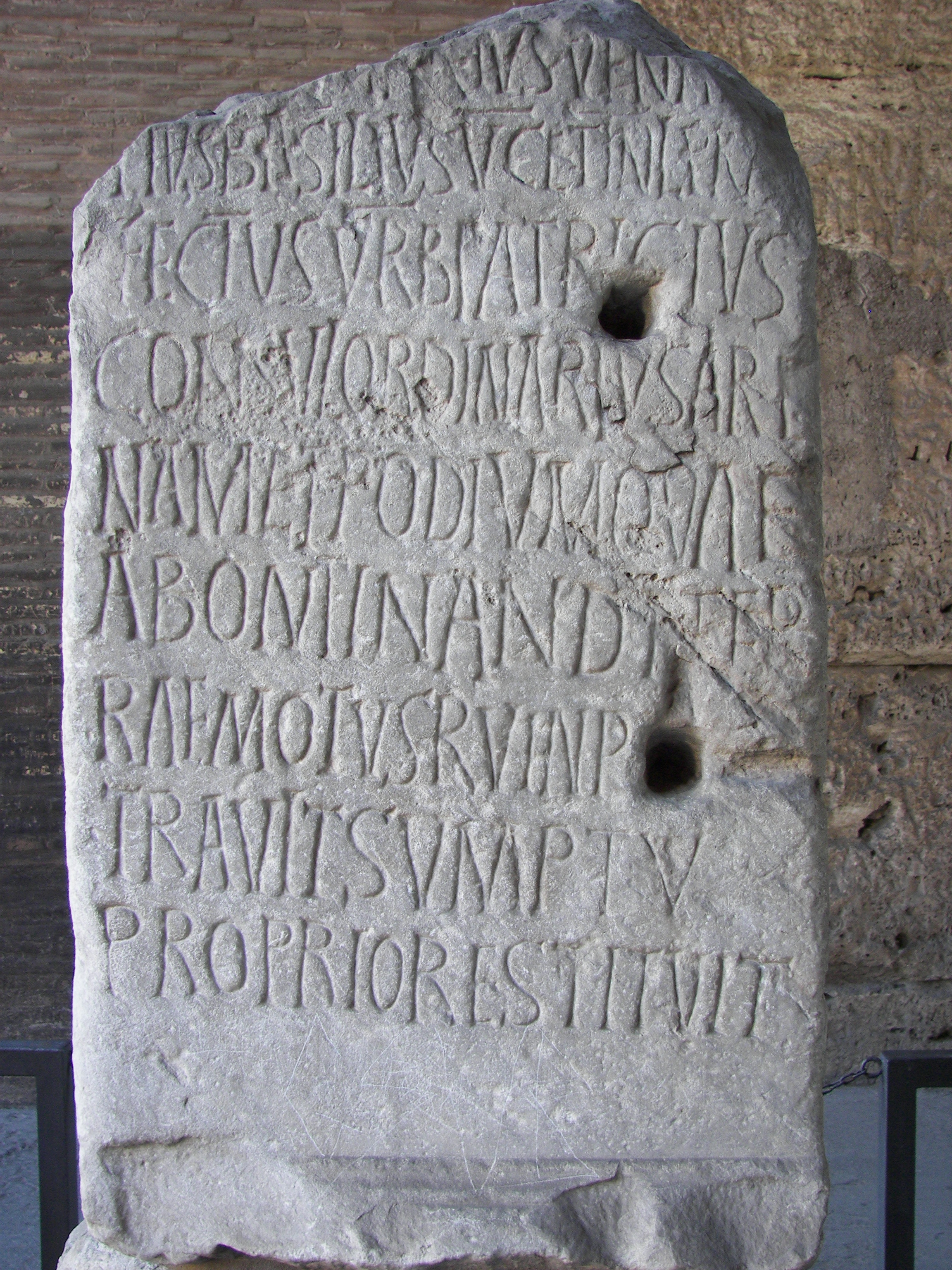 Inscription for 5th century Roman Consul Decius Ma...
 Vulgar Latin Vowel System (development from Classi...
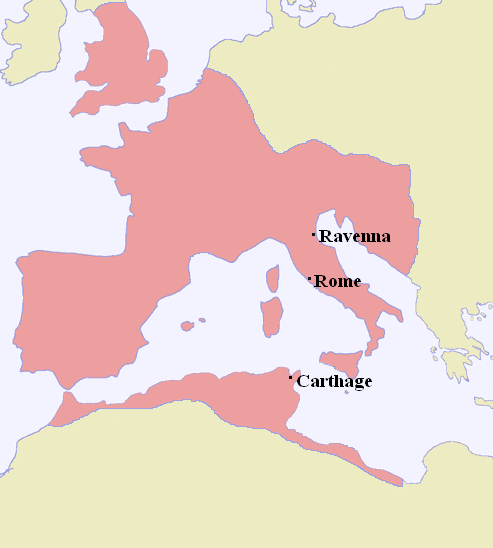 Original came from Wikicommons, author allows the ...
As a living language, Latin underwent a continuous evolution and was open to influences from other languages. In Gaul, Vulgar Latin incorporated elements from several other languages and came to be known as the Roman or Romanic language. It was so thoroughly established that the invading Germanic nations generally adopted it as their own language (Gill). Its general acceptance is reflected in the fact that beginning in the sixth century the homilies of Church councils held in France were translated into it. By the eighth century Charlemagne prescribed that sermons should be delivered in the popular tongue, while other parts of the liturgy remained in Latin. Nevertheless, even in Gaul the language spoken in different regions never became homogeneous. Distinct dialects co-existed with separate languages, the most important of which was Provençal. Broadly speaking, beginning in the early middle ages, two groups of dialects emerged in the territories roughly divided by the Loire. In the South, the langue d'oc remained more closely linked to Latin, whereas the Northern langue d'oil was more strongly influenced by other languages. The terms used to describe the two groups of dialects derive from the respective words to express "yes" in each (Willmer).
Vulgar Latin (in Latin, sermo vulgaris, "folk speech") is a blanket term covering the popular dialects and sociolects of the Latin language which diverged from each other in the early Middle Ages, evolving into the Romance languages by the 9th century. The terms Vulgar Latin and Late Latin are often used synonymously (Sánchez). Vulgar Latin can also refer to vernacular speech from other periods, including the Classical period, in which case it may also be called Popular Latin. Spoken Latin differed from literary Latin in its pronunciation, vocabulary, and grammar, though some of its features did not appear until the late Empire. Other features are likely to have been present much earlier in spoken Latin. During the Middle Ages, Vulgar Latin coexisted with a more classically structured form of the language, Medieval Latin, which was used by scholars, scribes and the clergy in formal settings, but did not have any native speakers (Willmer).
Most definitions of "Vulgar Latin" define it as the spoken, rather than written, language. It is important to remember that "Vulgar Latin" is an abstract term, not the name of any particular dialect. The term itself predates the field of sociolinguistics, and research into the history of Vulgar Latin was in some ways a precursor to sociolinguistics. The latter studies language variation associated with social variables, and tends not to view variation as a strict standard-non-standard dichotomy (for example, Classical-Vulgar Latin) but as variations. In light of fields such as sociolinguistics, dialectology, and historical linguistics, Vulgar Latin is the sociological, geographical and historic variations in Latin that excludes the speech and the writings of the educated classes. It is because there are so many types of variation that definitions of Vulgar Latin differ so much (Greene).
Because the daily speech of Latin speakers was not transcribed, Vulgar Latin can only be studied indirectly. Knowledge of Vulgar Latin comes from three chief sources. First, the comparative method reconstructs the underlying forms from the attested Romance languages, and notes where they differ from Classical Latin. Second, various prescriptive grammar texts from the Late Latin period condemn linguistic errors that Latin speakers were liable to commit, giving us an idea of how Latin was spoken. Third, the solecisms and non-Classical usages that occasionally are found in Late Latin texts also reveal, in part, the author's spoken language (Gill).
Throughout the Empire, Latin was spoken in many forms, but it was basically the version of Latin called Vulgar Latin, the fast-changing Latin of the common people (the word vulgar comes from the Latin word for them) (Greene). This Latin was a simpler form of the literary Latin, with terminal letters dropped, syllables dropped, and decreasing use of inflections, as prepositions (ad (> Ã ) and de) came to serve in place of case endings on nouns. Colorful or slang (what we think of as 'vulgar') terms replaced traditional ones -- testa meaning 'jar' replaced caput for 'head'. You may see some of what had happened to Latin by the third of fourth century A.D. when a list of 227 fascinating "corrections" was compiled by Probus (Willmer).
Between the changes in the language wrought by the native speakers of Latin, the changes made by the soldiers, and the interaction between Latin and the local languages, Latin was doomed -- at least in common speech. For professional and religious matters, Latin based on the literary Classical model, continued, but only the well-educated could speak or write it. The everyday person spoke the everyday language, which, with the passing years, diverged more and more from even Vulgar Latin, so that by the end of the sixth century, people from different sections of the Empire could no longer understand people in others: Latin had been replaced by the Romance languages (Gill).
Vulgar Latin was characterized by simple, rational word order, a disregard of unnecessary distinctions, and a desire for greater regularity in word forms. There was an increased use of prepositions, and clauses with quia, quoniam, or ut were used instead of the infinitive or accusative. Like colloquial Latin, Vulgar Latin used lots of diminutives and intensified verb forms. Sentences were dotted with emphatic words such as valde, nequissimus, facillime, libentissime. Vowels were slurred or confused, and the final m or s of a word was dropped (Sánchez).
Latin today may be a dormant language but it remains an important piece of our linguistic puzzle. The use of Latin for names of places, anatomy, biology and others still dominates several scientific and medical fields. People all over the world are studying Latin with enthusiasm and energy. It, of course, is still alive and well within the Vatican and the Roman Catholic Church. It is gaining new popularity among modern Italians and Romans; and conventions of Latin speaking people are becoming a regular occurrence in Europe. Latin is anything but a dead language.
Works CitedGill, N.S.. "Vulgar Latin." About.com. 7 Dec. 2008 Greene, Richard. "The Latin Language." UNRV History. 14 Nov. 2007 7 Dec. 2008 Sánchez, Demetrio. Latin Language. 2008. 7 Dec. 2008 Willmer, Richard. "The Latin Language." The Italian Language. 15 Sept. 2008. 7 Dec. 2008
 Grammatical genders in Classic Latin and Vulgar La...
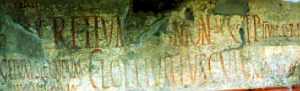 Vulgar Latin, as in this political graffiti at Pom...
 Latin Quarter