For my book synopsis, I chose "Dead Letters to the New World: Melville, Emerson and American Transcendentalism", a book of literary criticism by Michael McLoughlin. The author studies in depth the emergence of Transcendentalism as a school of philosophy in America in the 19th century, and focuses in particular on Ralph Waldo Emerson, as a leader of the movement, and author Herman Melville, whose relationship with various people in the Transcendentalist movement heavily influenced his writings.
McLoughlin's main purpose in writing is to create an exhaustive study of the relationship between Emerson and Melville, and to examine the effect the Emerson and his teachings had on the writings of Melville (who is most well-known for his sea epic, Moby Dick). Rather than examining all of Melville's works as one entity, the author is careful to distinguish between the two phases of his career: in the first, leading up to the publication of Moby Dick in 1850, Melville's works are full of Transcendentalist ideology, such as self-reliance and non-conformity that show the strong effect of Emerson and other American philosophers of the 19th century on him; in the second, beginning after Moby Dick, Melville's works become distinctly anti-Transcendentalism, devoid of all of the hope and optimism that characterizes his earlier works.
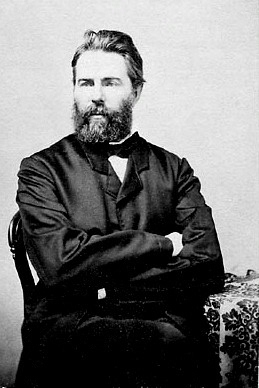 Herman Melville, American author. Reproduction of ...
 Photo of Herman Melville
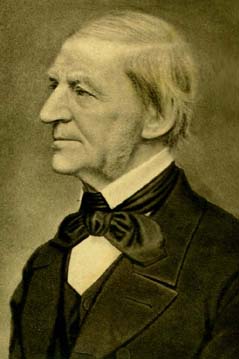 Ralph Waldo Emerson Español: Ralph Waldo Emerson....
McLoughlin begins by examining Transcendentalism as one of the first American schools of philosophy; he considers the strong influence that German philosophers of the 18th century had on the thinking of Transcendentalist thinkers, such as Emerson, one of the acclaimed "leaders" of the movement, and others, such as Nathaniel Hawthorne, whose friendship with Herman Melville between 1850 and 1851 had a huge impact on their writings. Emerson's struggle to break from his Unitarian roots and to find a way of living that included emphasis on self-reliance, the important of...