The Fate of The Blind. Interprets blindness in King Lear (by Shakepseare) and Oedipus
'There's a divinity that shapes our ends, rough hew them how we will.' These words from Hamlet are echoed, even more pessimistically, in Shakespeare's later play, The Tragedy of King Lear where Gloucester says: 'Like flies to wanton boys, are we to the gods, they kill us for their sport'. In Lear, the characters are subjected to the various tragedies of life over and over again.
An abundance of cyclic imagery in Lear shows that good people are abused and wronged regardless of their own noble deeds or intentions. Strapped to a wheel of fire, humans suffer and endure, prosper and decline, their very existence imaged as a voyage out and a return. The movement from childhood to age and back again, the many references to fortune whose wheel spins humans downward even as it lifts, the abundance of natural cycles which are seen as controlling experience, even perhaps the movement of play itself from order to chaos to restoration of order to division again.
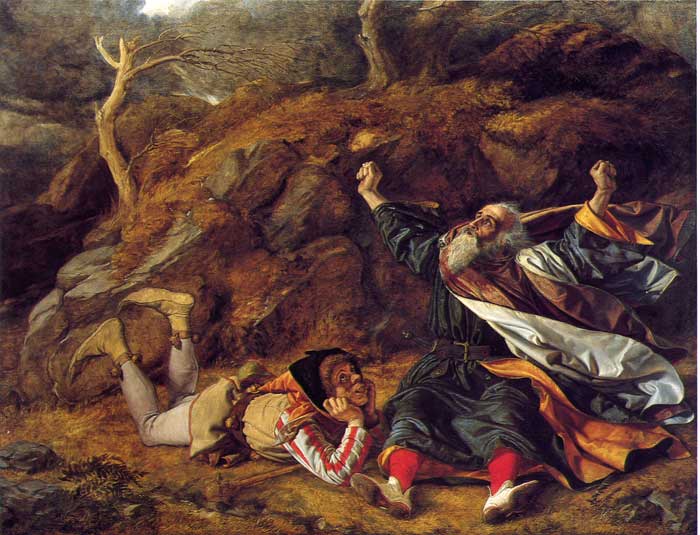
Throughout the text, the movements of celestial bodies are used to account for human action and misfortune. Just as the stars in their courses are fixed in the skies, so do the characters view their lives as caught in a pattern they have no power to change. Lear sets the play in motion in banishing Cordelia when he swears 'by all the operation of the orbs from whom we exist and cease to be' that his decision 'shall not be revoked'. How like the scene in Julius Caesar wherein Caesar says 'For I am constant as the Northern star' Lear vows to be resolute but dies regretting his decision at the hands of his daughters who claim love him 'more than word can wield' and are 'alone felicitate' in his presence.
That Edmund disbelieves...
More Shakespeare
essays:
The generation gap in "King Lear" by Shakespeare
... in Shakespeare's play, King Lear is the concept of the generation gap. This gap is mainly illustrated between the family. The older generation is Lear himself ... aide her father. She was not concerned about the political control in Britain. [Lines 26-29] 'In my mourning and importuned ...
Humility. Lear and Gloucester's JourneyBased on Shakespeare's King Lear. Describe King Lear and Gloucester's journey from arrogance to humility and to eventual wisdom.
... is demonstrated in William Shakespeare's play, King Lear. Throughout the play, it is seen that for a variety of reasons both King Lear and the ... and secondly by his arrogance. It is clear that both Lear and Gloucester's gullible nature and decisions are influenced by their positions in society and ...
Kingship In "King Lear".
... absolute control (V.1.55-69). Notably, King Lear was not always the ineffectual king represented in the middle and final acts of Shakespeare's ...
King Lear is a play about conflict between parents and children. Discuss this theme and one other of your choice.
... in Shakespeare's play King Lear. The conflict between parents and children is what makes up most of this theme. Lear is ... out and has a large affect on the play. The tragedy begins with one of the most prominent arguments of the ...
King Lear
... play "King Lear" Shakespeare writes symbols with themes to help give the audience a fuller understanding of the issues involved and a dramatic unity to the whole. Nature is ... is natural. Throughout "King Lear" there is many references to animal imagery, most ...
King Lear - Do you think the main plot and sub plot run parallel in King Lear. Discuss?
... King Lear a tragedy. The play is a result, of the consequences triggered off by lies and falsehoods that were told in King Lea's family, as well as in the family of the Earl of Gloucester. In this play, Shakespeare ...
King Lear
... best natures and characters can absorb pain and learn. In 'King Lear' Shakespeare seems to suggest that it is man's fate to suffer, with Gloucester declaring that we are like "flies" in ... man. 'King Lear' is a typical Shakespearean tragedy where ...
Divine Justice In "King Lear".
... of divine justice, although it offers little gratification for the audience. Throughout King Lear, the ... Shakespeare never intended for his audience to escape the painful questions that Cordelia's death creates. Instead, the audience is expected to struggle with the question of why such tragedies ...