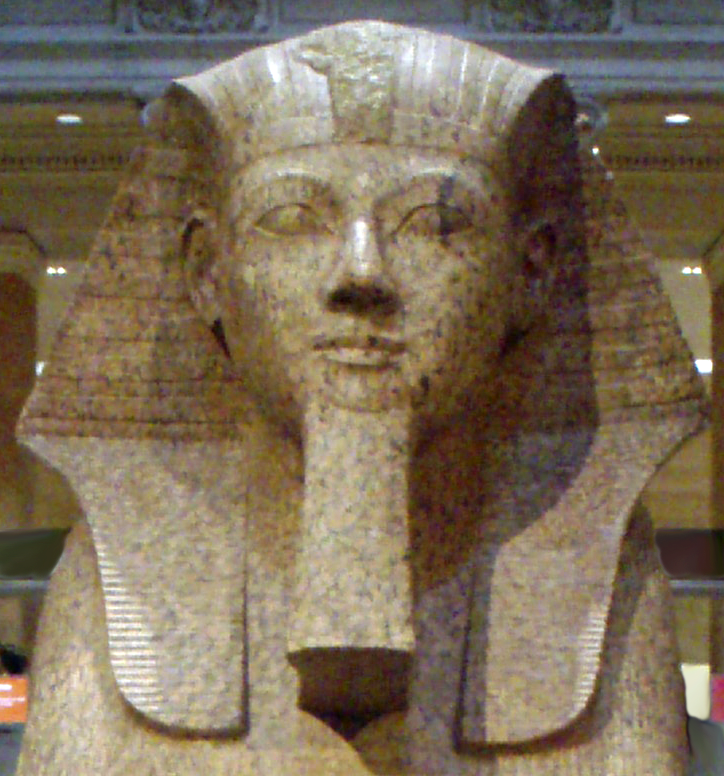
The first female pharoh Hatshepsut.
Hatshepsut
Ka-maat-Ra` Hatshepsut was the only child of Queen Aahmose and the pharaoh of the time, Tuthmosis I. She was the only legitimate successor, but was unable to succeed him because she was a woman. In order to secure the 'royal blood line' she was married to her half brother Tuthmosis II, who was born to Tuthmosis I and an inferior wife. Tuthmosis II was a frail man and did not rule for very lengthy period of time. Hatshepsut bore him two daughters but no sons. Hatshepsut was and ambitious woman and when her husband died was faced with the same problem of succession her father had. In order for Hatshepsut to fully accomplish her wish to become a pharaoh she had to overcome a great number obstacles.
"There was nothing for it but to give him the throne by marrying him to Neferura`, the royal heiress, her eldest daughter by Tuthmosis II. In this manner Pharaoh Tuthmosis III, the future conqueror of the world, was crowned king."(1)
The first obstacle that lay in her way was her stepson Tuthmosis III. He was the child of her Husband Tuthmosis II and one of his inferior wives. Since he was the next male in line to inherit the throne he had to be dealt with. Since he was young and in no position to question her, Hatshepsut took full advantage of the situation.
In Egypt they believed that the pharaoh was a direct descendants of Ra and was appointed by Ra. Since Ra was male and it was believed that he bestowed the title of pharaoh on man not woman, Hatshepsut had to work very hard to prove to her people that he chose her and that he had not chosen her nephew. In order for her to make her story...
More Ancient Egypt
essays:
Ancient Egypt
... artwork of this period of time is also the most sought-after, for therein lies the clearest picture of an ... the crowns, armlets, and collars worn by the royal princesses (David 20). Once again, the pharaoh was ...
Muhammad.
... a successful businessman and was a loving caring person. Overall Muhammad achieved many things, personally, politically and religiously. In my opinion Muhammad was a great man who achieved many things throughout his life which was a short period of time. He ...
Critically discuss how Egyptian pharaohs of this period (besides Hatshepsut) established and maintained the empire
... ruler of Egypt around 1550 BC at the age of 10, after the death of his father, the last king of the 17th dynasty, Seqenenre Taa II, and ruled for a period of around ...
Cleopatra
... brother, Ptolemy XIII, also pharaoh. Cleopatra's great grandmother was the daughter of one of the kings of Syria. She was Seleucid with Persian blood. Two potential rivals stood between Cleopatra and the succession, her two older sisters, at that time ...
Queen Hatshepsut: An Untraditional Pharaoh and Her Rise to Power
... had two more sons with a commoner woman. Upon the death of her father in 1493 B.C., Hatshepsut married her half-brother, Thutmose II, and assumed the title of Great Royal Wife ...
EGYPT--Description of Egyption culture, mummification, government and religion of ancient egypt--also a comparison with modern Egypt
... thousands of years many people have searched for her, but she has never been found. Yuya was found in the Valley of Kings although he had no royal blood. His daughter married the pharaoh, Amenhotep ... very successful female ruler. Few woman were successful but she brought Egypt 22 years of peace ...
"Assess the contributions and impact of Amenhotep III"- a prominent king of the 18th dynasty of ancient egypt
... highly successful in his contributions to the administration, foreign policy, building program and religion all of which were vital to the peaceful and prosperous period of his ...
Ancient History Assessment Task: The Reign of King Thutmose III
... period of Egyptian history. Records written during his reign depict him as a strong warrior pharaoh with a somewhat controversial start to his reign. One particular source, written by the Royal Scribe of Thutmose , speaks of Thutmose being denied his blood ...