Taxonomic Classifications
Flowering dogwood is a member of the genus Cornus within the family Cornaceae. The currently accepted scientific name is Cornus florida. The taxonomic classification for the flowering dogwood is the following:
Plantae (plants)
Embryophyta (higher plants)
Magnoliopsida (dicotyledons)
Cornales
Cornaceae (dogwoods)
Cornus (dogwoods)
Cornus florida
Common names of the species include: flowering dogwood, cornel, false boxwood, Florida boxwood, arrow wood, and bunchberry (Wood Bin, 2005).
Cornus florida is the aristocrat of native flowering trees. The Dogwood tree has four-season character; beautiful flowers, summer and fall foliage, fruit and winter habit. It is excellent as a specimen plant, near a patio or corner of a house, in groupings, or against dark evergreens or building background where the flowers can be accentuated.
Diagnostic Features
The flowering dogwood has opposite, deciduous green leaves, 3-6 inches in length, that turn red and purple in autumn (ODNR, 2005). (Figure 1) The actual flowers are tiny and inconspicuous.
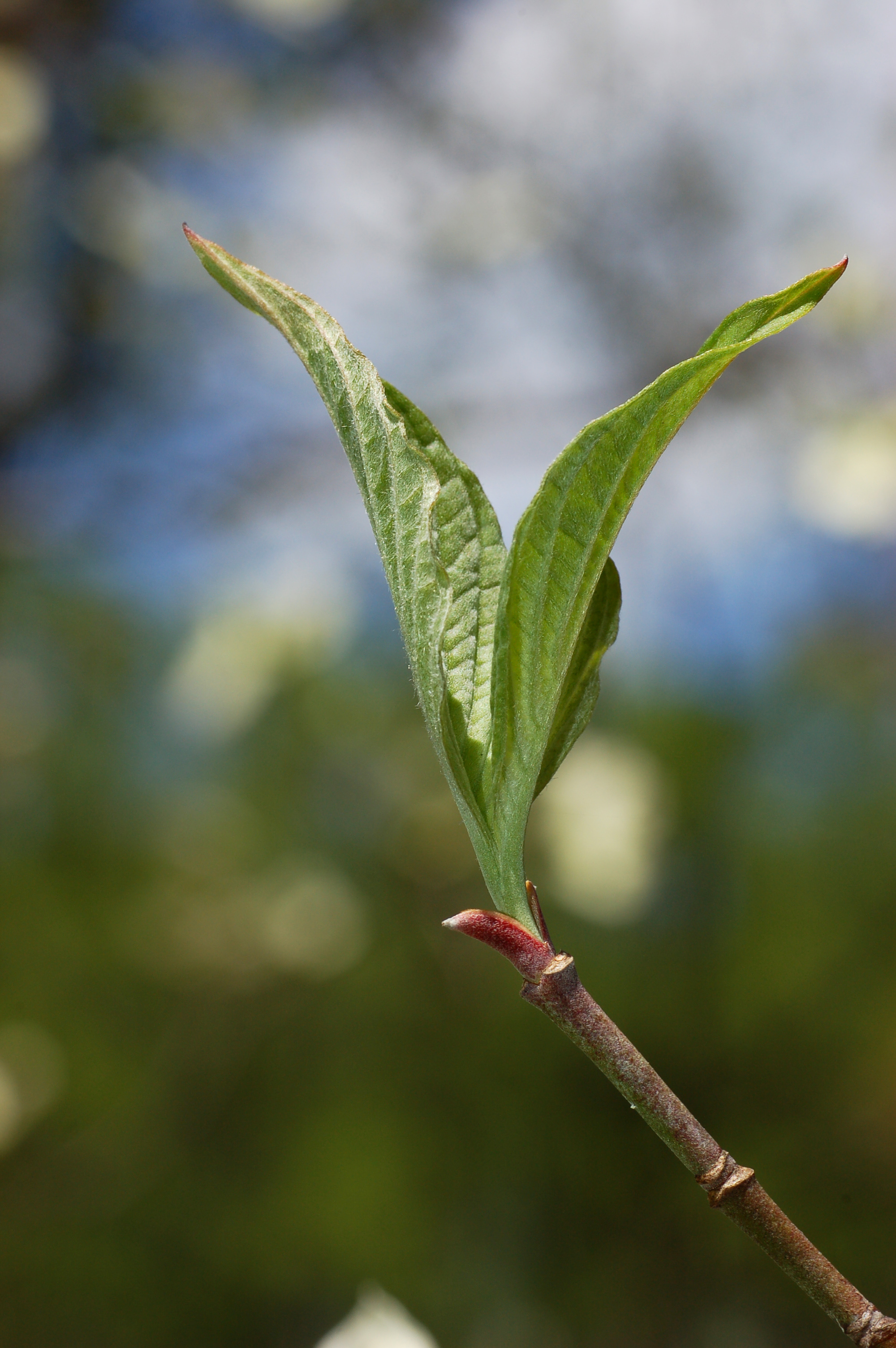 Flowering Dogwood Cornus florida Leaf 2000px
 Flowering Dogwood Cornus florida Lone Flower 3008p...
 Flowering Dogwood Cornus florida Bark Closeup 1800...
They are a greenish yellow color and are surrounded by four snowy white or pink bracts, ovate to elliptical in shape, which are each approximately 2" long (ODNR, 2005). (Figure 2) The dogwood blooms in mid-spring, as its newer leaves are unfolding, and usually remain "snowy" for 2-3 weeks (ODNR, 2005). The true flowers that are occur in the center of the bracts produce numerous green football shaped fruits by early summer. These turn red by late summer and fully ripen by mid-autumn (ODNR, 2005). (Figure 3) The Dogwood tree can grow 15 to 20 feet in height with a spread equal to or greater than the height (ODNR, 2005). It prefers well-drained soil and grows best in partial sun. The bark on mature trees is broken up into small square blocks, and is often referred to as "alligator" bark. (Figure 4)
Environment
The range...