Was Germany primarily responsible for the outbreak of the Great War?
The Great War was the turning point in European if not global history; it was the starting point of the most violent century humankind has ever known. Over the past ninety-one years historians have become almost obsessive in the search to explain who was responsible for causing the Great War. Many historians spent their life searching for an answer that never truly came.
In deciding wether or not Germany was primarily responsible for causing the Great War of 1914-1918 several main points have to be addressed such as the alliance systems, nationalism, the arms race and imperialism. Evidence of these can be found in the actions and decisions made by Germany in the period from Unification in1871, outbreak of war in 1914 and the signing of the Treaty of Versailles in 1919.
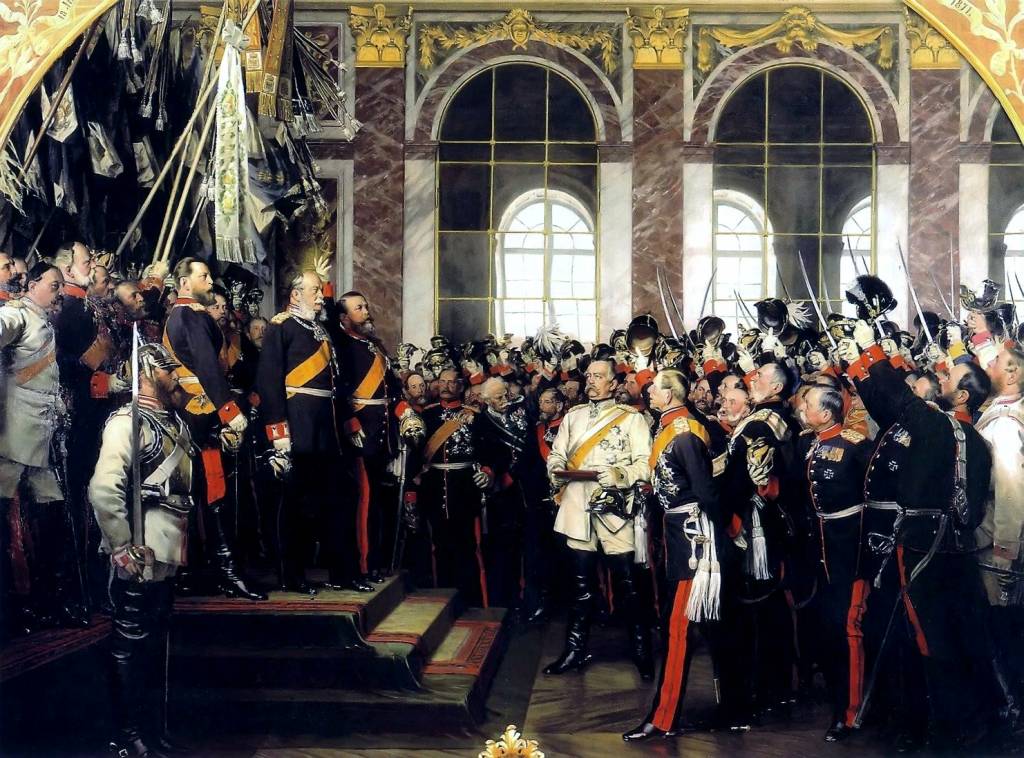
The unification of Germany in 1871 was announced at Louis XIV palace at Versailles before the Franco-Prussian War of 1870 came to an end. The unification of Germany was controversial the two great powers of Austria-Hungary and Prussia wished to rule the unified German state. Prussia had an efficient government it believed that Germany had to be a strong state of which other weaker nations could join. Austria on the other hand did not want Germany to be unified at all, as it saw advantage in ruling a weaker, un-united Germany like it did in other states such as the smaller Slavic states. An advantage for Prussian was that not only did it have an efficient government the majority of its population were Germanic and it had one of the best armies in Europe. After the Unification was signed, King Wilhelm I of Prussia became Kaiser Wilhelm I of the German Empire.
The new German state set the terms of peace for the Franco-Prussian War, France had to...
More World War I
essays:
Germany bears the vast bulk of the blame for the outbreak of WW1.
... the Franco Prussian war, where many alliances and increasing armaments and economic rivalry started off from, that war would have broken out without the assassination of Arch ...
Causes of World-War-One competing alliances - rival empires - arms race - catalyst
... beginning of the rise of a new European power causing many new alliances to be formed. After the French defeat in the Franco-Prussian war France as a nation was ... preservation of Imperial power were largely responsible for the ensuing world war. The alliance system developed ...
To what extent is Germany responsible for the start of World War One?
... the alliance system, imperialism, militarism and the Balkan area also contributed to the war. It can be blamed in the sense that its general behavior of provoking other countries was a chief cause for the outbreak, but ...
Poets of the first and second world war.
... poetry of the Great War 1914-1918. In his introduction, Yeats was quite candid about his decision to proscribe Owen, Sassoon, Graves and other war poets ...
Critically asses three major causes of the First World War
... share of nationalism, as it was resentful of Germany because of the Franco-Prussian war and ... countries. Alliances and diplomatic agreements before the Great War were often made behind closed doors, and it was not unusual for clauses to be kept secret. Treaties were sometimes made public ...
The Causes of World War I.
... Imperialism and the system of alliances are the last two major causes of the War. There was a quarrel between France and Germany about controlling the colonies, and especially Morocco, which leads to a greater conflict, the Great War. Europe at ...
How much did the outcomes of the treaties reflect the leadership personalities of France, Germany and Great Britain?
... The Treaty of Versailles was the peace settlement signed after World War One had ended in 1918 and in the shadow of the Russian Revolution and other events in Russia. The treaty was signed at the vast Versailles Palace near ...
Causes of the First World War
... feelings of nationalism in France and a banning together to get revenge on Germany. After the Franco-Prussian War, Germany began comparing their influence to Britain. There was increasing jealousy brewing during the time at Britain due to their imperial, economic ...