Countertrade.
Countertrade is a creative sticky sales project that might not otherwise happen due to currency barriers. Countertrade is an umbrella term for a variety of unconventional reciprocal trading arrangements. It often occurs between developed and developing nations, but it also occurs between one developing nation and another( Nelson, 1999). It is the trade between two countries in which goods are traded for other goods rather than for hard currency. Countertrade is often the solution for exporters that may not be able to be paid in his or her home currency and according to the text few exporters would desire payment in a currency that is not convertible.
"Sometimes both parties are happy with the goods they receive, other times one country will liquidate the received asset, ultimately receiving cash in the deal. This is also referred to as "using barter to complete a trade." (www.investopedia.com)
Soft Currencies.
Another name for "weak currency," there is very little demand for this type of currency and values often fluctuate.
 Rough Trade Counter Culture 09
 English: Pascal Lamy, Director-General, World Trad...
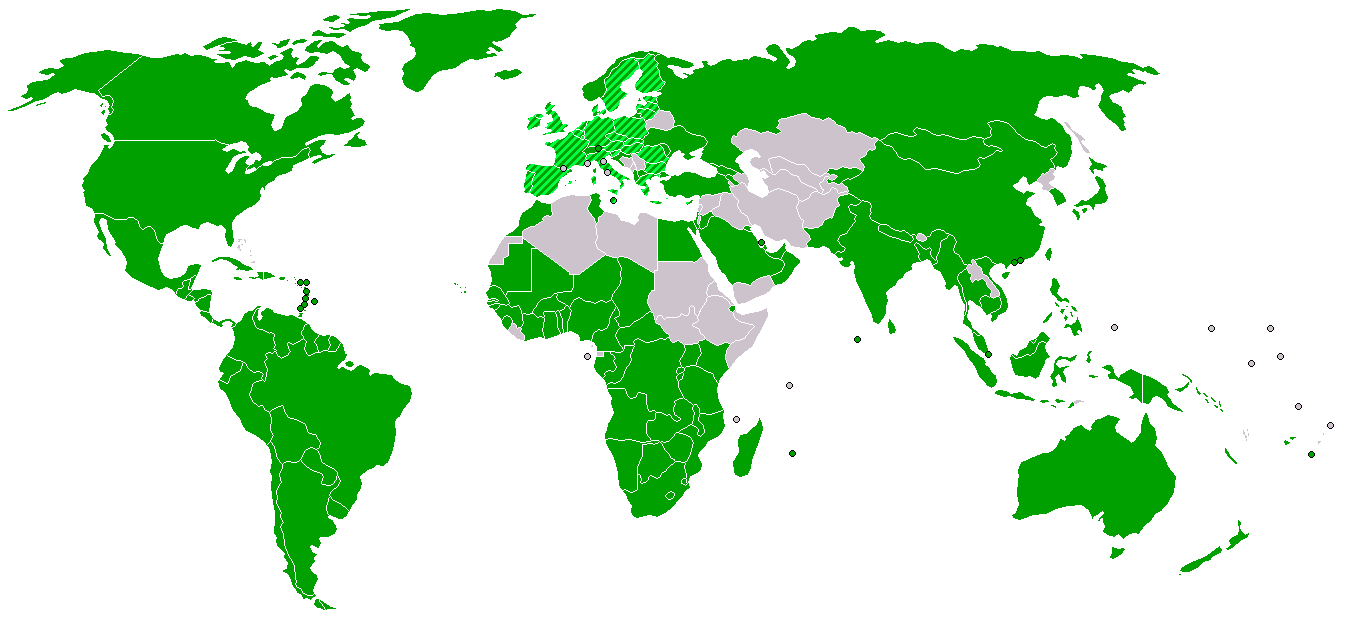 World map of World Trade Organization (WTO) member...
Currencies from most developing countries are considered to be soft currencies. (www.investopedia.com)
Hard Currencies.
A currency, usually from a highly industrialized country, that is widely accepted around the world. The U.S. Dollar and the British Pound are good examples of a hard currency. (www.investopedia.com)
Countertrade is an general term covering a wide range of commercial mechanisms for reciprocal trade. Reciprocal trading (two-sided trading, trade in return) occurs when the trade customers is also a supplier. The reciprocal trading arrangements may or may not be formally linked. In practice, reciprocal trade may strengthen an existing trading relationship, and may even create mutual dependencies, which may create new trade relationship. Barter is probably the oldest and best known example of countertrading, however others, such as offset, buyback, tolling and switch trading, have also evolved...
Hard currency and countertrade
Hard currency, in economics, refers to a currency in which investors have confidence, such as that of a politically stable country with low inflation and consistent monetary and fiscal policies, and one that if anything is tending to appreciate against other currencies on a trade-weighted basis(wikipedia). USA dollar is an example of hard currency. there are many dollars circulating outside USA. In other words, transaction usually takes place in US dollars. it is regarded as a safe currency. because it has international acceptance and you can save it. but you can not use all countries' currencies. because they are non-convertable. as a result of this, countertrade is a method if you want to do business with those countries which have a shortage of hard currency.
1 out of 1 people found this comment useful.