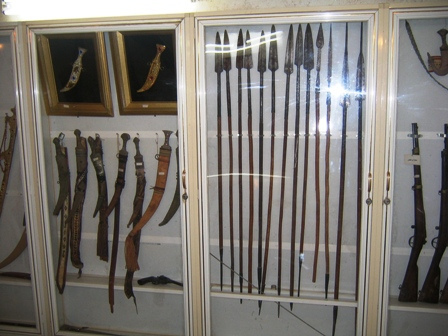
Greek weaponry and armory.
The Hellenistic Age began with the death of Alexander the Great in 323 BC and lasted until the true establishment of the Roman Empire upon the death of Cleopatra in 30 BC. The method of warfare in ancient Greece, and the world, consisted of arrows, spears, swords, axes and shields. Because of its ease of casting and superiority in strength, bronze was preferred in the making of weapons.Later on, Greeks fought in a very different way. Soldiers now fought in a strict battle line, standing in rows. They wore heavy armor which protected them very well when they fought as a group, but not if they were split up. They were called 'hoplites' after the shields they carried called a 'Hoplon'.
These weapons might have been like those used in the Trojan War. The sword blade (right) has a short blade and a spike so that it could be fitted onto a hand-grip. The spear head (left) could be fitted onto a wooden shaft.
The spearbutt is meant to be a counter weight to the tip it could also be used in battle if the spearhead breaks
This little rock is only about three centimeters long and was used in a sling, a sling is a rope with a central pocket to hold the weapon being launched like rocks. The almond shape of it makes it fly like a missile. The shape is aerodynamically good, and a slinger could send a bullet over 100 km. per hour to a point 400 meters away, there causing fatal injury even to someone wearing armor.
2
Here are two different kinds of Greek helmet, made of bronze. One of them covered the whole head, apart from the eyes and mouth.
The other had flaps of bronze to cover the soldier's cheeks and the...
More European History
essays:
"Battle of Marathon" This essay talks about the great Battle of Marathon during the Persian Wars in ancient Greece 490 BCE
... golden age was a direct result of the wealth and prestige of empire; without it Athens may not have reached the point where it became the educational and cultural centre of the Greek world. From this centre came great thinkers ...
The Importance of Women in Ancient Greece
... cultures, the Greek women were the most educated until the 19th century. (The Role of Women in the Art of Ancient Greece, 103) Women were not legally independent. The man was always head of the household ... parties, the hetaerae would flirt with the men, holding their hands, amusing ...
A Tale of Two Civilizations: Question was to explain the similarities and differences between the two Greek Empires of Athens and Sparta.
... sorts of athletic activities. They made very good use of their free time and took advantage of their great city-state with an positive approach. In the Spartan civilization the culture ...
The Trojan War
... and arrows of Hercules and whom the Greeks had earlier abandoned on Tenedos. Events then happened, including Achilles' victories over the Amazons and Ethiopians Troy's allies, and the death of Achilles at the hands of Paris ...
"Discuss the reasons for the decline and ultimate fall of the western Roman Empire, evaluating internal and external influences."
... collapse of this great empire. We can not focus alone on either internal or external reasons. Instead we must look at both. The Roman Empire at its peak governed over most of the Eastern world. After the death of Julius ...
Discuss representations of Augustan power and the ways in which this power has been portrayed as beneficial for Rome and the Roman Empire.
... champion of Rome while others have suggested that this portrayal of Augustus is very similar to the cult worship of Alexander (the Great) (Bosworth ... became the earliest emperor of the Roman Empire, which he ruled single-handedly till his death in AD 14. The reign of Augustus ...
The Purpose of Marriage in Ancient Roman and Modern American Society
... Pliny the Younger Letters 1.14). When choosing a partner, Romans placed a great deal of emphasis ... kill the man who she was unfaithful with. On the other hand, women ... himself, the promise of the girl was always given by the male head of her family. In ancient Roman times ...
Height of the Roman Empire
... not. The idea of the empire began with Julius Caesar, who was killed because he was ruling the government by himself. His adopted son, Octavian, became the first emperor, calling himself Augustus Caesar. The Roman Empire split into ...