The "GREENHOUSE EFFECT"
Greenhouse effect is a warming of the lower atmosphere and surface of the planet by a complex process involving sunlight, gases, and particles in the atmosphere. The amount of heat-trapping atmospheric gases, called greenhouse gases, have greatly increased since the mid-1800's, when modern industry became widespread. Since the late 1800's, the temperature of the earth's surface has also risen. The greenhouse effect is so named because the atmosphere acts much like the glass roof and walls of a greenhouse, trapping in the heat from the sun.
The natural greenhouse effect. The atmosphere reflects toward space about 30 percent of the energy in incoming sunlight. The atmosphere absorbs about another 30 percent and the remaining 40 percent or so reaches the earth's surface. The earth's surface reflects about 15 percent of the solar energy that reaches it, back toward space. The remaining energy heats the lands and seas.
 English: NASA projection from 1974 to 2060 of the ...
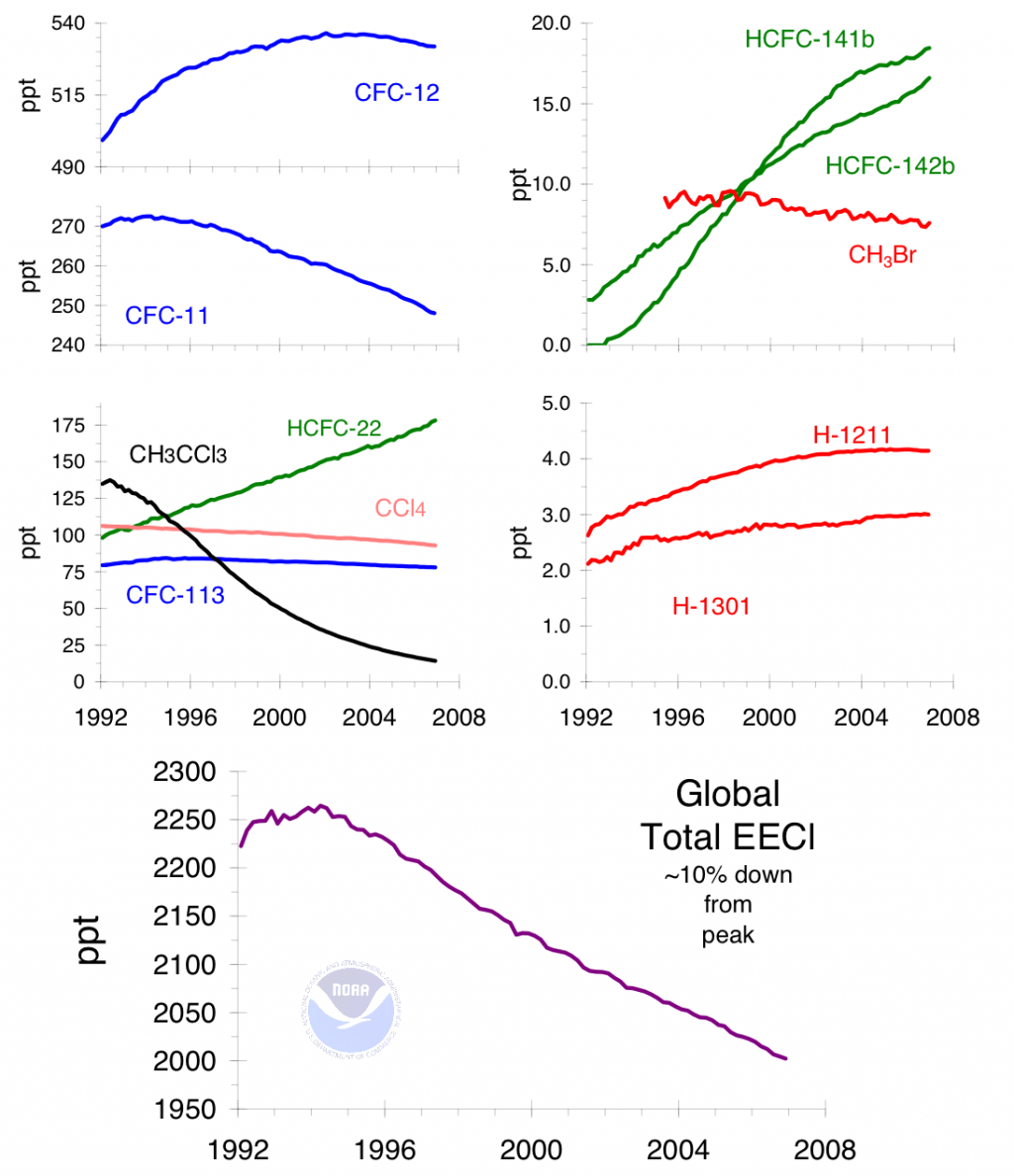 Ozone-depleting gas trends.
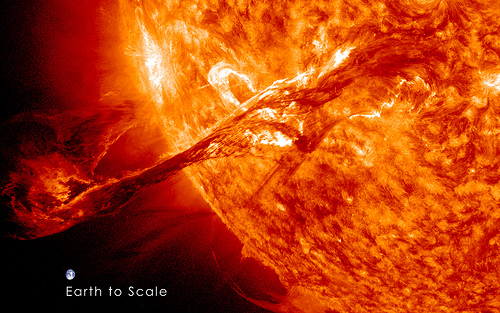 Magnificent CME Erupts on the Sun with Earth to Sc...
The warmed lands and seas then send most of the heat back into the atmosphere, mainly as infrared rays and in evaporated water. Infrared rays are much like light waves but are invisible to the human eye.
When the rays from the lands and seas strike certain substances in the atmosphere, such as greenhouse gases and particles, those substances absorb the rays. As a result, the gases and particles are heated. They then are cooled by sending out infrared rays of their own. Some of the rays go into space. The remainder radiate back toward the earth's surface, adding to the warming of the surface layer of air. Without the natural greenhouse effect, the average temperature of the earth's surface would be about 33 degrees Celsius colder than it is now.
The chief greenhouse gases are made up of atoms of carbon (C), hydrogen (H), and oxygen (O).