Guernica
Guernica
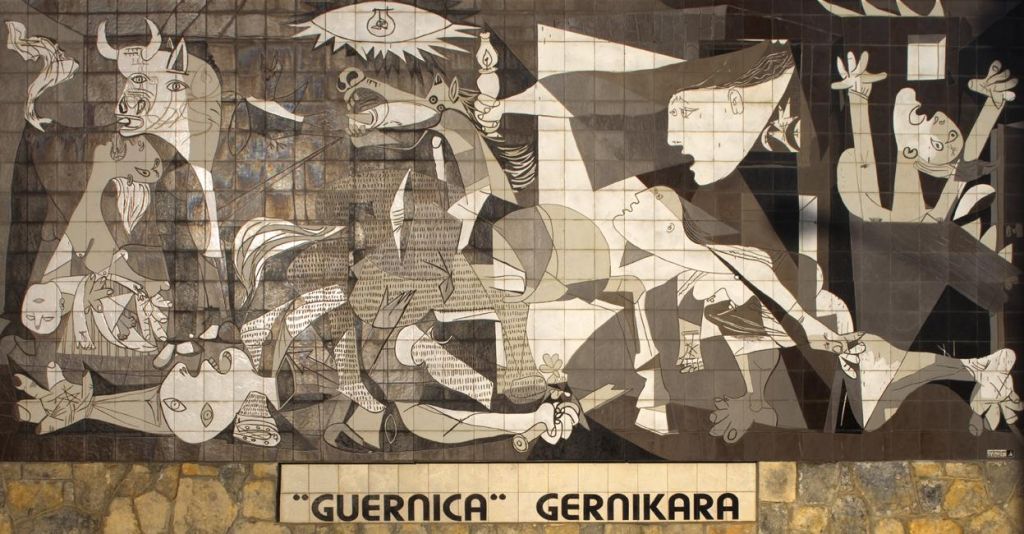
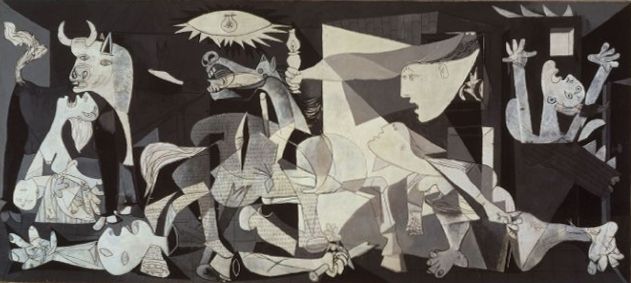
In 1937, Pablo Picasso painted Guernica, oil on canvas. The Republican Spanish government commissioned the mural for the 1937 World Fair in Paris. Guernica is a large mural, twenty-six feet wide and eleven feet tall, and was placed at the entrance to Spain's pavilion. Picasso did not do any work after receiving the commission until reading of the bombing of the Basque village of Guernica, in Spain. It was that attack, perpetrated by the German Luftwaffe, that inspired him. Guernica, however, is not a complete depiction of that event. In Guernica, Picasso masterfully conveys the suffering of the Basque people and the tragedy of war. He seeks not to report on every detail of the bombing, but only to highlight the suffering by all.
On first viewing Picasso's Guernica, one initially focuses on the center of the mural. Many lines cross or meet near the middle of the work. There are two major diagonal lines crossing Guernica. They start at the two bottom corners and meet toward the middle-top where the vertex is an oil lamp. These main diagonals are not explicitly defined, but are created with overlapping, dark and light values, and the subjects themselves. For example, towards the bottom right a there is woman picking herself up whose head, neck, and arm point along one of the main diagonals. That diagonal is continued in the background by a contrast between light and dark shapes. These lines frame the middle of the mural, which is further highlighted by some of the lightest values within the work. This area contains a large geometric shape of pure white as part of the background. This light color draws the eye to the center. However, the eye is also drawn to this area because of contrast in light and dark. The black,
More Works of Art
essays:
Oil On Canvus
... during a winter evening. This is an Oil on Canvas work of art. The artist painted this looking straight ahead on ground level. The colors in ... geometrical and are very simple. The painting is has a lot of implied lines in the background. It resembles to me a painting of the Impressionist. ...
Allegories of Blood: Comparing Picasso's Guernica to Gericault's Raft of the Medusa
... predominant focus on the human condition places makes it a stereotypical Romantic piece. Another artist famous for highlighting the human condition is Spanish-born Picasso. In 1881, Pablo Picasso was born to an academic painter in the town of Malaga, Spain ...
Guernica
... painting Guernica, which was created in 1937, by Pablo Picasso, is still considered today to be one of the most famous works of art throughout the twentieth century. Pablo Ruiz y Picasso was born on October ...
Art Criticism on Vincent Van Gogh's Starry Night
... with Crows (see picture 1). Wheatfield with Crows was painted on the same oil on canvas structure in 1890. Both paintings show the progression of mental ... as a release from his mental anguish that he was suffering at its conception and completion. This year was probably the ...
Abstracted work of art vs. a total abstraction, specifically "Girl in Window" vs. "For the Light" [Written in N.Y.C. on 12/02]
... art depicts things that we see in our every day in an unusual and may be even strange manner. One of such works is Girl in Window by Roy Lichtenstein. This is an oil on canvas painting ... is focused on is the feeling that is created by few lines and ...
Discussion and comparison of 2 works of Art from the MET. "Merry Company on a Terrace" by Jan Steen vs. "Modern Rome" by Giovanni Paolo Panini.
... is Modern Rome by Giovanni Paolo Panini. It is also oil on canvas painting, and it was created in 1757. The subject matter ... Dutch baroque paintings. We can see a great use of diagonal perspective that creates a suggestion of motion. It is as ...
"Modernist styles such as impressionism, post impressionism, cubism and expressionism challenged conventional ideas in art making and the ways in which art was thought about
... emphasis on open space in art. Artists such as Pablo Picasso abandoned naturalistic perspective and three dimensional space, endeavoring to depict solidity ... aren't blended and to critics of the time, the oil on canvas was unfinished. Indeed, one critic attacked the painting, saying, "Impression ...
From Realism to Modernism
... Luncheon on the Grass"), originally titled Le Bain ("The Bath"), is an oil on canvas painting ... to the painting by painting in a frog in the bottom left hand corner. This went along with his theory of painting "only what ...