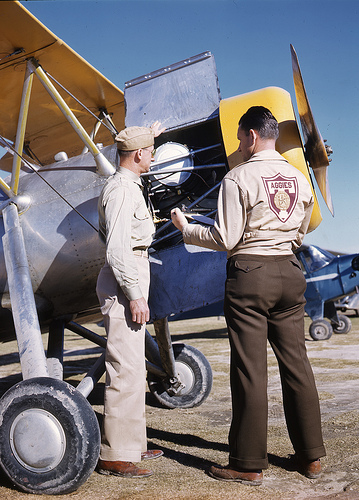
Scope of the ProfessionNature and Range of Work DoneAerospace engineering is the branch of engineering concerned with the design, construction, production and maintenance of vehicles and objects for use within and beyond the atmosphere. Aerospace engineering has broken into two major branches: aeronautical engineering and astronautical engineering. The former deals with craft that stays within Earth's atmosphere, and the latter deals with craft that operates outside of Earth's atmosphere. While "aeronautical" was the original term, the broader "aerospace" has superseded it in usage, as modern flight technology advanced to include craft operating in outer space. Aerospace engineering is a growing field with applications in areas as diverse as military and civilian aircaft, rockets, unmanned aerial vehicles, control and guidance systems, spacecraft, satellites, hang gliders and hot air balloons. The environment in which aerospace engineers work can vary widely, from an office to a laboratory or an airfield or even outer space.
 JoAnn H. Morgan, aerospace engineer and former Dir...
 Aerospace Engineering
 Portrait Photograph of Dipl. Ing. Josef Fröhlich,...
As an aerospace engineer, you may address problems such as how a vehicle moves, how high and how fast it can travel, how it holds together under various forces and how it stays on course. It also involves solving problems using knowledge of mechanics and dynamics, materials and joining methods, thermodynamics, heat transfer, vibrations, guidance, control and modelling techniques.
Health and Safety MattersEngineers working in any workshop or field environment come across hazards as part of their everyday working life. Aerospace engineers work in environments that could be life threatening. Hazards particular to aviation industry include:Excessive noise from aircraft in both the field and workshop environment.
Exposure to potentially dangerous chemicals and vapours from solvents, surface treatments, fuels, etc.
Dirt, dust and fibre may be inhaled while sanding or grinding fibre composite materials.
Through the introduction, monitoring and evaluation of appropriate risk management policies, workplace environments and...