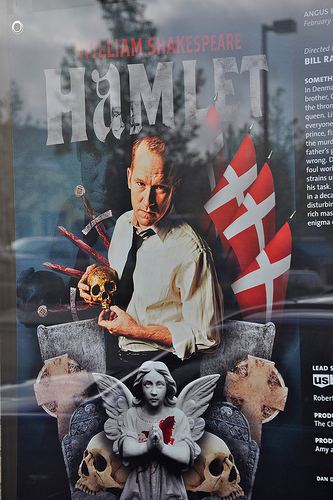
Hamlet, by Shakespeare
Hamlet
Yet I,
A dull and muddy-mettled rascal, peak
Like John-a-dreams, unpregnant of my cause,
And can say nothing--no, not for a king,
Upon whose property and most dear life
A damn'd defeat was made. Am I a coward?
Who calls me villain, breaks my pate across,
Plucks off my beard and blows it in my face,
Tweaks me by the nose, gives me the lie i'th' throat
As deep as to the lungs--who does me this?
In Shakespeare's Hamlet, Hamlet has been saddened by
the death of his father. When he finds out that is was the
doing of his crooked uncle, Hamlet's chief goal is to
revenge the ignoble deed. This revenge, which the play is
centered upon, is hindered by Hamlet's tragic flaw and is
seen in the above passage. The flaw, hesitation, impedes
his ability to avenge his fathers death, and ultimately
results in his decline and demise.
The play opens with King Hamlet having already been
murdered. Claudius, the dead King's brother, has seized the
throne as well as the Queen's, and mother of Hamlet's, hand
in marriage. All of these events have shocked the
protagonist, Prince Hamlet, who still laments the death of
his noble father and curses his mother for marrying his
uncle with "most wicked speed, to post with suck dexterity
incestuous sheets." However, in spite of his disapproval,
Hamlet does not voice his anger by saying "but break my
heart, for I must hold my tongue." Hamlet wears "customary
suits of solemn black" and cries with the "fruitful river in
the eye" for his father and states that he acts as suck
because "within which passes show, these but the trappings
and suits of woe." Hamlet does not care about the kingdom,
he merely wants to grieve the death of his...
More Drama
essays:
George Bernard Shaw's "St. Joan's" tragic Flaw, The Epilogue.
... single soldier to us; and I will not risk that life, much as I cherish her as a companion-in-arms.' Appropriately, following Dunois into King Charles' dream is a soldier. We learn from Joan that ...
Creon, the Tragic Hero of Antigone.
... want because he thinks that, since he is king, he could do whatever he wants with his absolute power. A citation from the play said by Teiresias to help explain his tragic flaw would be, "But a good man yields when ...
The Fall From Power In Hamlet and Oedipus
... by Hamlet. His internal tragic flaws such as excessive angry, procrastination in killing Claudius and ...
Beyond the Horizon by Eugene O'Neill
... She loses her only chance for happiness because of her wilfulness and her tragic flaw, an overweening pride.' In essence Emma cannot live with Caleb and ... and Rob Mayo were both physically destroyed by the decisions they made in life. Ruth and Andy, although they survive, they have little left in them ...
The Tragedy of Oedipus the King
... he did so from his own will, leading to his tragic flaw of hubris. In order for the Greek audience to relate ... his duties of taking responsibility. The events in Oedipus the King, written by Sophocles, shows an underlying relationship of man's ...
Antigone Study Guide.
... end Tragic Hero/Heroine: hero neither good nor bad, highly renowned and prosperous Tragic Flaw: a ... Oedipus, her death must seem the "natural climax" to her life. Creon, on the other hand, devotes himself only to the ...
Death Of A Salesman Essay
... problems and hardships of life. There is only one flaw to this though, that flaw is that when you spent your whole life in an imaginary ... between success and failure within the system. Willy and Linda are the tragic hero and heroine, but their tragedies are totally different from each other. ...
Death Of A Salesman Essay
... problems and hardships of life. There is only one flaw to this though, that flaw is that when you spent your whole life in an imaginary ... between success and failure within the system. Willy and Linda are the tragic hero and heroine, but their tragedies are totally different from each other. ...