"Heart of Darkness" by Joseph Conrad in "The Hollow Men" by T. S. Eliot.
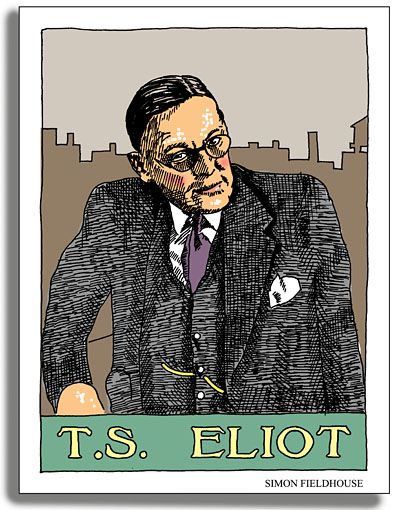
People often have trouble clearly stating their obscure emotions and ideas; therefore they associate and realize these ideas through other literature, cinematography, or music. In his dream-like "The Hollow Men" T. S. Eliot uses allusion as a vehicle for his purpose. The purpose seems elusive to the author himself. Therefore, he employs a reference to classic literature to show his reader a glimpse of what he really means through a more explicit analysis the human soul. This purpose is to survey the human as a product of the society and compare fundamental questions about human aspirations and the nature of the civilized society. Both Eliot's poem, and Joseph Conrad's Heart of Darkness have particular tendencies in imagery and organization that portray a common theme of a rift between the belief of a society-influenced man, and the practice of a man at the level of his primal emotions. By selecting Heart of Darkness as a universal allusion in this poem, T. S. Eliot is able to promote his purpose though the themes and rhetoric of this novel. Conrad's novel is an inward journey to discover what Freud would call the id. This is a level of subconcienceness completely uninfluenced by the world around the individual. T. S. Eliot is trying to express the war-generated emotions and yearnings of his id through imagery, diction, and organization.

T. S. Eliot hides beneath the cover of a larger work, which in its size can more clearly explore this purpose. "Mistah Kurtz - he dead" is the opening line of the poem. Eliot picks up where Joseph Conrad left off in his Heart of Darkness. Conrad looks into the idea of a man in his primal state (Kurtz) versus a man influenced by the society (the hypocritically clean central station manager, for example) in this...
More North American
essays:
Nature and Conversion Imagery in T. S. Eliot's "Journey of the Magi": A Review of Criticism in Books
... book T. S. Eliot: Moments and Patterns, both times in reference to the nature and conversion imagery. In the first instance, Unger compares both Eliot's and Conrad's use of the ... in T. S. Eliot: The Poems, makes note of the fact that the three Ariel Poems, which includes "Journey of the ...
Achebe's "An Image of Africa : Racism in Conrad's Heart of Darkness"
... longer question their being right or wrong. Achebe found that in Heart of Darkness, Conrad discussed and displayed these racist ideals in extreme amounts and Achebe felt the racism Conrad openly showed was unacceptable. Surely society played ...
Comparing T.S. Elliot's "The Hollow Men," with "The Heart of Darkness," by Joseph Conrad
... The Heart of Darkness by Joseph Conrad embody apathy and indifference. Both Conrads Station Manager and Elliots hollow men present a profound intellectual and emotional lack of interest or concern as well as being devoid of distinguishable humanity. The ...
Heart of Darkness A Product of its Time
... many to be inferior. Conrad's liberal use of derogatory outdated and offensive terminology can at time seem misplaced in our society but would have been the norm during the 19th century. Heart of Darkness reflects ...
Surrealism and T.S. Eliot's "The Love Song of J. Alfred Prufrock"
... word to use about the poet, playwright and critic T.S. Eliot, and certainly with his first major work, 'The Love Song of J. Alfred Prufrock '. Eliot wrote the poem, after ...
"Heart Of Darkness" by Joseph Conrad and "the lord of the files" by William Golding.
... attempt to trace the defects of society back to the defects of the human nature. In the Heart of Darkness, Conrad used Kurtz as a main character to introduce the 'truth' to his ...
The Heart of Darkness by Joseph Conrad, essay on the duality of human nature within the novel
... the question of whether or not people are shaped and corrupted by society or if its heredity that determines a person's morals. The Heart of Darkness by Joseph Conrad brings different theories to the ...
Heart Of Darkness Imperialism
... role of Joseph Conrad and the timely publication of his novella Heart of Darkness in 1902 is the subject of debate even today. The immediate temptation in examining the question of Conrad and imperialism would be to look to Conrad's ...