Henrik Ibsen's "A Doll's House" How Isben wanted the reader to interpret Nora's exit from her marriage and the life she knew.
Henrik Ibsen wrote the play A Doll's House in a time when women were amidst a social struggle in order to stop the oppression society placed on them concerning their roles. The main character in Ibsen's play is Nora Helmer, the beautiful wife of Torvald Helmer. She struggles with her need to escape Torvald's power, and be able to learn things about the real world, which she has never experienced. Ibsen wants Nora's exit to be interpreted as an expression of her freedom, intelligence, individualism in an oppressive society and most of all escaping a life that is not her own.
The title A Doll's House is a metaphor for how Torvald and Nora are living. Their lives are a game in which Nora is a doll for Torvald to play with and do with as he pleases. Torvald calls her demeaning names like "skylark", "squirrel" and "songbird", which she does not like. By using these names Torvald does not treat Nora as a mature woman in her twenties. Instead she plays the role of his child-wife and goes along with it. To get her way she must play the role Torvald gave her.
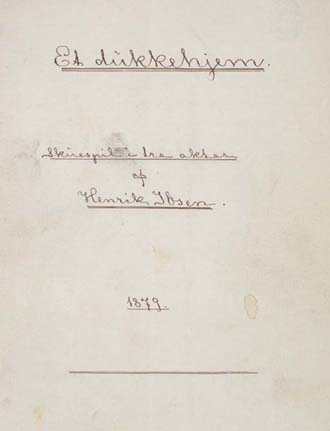
NORA. If little squirrel asked you really prettily to grant her a wish--
HELMER. Well?
NORA. Would you grant it to her?
HELMER. First I should naturally have to know what it was.
NORA. Squirrel would do lots of pretty tricks for you if you granted her wish.
(1001-02)
In their game though, it seems as if Nora is in control. She always gets her own way, eating macaroons, spending money as well as receiving more from Torvald.
HELMER. [follows her] Now, now! My little songbird mustn't droop her
wings. What's this? Is little squirrel sulking? [Takes out his purse] Nora; guess
what I've got here.
More Authors
essays:
Discusses the setting, theme, and point of view from William Carlos William's "The Use of Force" and Endora Welty's "A Visit from Charity"
... 's story. The reader is able to know the thoughts of the doctor as the protagonist and his personal struggle to discover what he and the girl both ... narrator and hears what he or she thinks and feels. The third person omniscient allows the reader, in a sense, to play God and hear the thoughts of ...
Imagery and Symbolism in Ernest Hemingway's "A Farewell to Arms".
... his struggle to escape galvanizes his feelings toward Catherine, and for possibly the first time he begins to care ... from a selfish, unemotional man focused only on animalistic pleasures to a caring individual capable of giving and receiving love. Henry expresses sorrow at ...
A discussion of Mark Twain's anti-racist stance in Huck Finn and the novel's theme of freedom for all.
... satire proclaiming that the practice of anti-racism is what society needs to learn in order to progress. Since the story is written during the 19th century ...
Modernism in "A Lost Lady" vs "Passing".
... sexual oppression in her characters' search for wholeness. (Bell, pg.112) Clare's indifference to fully belong to either race demonstrates the problem of racial identity. Clare neglects her Negro roots, yet she doesn ...
Betrayal: How It affects The Narrator in "The Space Merchants" and "The Handmaid's Tald"
... a society where consumerism was valued above all else. In the fourth paragraph of the novel we see how important Kathy is to Mitch: "But I lost the five minutes again by trying to call Kathy. She didn ...
My oral presentation on Hemingway's 'A Farewell to Arms': analysis of rain
... or makes a tragedy of everything. Hemingway uses rain as a metaphor for death. The rain plays a very important role in the expression of emotion and ... in a scene. Henry escapes from a mutiny in the army, finds Catherine and they flee to safety in Switzerland, where she is to have their child. Again ...
Edgar Allen Poe's View of Death in "The Fall of the House of Usher"
... them, '...but then without those doors there did stand the lofty and enshrouded figure of the lady Madeline of Usher' (Poe, 182). She came back to receive Roderick's soul that had been lost because of her non-existence. He fell ...
The first person point of view applied in Edgar Allan Poe's "The Fall Of The House Of Usher". What effects does it have on the reader and on the story itself?
... a "madman"; "Madman! I tell you that she now stands within the door!" However, he's the only one who managed to escape the real madness as the house ... and has for only results madness and mental death. This principle must not be played with, as we can see in the story. All along the story, Poe ...