Hinduism is, some would say, the world's most ancient and sprawling religion. Its scriptures and teachings are voluminous and wide-ranging, addressing everything from science and history to philosophy, art and, of course, spirituality. Comparatively speaking, the Hindu teachings are uniquely inclusive rather than exclusive. One of its early Vedas openly recognizes the universality of the spiritual path: "Truth is one; sages call it by different names." As in Buddhism, Hinduism stresses the necessity of letting go our compulsive attachment to, and fascination with, the ego or the self, so that we can realize The Self, or selflessness. The differences in supreme beings between Hinduism and Buddhism show two extremes of the same idea. Hinduism believes in one Supreme Being, but separates its characteristics into many different Gods. Everything is a part of the Supreme Being. Buddhism sees the individual's thought and nature as supreme, and therefore does not have a single God, and so turns inward instead of outward.
 Symbol of the major religions of the world: Judais...
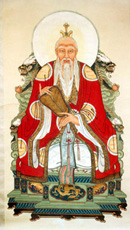 Lao Tzu, traditionally the author of the Tao Te Ch...
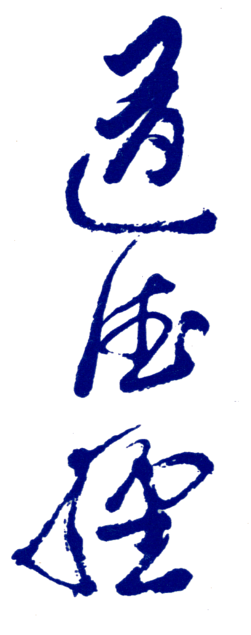 Calligraphy by Gia-Fu Feng, from the cover of the ...
Similarities between views of man and nature greatly show the progression from Hinduism to Buddhism as the same ideas of everything being one and the same are expressed in different contexts. Both religions are also similarly based on attaining certain knowledge in order to reach salvation or Nirvana. Taoism and Confucianism have to be seen side-by-side as two distinct responses to the social, political and philosophical conditions of life two and a half millennia ago in China. Whereas Confucianism is greatly concerned with social relations, conduct and human society, Lao Tzu emphasized the need to look beyond the promises and treaties of human beings for a source of peace and contentment; and he urged to return to nature's way, that is, a simple and harmonious life. Chuang Tzu developed Taoism emphasizing on the natural way as opposed to the artificial...