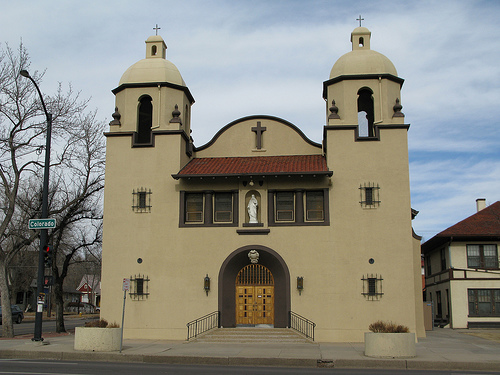
On the history of the Catholic church from Rome, Byzentine to monestaries.
5th Century: The Rhine and the Danube rivers formed a northern boundary of the empire. In earlier times, they had stationed soldiers on both sides of the rivers and built walls. Gradually, the power of the Roman Empire began to decline and the Roman legions could no longer safeguard the Roman frontier. More and more of the Germanic tribes crossed the border and occupied large sections of the empire (in both N. Africa and Europe).
Due to the constant invasions, the once powerful empire that existed disappeared in the West by about the year 500. By this time, the rich province of Gaul (France) had been conquered by the Franks. The Visigoths (Germanic tribe) had invaded Spain.
In 467 a king of the Ostrogoths (another German tribe) seized power from the last Emperor in the west and established his own kingdom in Italy.
In the 7th and 8th centuries, a new and more powerful threat came out of the East followers of Muhhamad (570-632), a native of Mecca who had united the warring tribes of Arabia by religious enthusiasm, the armies of Islam conquered much of the middle East, all of North Africa, and most of Spain in less than a century. Such great Christian centers as Alexandria, Antioch, and Jerusalem fell to the Muslims. All this made travel and trading dangerous around the Mediterranean Sea. The European economy was strangled, and Europe was isolated from the East.
As the Roman Empire disappeared in the West, many wondered whether the Catholic Church would also disappear from Western Europe. The Barbarian invaders were not Catholics; most of them were pagans. If the Catholic Church were to survive in Western Europe, it would have to evangelize and convert these newcomers to Catholicism. That was not an easy task, however. The church was...
More Roman History
essays:
This is a short essay on why the Roman empire fell.
... the last Roman emperor from the throne. In 408 A.D. Visigoths, led by their king, Alaric, they marched toward Rome going across the Alps. After putting Rome under siege, hordes of Germanic tribes stormed ...
Some causes for the fall of the Roman Empire (Massive Slavery, invasion, curruption of the government) (also talks about Christianity)
... the Roman Empire expanded from Great Britain, in the west, to the Euphrates River, in ... the Germans wanted to obtain the wealth of Rome. Another group that was in opposition to the Roman Government were the internal group of Visigoths. The Visigoths, while ...
The Roman Empire and Ireland
... this time, Christianity. Thanks especially to the Emperor Constantine, by the fifth century Christianity was the official religion of the Roman Empire. Through ... having distinct identities and somewhat different ethnic histories" in which tribes were led by a king who "was a sacral person ...
The Fall of the Roman Empire
... the Roman Empire because less than half of the population had pipes. Most Ancient Romans used ...
Height of the Roman Empire
... first emperor, calling himself Augustus Caesar. The Roman Empire split ... the Roman Empire depended on the unity of the Mediterranean or, as the Romans called it, Mare nostrum, "Our Sea." Outlying reaches of the empire were connected to the sea by the rivers and ...
"Childhood in the Roman Empire" by Ray Laurence - Article Review
... . Laurence presents information in regards to the treatment of children in the Roman Empire and quickly follows many of his statements with proof or information ... about the treatment and role of children in not only the ancient Roman times, but also our own. The information is relevant not only for ...
The Roman Empire, from Caesar's reign through Augustus, and finally the infiltration of the Germanic barbarians. 7-8 pages, double spaced, 10pt Times New Roman, with 'quick references'.
... the Roman Empire? Simply, it was not the overall concept of the strategy that failed, but rather, the execution of the strategy. For example, the drastic decline in the emperor's ability to conjure and commit military forces to the frontiers ...
The Fall of the Roman Empire Explains the fate of Rome in the West in the course of the 3rd to 5th centuries AD. Accounts for the role of Christianity for both the Roman West and East.
... the Rhine-Danube frontier pulled away to fight a civil war in Italy, which left the border open and susceptible to invaders. Eventually the Germanic tribes began to overtake the lands. The Visigoths, Ostrogoths, Vandals, Franks, and ...