The first electronic digital computer was called ENIAC (Electronic Numerator Integrator Analyzer and Computer), and was invented at the University of Pennsylvania in 1946. Its was constructed for military purposes. Weighing around 27 tons and was the size of a room (was about 9m by 17m). The ENIAC made loud noises, it crackled and buzzed when it was performing an equation, it also let out an incredible amount of heat since it had 17,000 vacuum tubes. Before this machine was invented, a room full of mathematicians were required to calculate the equations. This "computer" could execute 38 divisions and 357 multiplications in less than a second. Although, today a calculator has more power and memory that the ENIAC.
In 1951, Real-Time Computing was achieved with the "Whirlwind". It was first built for flight simulation. But this machine could perform many tasks, which included air-traffic control, processed data, which was all presented on a screen, and could be subsequently directed by using a light gun.
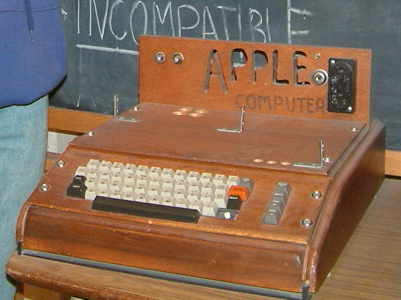 Apple I at the Smithsonian Museum
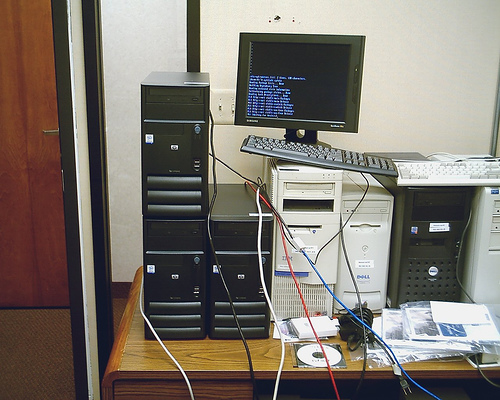 Computer Mess
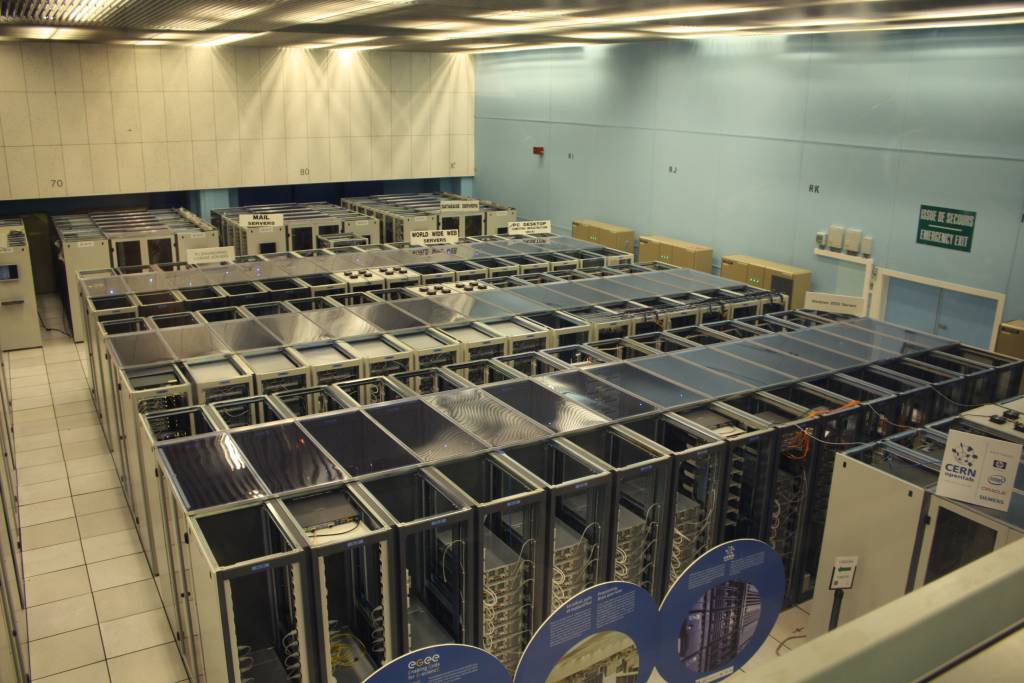 English: The CERN datacenter with World Wide Web a...
Development of the Whirlwind computer began in 1945, and the system was first demonstrated on April 20th, 1951. The Whirlwind was also the first computer to use Core Memory for RAM, a storage method that grew until the 1970's. Core memory permanently stores binary data on small donut shaped magnets strung together by a wire grid. The Whirlwind computer was ultimately used by the U.S. Air Force for use in the SAGE (Semi-Automatic Ground Environment) air defense system, which eventually began operations in 1958 with more advanced display capabilities. The last of the Whirlwind-based SAGE computers was shut down in 1983, giving the Whirlwind a record for practical operational endurance among digital computers.
In 1951, the first computer built for business use was invented, called LEO. This machine calculated taxes, payrolls. The LEO could compute employee...