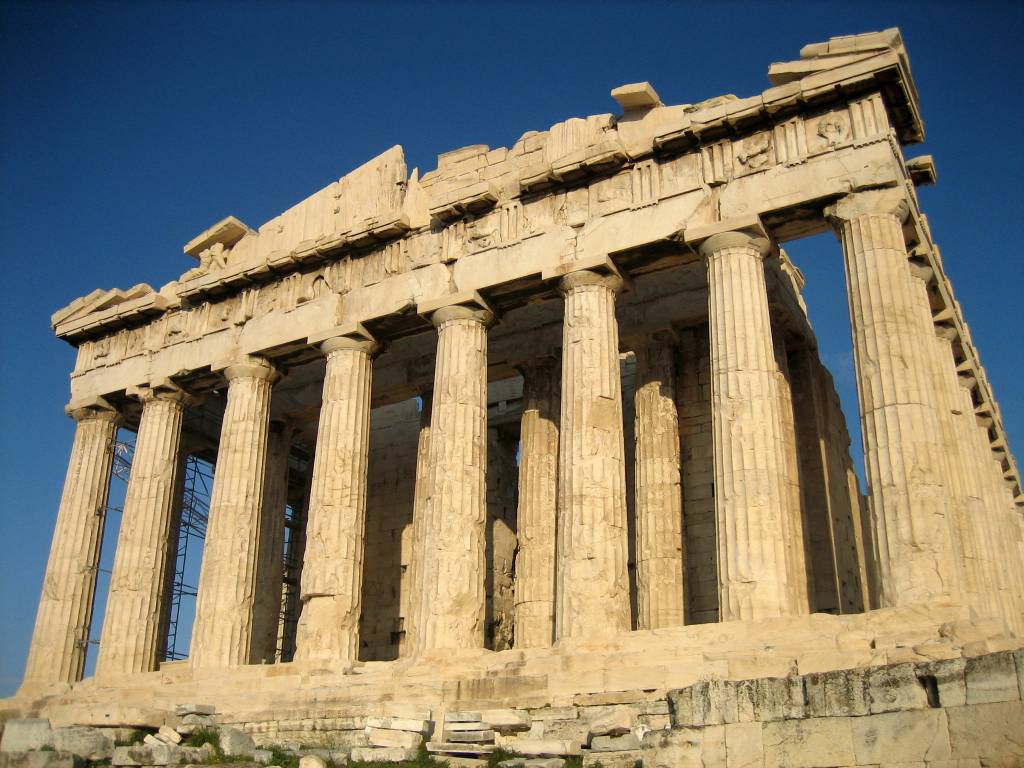
The History of the Greeks: Hellenic and Hellenistic
The Hellenic Age and the Hellenistic Age are the two main periods in Greek history. The Hellenic Age is significantly different from the Hellenistic Age. The Hellenic period saw the rising and falling of the polis while Hellenistic period was plagued by warfare among the remaining dynasties. Despite the differences between the Hellenic and Hellenistic periods, the one thing that remained consistent in both periods was the Greeks' ability to not only advance science and philosophy but to strive for excellence in everything that they undertook including their ability to deemphasize the role of the gods in their lives.
The first period that shaped Greek history was the Hellenic (c.750-323 B.C.). One of the characteristics of the Hellenic period was the polis, or very small city-state. Each polis was dedicated to one specific god. Each polis was self-governing and allowed for the citizens to be involved in the political and cultural life of the city. The early city-states were colonized as religious institutions. The citizens of each polis had a desire to maintain a bond with the gods. The city-states were originally in Greece, with Athens being the largest, however, because of the growing population, the Greeks needed to expand their territory. They began their colonization to the east on the coast of the Aegean Sea. They then moved to Cyprus along with the coasts of Thrace, the Sea of Marmara and the south coast of the Black Sea. Their western colonization included the coasts of Albania, Sicily, southeastern Italy, the south coast of France, Corsica and Spain. The two most distinct city-states of Greece were Athens and Sparta. During this massive colonization period, one poet would forever change the way the Greeks lived their lives.

The poet's name was Homer. Around...
More European History
essays:
Why did the French fail so often in military battles around the period of the French Revolution? A look at France's military tactics from the 1400s-1800s.
... as the illuminations of history books." (Duby, 156). This new tactic differed in that the entire army was concentrated on one point--the target of the siege--and left the rest of the country ...
According to the Sources how far did the Nazis succeeded in converting German Youth to the ideals of the Volksgemeinschaft?
... escape the intrusive Nazi system, and were very against and violent towards the Hitler Youth. From the sources of Nazi culture by Mosse and History Today Gerhard Wilke there is a definite confusion of the effect ...
The Industrial Revolution: changes in jobs, transport, the beginning of the English empire, the general situation in Europe, the Agricultural Revolution.
... This period is called the Industrial Revolution. In 1750 most people lived in the countryside. They lived in small villages, growing crops and animals. By 1900, most people worked in towns. Even in the countryside, things changed. This was because of ...
The Execution of the Man who made the Guillotine Famous/Maximilien Robespierre's execution
... most of the men involved hadn't slept for over 48 hours and were living on caffeine, paranoia and adrenaline. On the day of his execution, Robespierre was taken first to the Committee ...
Whether the Greek or the Turkish side should be blamed for the emergence and the prolongation of the inter-communal conflict in Cyprus,
... in the history of the conflict: the Turkish military intervention of 1974. The junta's radicalism was obvious and it did undermine both relations with Turkey and the Greek Cypriots, it was the coup ...
Reliability of Testimonies of the Holocaust Survivors: Elie Wiesel's Night and Binjamin Wilkomirski's 'Fragments'
... us the actuality of the Holocaust, since language can never equate to reality. Primo Levi, in his memoir The Drowned and the Saved, discusses the problems posed by attempting to put the history of the Holocaust ...
Critical Book Review of "In the Beginning: The Story of the King James Bible and How It Changed a Nation, a Language and a Culture" by Alister McGrath
... with the history of the period and the mitigating factors that led to the King James Version of the Bible. This is the book ...
The Religious Crusades
... this period were made in what is now Portugal, where English troops, which had turned aside from the Second Crusade, helped free the city of Lisbon from the Moors. News of the fall of Edessa reverberated throughout Europe, and the Second ...