Physics began when man first started to study his surroundings. Early applications of physics include the invention of the wheel and of primitive weapons. The people who built Stone Henge had knowledge of physical mechanics in order to move the rocks and place them on top of each other. It was not until during the period of Greek culture that the first systematic treatment of physics started with the use of mechanics. Thales is often said to have been the first scientist, and the first Greek philosopher. He was an astronomer, merchant and mathematician, and after visiting Egypt he is said to have originated the science of deductive geometry. He also discovered theorems of elementary geometry and is said to have correctly predicted an eclipse of the sun. Many of his studies were in astronomy but he also observed static electricity. Phythogoras was a Greek philosopher. He discovered simple numerical ratios relating the musical tones of major consonances, to the length of the strings used in sounding them.
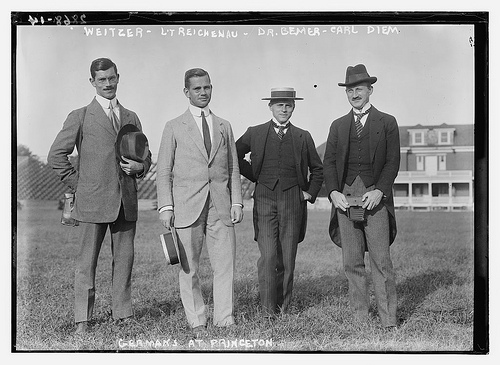 Germans at Princeton -- Weitzer - Lt. Reichenau - ...
![[German vehicle tax registration issued to George Grantham Bain] (LOC)](/uploads/6/60390/german-vehicle-tax-registration-issued-george-grantham-bain.jpg) [German vehicle tax registration issued to George ...
[German vehicle tax registration issued to George ... Greek Blogger Camp Day 1
The Pythagorean theorem was named after him, although this fundamental statements of deductive geometry was most likely first an idea from Egyptian methods of measurements. With the help of his followers he discovered that the earth was a sphere, but he did not believe it revolved around the sun. Democritus was the leader of a group called Atomists. Although they were unable to prove that matter was made up of small particles, they were the first to come up with the idea. Democritus believed that atoms differed in size, shape, and movement but were all made of the same substances. Aristotle was the most important scientific philosopher in Greece. He believed that all matter on earth consisted of four pure substances or elements, which were earth, air, fire, and water. He also...