History Of The Trumpet
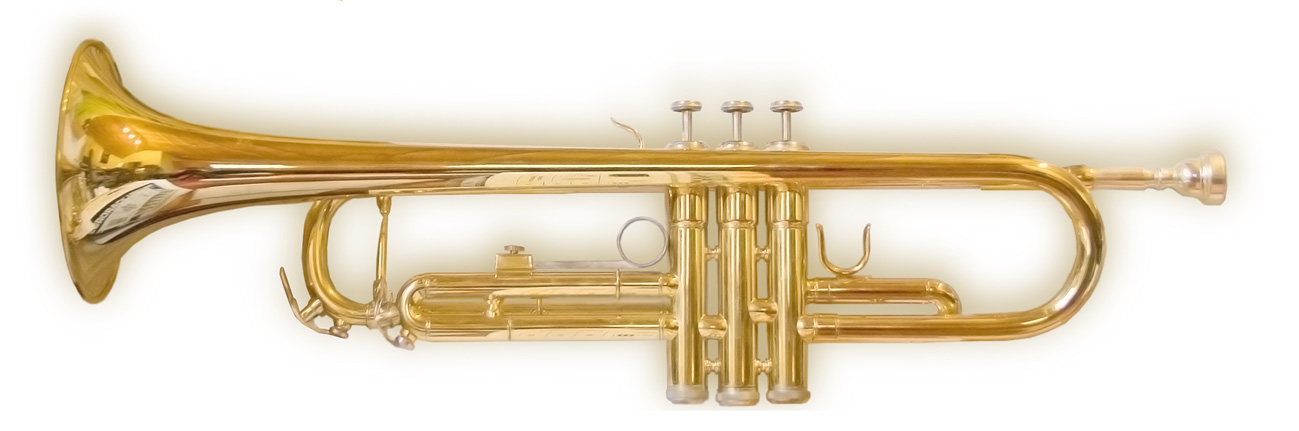
The trumpet has probably evolved more than any other instrument that is presently in use. Its long history began with ancient people using hollow materials such as animal horns and seashells to amplify sounds that they made. The trumpet as we have it today is almost a totally different instrument from what it was thousands of years ago.
Since the beginning of time, man has composed music, both instrumental and vocal. The very first instruments were probably part of the percussion family. People would bang on things to make sounds. After that, people looked for things to amplify their own voice. In order to produce any sound on a trumpet the player needs to "buzz" his or her lips. It is believed that the first ancestor of the trumpet was played while someone was trying to blow a sea animal out of a shell. Instead of blowing, the person somehow buzzed his lips into the shell. After this discovery, people started buzzing into hollow things to send a message from one person to another.
The oldest evidence of trumpets has been found in Egyptian drawings on the inside walls of a Pharaoh's tomb. These drawings have been dated around 1500 BC. The trumpets shown were made of a long tube and had a bell flaring out on one end. They were probably used for communication purposes, like signaling in battle, or announcing someone's arrival. In the Bible, trumpets are symbolic for the voices of angels.
During the Middle Ages, a major revolution occurred with regards the trumpet. At this time various trumpeters joined together and began to compose their own music for their own instrument. During the Renaissance, a new kind of trumpet, the slide trumpet, was invented. Its slide was similar to that of the trombone. In early versions,
More Music History & Studies
essays:
Influential Musicians from 1940-2003 ~Paul Simon, Bob Dylan and Jimi Hendrix~
... also try to reproduce the sounds on the guitar that he had heard while jumping. As a result of a broken ankle, Hendrix was able to leave the army as Private First Class ...
The history of the Mariachi
... was a means of communication by which a young man could send a message of love to the woman of his heart. In many areas of Mexico, it is not unusual to be ...
History Of Jazz
... not a band or a group. One person was singing and playing an instrument and while other instruments accompanied the main performer was the focus. The blues style of music lead to the start of another ...
Beethoven, Bach, and Bartok.
... very beginning of his life in Salzburg, Austria, Wolfgang Amadeus Mozart was a master of music. His father, Leopold Mozart, sacrificed his own career as a respected composer and theorist so he could concentrate on fostering ...
This is a basic history of polish music, from the begining of the creation of the polish nation, to just after world war two. Refrences used are cited and some notes to clarify are put.
... for a few voices, instruments and basso continuo. The reason for this was the fact that almost all polish composers during this time used this musical genre. Later, the professional musical life was on a decline ...
This essay is about Jazz's dominant affect on the social environment in America.
... and begin to respect his race. He also felt that if a person was going to play his best, he would need to look his best. Ellington tried to improve the black image through his music as ...
Rock n roll - the history of
... into a world musical revolution. Racially, the emergence and reaction to Rock and Roll may be much more revealing. The Blues, from Gospel, and into Rock and Roll, may have been the beginning of an ...
Comparison of the Beatles "A hard days night" to Elvis's "Jailhouse Rock".
... they try to board a train, Lester achieves an incredible energy level. As a member of the audience we can feel the hysteria of the fans and the excitement of the Beatles, intercut with the title song (the first time movie ...