The IB Physics Compendium 2004
3. THERMAL PHYSICS
3.1. From mechanics to thermal physics
Many concepts in thermal physics are based on mechanical concepts - for example temperature which is a measure of average kinetic energy. When mechanics is applied on millions and millions of atoms or molecules moving and colliding, it is often not possible to study every one in detail, but they are represented by "collective", more easily measurable quantities.
3.2. Temperature, internal energy and heat
Temperature
This is ususally measured in degrees Celsius or oC where the freezing point of water is 0 oC and the boiling point is + 100 oC. We have taken observable physical phenomena for the substance water, and comibined with something that changes in the interval between them (the height of a pillar of a liquid in a thermometer) a temperature scale could be defined. Though we have negative values on the Celsius scale temperature is a scalar - the negative sign does not give information about any direction, only about what value the "temperature" has compared to that of a chosen phenomenon (freezing or melting water).
 Debye vs. Einstein. Predicted heat capacity as a f...
 The dimensionless specific heat of a number of dia...
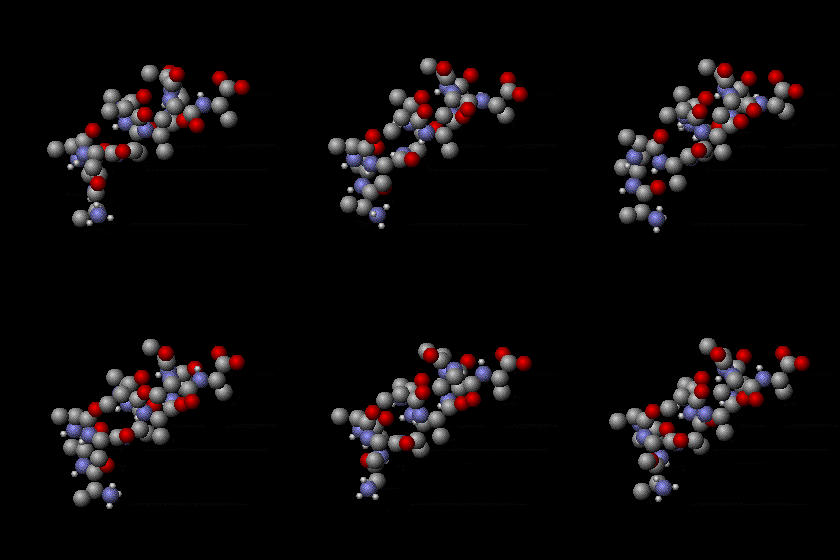 Thermal vibration of a segment of protein alpha he...
In the Kelvin scale the size of a "degree" is the same as in Celsius, but the scale has been shifted to avoid negative numbers. The lowest possible temperature in the universe (more about why it is that later), about - 273 oC is 0 Kelvin = 0 K (not called 'degrees') and 0 oC is 273 K.
ex. 25 oC = (25 + 273) K = 298 K and 400 K = (400 - 273) oC = 127 oC
The higher the temperature, the more do the atoms or molecules move. A more exact definition of temperature is that
temperature is proportional to average kinetic energy
[or (not necessary in IB) Ek,average = ýmv2average = 3kT/2 where m...
Thermal Physics
I think that this is definitely a great piece for study notes. You have written about this topic in great detail with very informational scientific knowledge.
Well written with good formulas, and well explained. Well Done
2 out of 2 people found this comment useful.