Importance of Oedipus and Teiresias' Conversation in Scene One of Oedipus Rex
Oedipus Rex, a classic Greek play, was written almost 2500 years ago by a famous playwright named Sophocles. The play focuses on finding Laius' killer but through the process, Oedipus finds out who he truthfully is. In Scene one lines 284-448 Oedipus is speaking to Teiresias a blind prophet, he asks Teiresias to reveal Laius' killer. This passage has defining characteristics that are important to the play as a whole, which can be simply conveyed on stage. This passage helps develop and make the play more intriguing by showing how blind to the truth Oedipus really is.
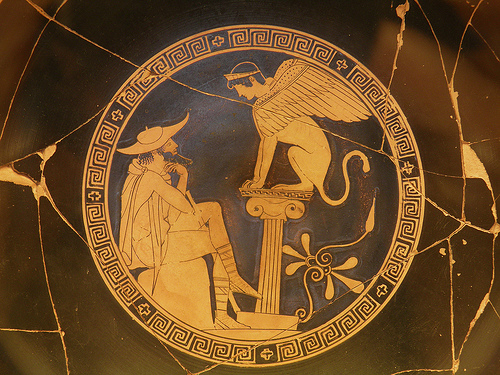
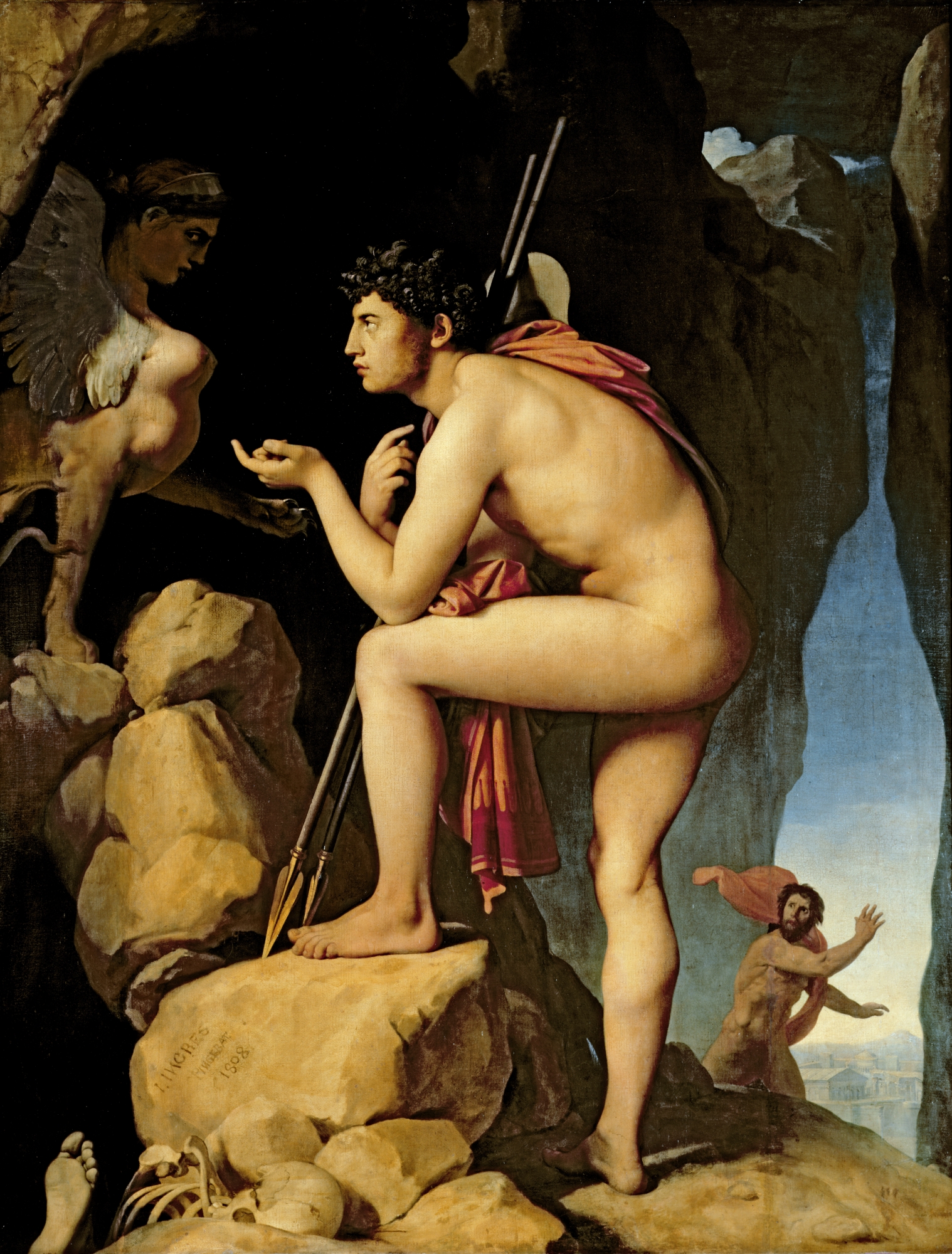
Before the beginning of the play Oedipus saves the people of Thebes from the curse of the Sphinx and becomes king virtually overnight. He proclaims his name proudly as though it were itself a healing charm "I have come myself to hear you-/ I, Oedipus, who bear the famous name."(Prologue 9-10) what Oedipus does not realize is that he had killed Laius son of Labdakos on the way to the Sphinx. The play is based on finding the killer of Laius. Oedipus wants justice done and for the murderer to be banished from Thebes. Oedipus does what he can to make this happen. This includes a conversation with Teiresias.
The passage starts off when a boy leads in the blind prophet Teiresias to Oedipus. Oedipus then begins to beg Teiresias to reveal who Laius' murderer is, but Teiresias answers only that he knows the truth but wishes he did not. Puzzled at first, then angry, Oedipus insists that Teiresias tell Thebes Thebes what he knows. Provoked by the anger and insults of Oedipus, Teiresias begins to hint at his knowledge. Finally, when Oedipus furiously accuses Teiresias of the murder, Teiresias tells Oedipus that Oedipus himself is the curse on Thebes that he is...
More Drama
essays:
The Use of Language and the Image of Irishness it Portrayed in "Translations" by Brian Friel and "Playboy of the Western World" by J.M. Synge.
... . There is no doubting the quality of Playboy; the touching of the nerve of its contemporary audience showed how close to the bone it struck. However ... indicative of a period of great strife and change but a period we must ultimately move on from. There maybe a great deal of romanticism and rebellion ...
Using Irony in a Play. An essay about Sophocles' Antigone and the usage of irony throughout the play,
... s blindness to the truth caused him to lose not just one, but three family members. Dramatic, attitudinal, and verbal irony: all different types of irony, but have many of the same impacts. Sophocles' use ...
As a designer in a production of Bertolt Brecht's 'Mother Courage and Her Children': "The anti-illusionistic devices in my play arouse curiosity and create understanding."
... able to follow the happenings on-stage. I do not intend to change the overall shape of the theatre or the stage, as ... throughout the play. I do not, however, wish to leave all the workings of the lights in plain sight, as this may be a distraction to the audience. As their focus of ...
Race and Racial Perspectives in Shakespeare's Othello
... and on other grounds,/ Christian and heathen, must be be-leed and calmed/ By debitor and creditor." To the characters, the word Turk is an insult; to assure he is telling the truth, Iago ...
The time period from about 1650 to 1920 was ever changing in the world of drama.
... challenged on stage. From neo-classicism and strict guidelines to free flowing, emotionally based romantics, to the "real ... In the naturalistic play Miss Julie by Swedish playwright August Strindberg, a naturalistic tragedy develops as the characters ...
In 'Tissue' how does Louise Page present the political elements and what impact do they have on the audience
... for the stage, this also demonstrates that these issues have just as much social and political significance to the audience as other issues approached by male playwrights. She uses theatre to raise ...
Dario Fo uses laughter as a political weapon to educate his audience. Discuss this statement in reference to 'The Accidental Death of an Anarchist".
... audience comes closer to the truth about the death, the slapstick comedy provides a macabre contrast with the underlying seriousness. For example: In Act Two Scene One Bertozzo comes towards the Maniac, infuriated, but slips on the glass eye and falls ...
Reality, Illusion, and Foolish Pride in The Cherry Orchard by Anton Chekhov, A Doll's House by Henrik Ibsen, and Galileo by Bertolt Brecht
... by leaving everything she has ever known. Nora's failure to accept what she had really become led to the end of her life with Helmer, and her downfall ... be your cherry orchard, but your whole estate that will be sold at auction on the twenty-second of August. Make up your mind. I tell you there is no ...