On "Iron Laws" of Economics.
ABSTRACT: 1. A strong interest shown by modern society to the sphere of economic attitudes, and connected to it the growing authority of the economists. - 2. Perception about the "iron" laws of economics as highest criteria of economic activity and life in general (economic fatalism). - 3. An exploration of the most widespread motives of housekeeping: struggle for a survival, earning one's "life", earning on "the black day". - 4. Logical "circumvention" of all these motives confirmed by the daily facts. - 5. Managing for the sake of managing - professions for amateurs. - 6. Narrowing the sphere of action of the economic "laws" from "all" to "wishing". - 7. Optionality of the "iron laws" of economy, even for those wishing to be engaged in it. (with examples). Dependence of economy on ethics and psychology. - 8. The essence of the moderate fatalism, its incompleteness and discrepancy.
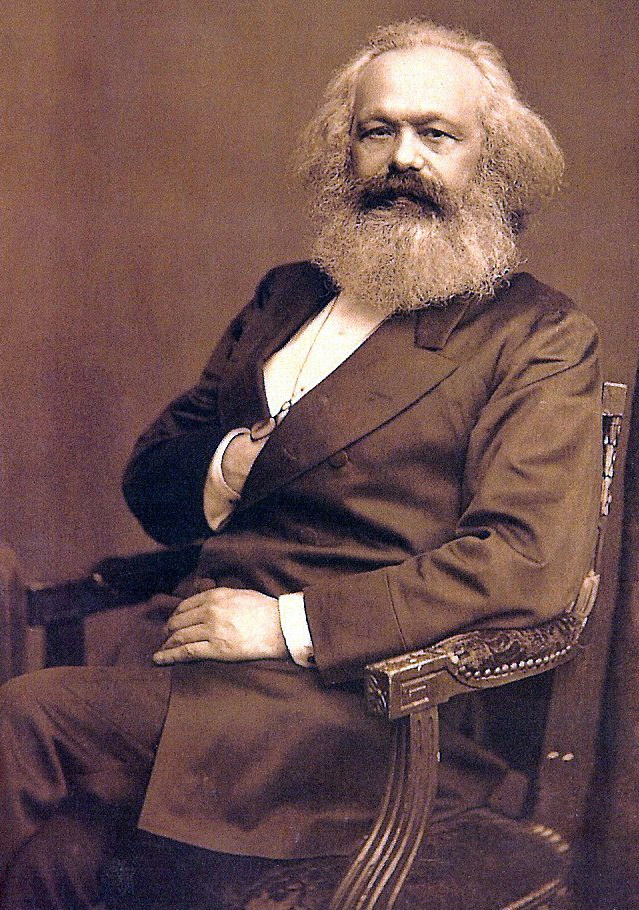 A portrait of Karl Marx.
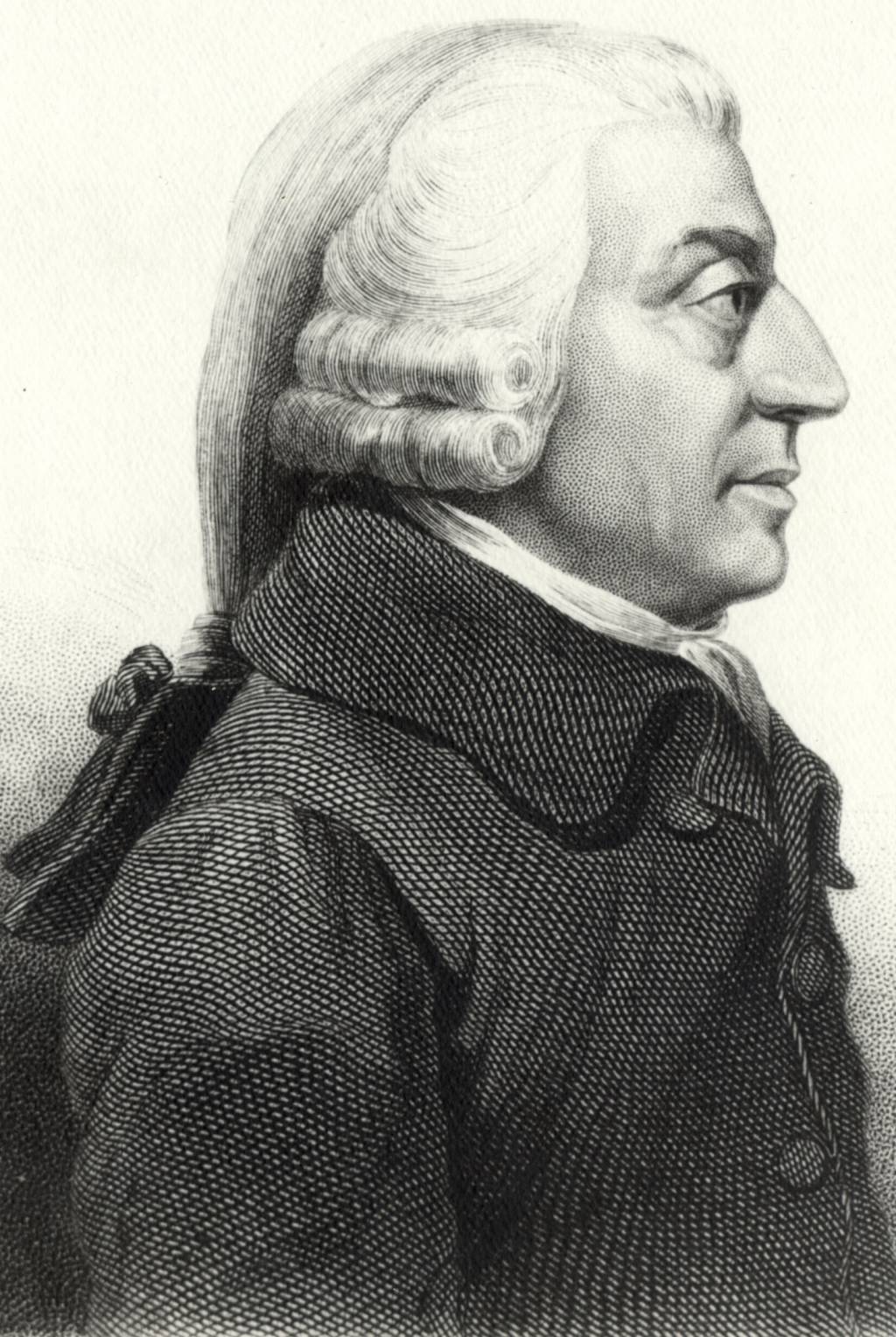 Profile of Adam Smith
 economics
- 9. Economics as a game, initiated and regulated by the government. Decreasing of the status of economic game with the eldering of the population. - 10. Inevitability of occurrence of "shadow" sector in economy, which considers as its basic purpose the obtaining of the profit. 11. A dilemma rising before any man without preconception: to admit economy to be a "dirty business", fun for the adults, or to search for the "third" way, which... 12. ...on my sight, consists of returning to the initial sense of the word: economics-a reasonable running of an economy, or keeping house keeping) - 13. The elementary analysis of this definition. - 14. The task of philosophy of economics in the given context. - 15. Concept of "organic economics" demanded by real life, instead of the obsolete, and diminishing influence of the exclusively mechanical approach. Universal character of this concept.
"Economics is a special world, with it's own laws and problems, dramas and contradictions" -- The textbook "Modern Economics"
Respectable colleagues!
It's unlikely, that I need to explain to any of you, what place in our life the phenomena of economic order has achieved. The well-known "market attitudes" have penetrated into practically every, sphere of our life, even most intimate. The leading economists, beginning from Marx and ending with the present "liberals", habitually incur the role of critics and prophets, predicting the possible and even the certain future. In their own declarations, they have the right to do it, because of a vast knowledge of the nature of economics.
"Economics has it's own special, immutable, iron laws, which no one can violate with impunity. Our task is - to study it carefully (through an economic science) and try to follow it all the time". These calls, metamorphosing sometimes into exorcism, are often forced upon us. Some even compare economic laws on power to the natural laws- such, say, as the law of world gravitation (which all are obliged to follow); and on clarity to the table of multiplication.
All of it, together with the aggravated economic concern, has resulted in an occurrence of the original worldview - economic fatalism, which by it's popularity can be compared only with the astrological fatalism.
I believe, that economic fatalism (as any fatalism) does not, by any means, promote normal development of the economic sphere, and consequently, I consider it my obligation to convert it into a subject of critical research.
It is doubtless, that within the basis of all economic life lays the simple, and apparently, really "iron" principle: the economy (housekeeping) is necessary for survival. But even here there is something to muse upon. It is no secret that the instinct for survival (under any conditions) is, by no means, characteristic to all. There were, and are, people who prefer a proud death to a base vegetative existance by any means. It would be too hasty to announce them from the doorstep as abnormal and sick. For this it is necessary, at least at first, to comprehend in a general way the blind instinct of survival (why survive?), to make from this instinct a rational principle, which is not too easy. Moreover, the word "survival" itself can be understood differently: some have only in view not dying from cold and hunger, others - to preserve the status quo, that is, to not lose the obtained positions, which sometimes can be rather high.
Concerning "cold and hunger", it is necessary to note, that in many advanced countries there is a special sort of citizens, which haven't any economy at all (in the habitual sense), going about from one flophouse to another, from one soup line to another, and selecting clothing for themselves in a rubbish heap. This fact (sad in itself) testifies, however, that with the existence of a well developed charitable system, housekeeping for the physical survival of the individuals is absolutely not necessary. The people voluntarily engaged in an economy, are quite able to very poorly dress and feed their less lucky co-citizens. Generally speaking, the "economical" resources of the human organism are really inexhaustible. A precious example: Indian yogis, a certain sort of leaders in asceticism - some of them suceed in feeding not by the famous ëbread and waterû, but by, strange to tell... air! Certainly, on all similar "miracles" there leave years of wearisome trainings, but, you see, the search for appropriate work, (for any fan of tasty eating), can also require considerable efforts.
Another widespread motive, exposed by the supporters of compulsory housekeeping, is earning one's life. Really, the aspiration to life is inherent, apparently, to each of us, but, you see, the life in this case should not be understood literally. It's clear to everyone, how much you will work -- you will not work for life, the richest and most influential magnate dies and decays in just the same way as the poorest beggar.
Under the "life" it's usually understood not the life itself, but a certain sensation of life, as opposed to mere existence. And what's more, the subject, which evokes this sensation differs not only in every separate man (someone needs for "life" a bottle of vodka; another - a villa on the Canary Islands; a third - a new wife; a fourth -- lives only when he is playing "with a big stake"), but also within the same person in the course of time.
In order to leave a shaky area of psyhological sensations and moods, some experts offer to understand "life", as offered by the statistical science: an average standard of living, expressed in a certain quantity of things and money, for the sole of the population. If I have these things - I live, if not - I exist.
Even without any exploration of the question of trustworthiness of any kind of statistical calculations, it can be said with assurance, that in this case, aspiration to life, which is really inherent to everyone, is substituted by the conditional and occasional fact of possession of a certain amount of property. Such substitution causes indignation of many intelligent people, who regard it as childishness and narrow-mindedness. The aspiration to ëaveragenessû, to "being not worse than others", by analogy with the animal's flock instinct, for a long time was contrasted with the aspiration to originality and independence, among other aspects in an attitude towards property. From this comes children, who squander their parent's fortune or go looking for themselves far outside of the material sphere ("Artamonov's Business " by Maxim Gorky , "Buddenbrokes" by Thomas Mann and so on).
Really, to consider someone's life in possession of a certain statistically-calculated things, is obvious, though a very ancient illusion. That fact, that millions are working zealously for the benefit of this illusion, speaks only about the power of habit and about the low level of education in the given area. It's clear, that in the course of time, and with the development of critical thinking, less and less people will be fascinated by this illusion, until it lastly it will be converted into some museum artifact.
After all said above, it becomes clear that the economic activity, as such, isn't something compulsory, hanging, so to say, as a Damoclov's sword (an evil fate) upon each of us, but it is a subject of choice, a desire, or, if you like...a calling. With such an approach the "social base" of notorious economic laws is rather essentially reduced - namely, from "everyone" to "anyone who wishes". But even within these, much more narrow limits, the effectiveness of the above mentioned laws doesn't look completely obvious.
Let's take, say, the most simple and less controversial of these laws, namely: the price of goods or services determined by the correlation between supply and demand. That is, the greater a requirement of a product -- the greater its cost, and vice versa. Imagine an elderly woman, rather well-to-do, who rents a room to the young graduate student working upon his dissertation. By some situational reasons, the demand for the rented dwelling place increases, and the hostess of the apartment would, by idea, desire to increase the rental payment. But here, she, from compassion for the awkward material condition of her lodger, prefers not to increase the price for the flat to the "balanced" level, and leaves it, lets suppose, at the former level. From the point of view of economic fatalism, by this action, she commits a crime.
But somebody would disagree with me, and say: though the crimes of the given economic law are possible, it does not pass unpunished. Let's look, however, further -- this post-graduate student, after becoming a doctor and receiving popularity and glory in the scientific world, visits his former hostess, and in a sign of gratitude, makes her a present, which far exceeds her "losses" during their joint residing. Instead of a punishment, it appears to be a reward!
I, however, do not assert, that now, all relations between lodgers and landlords are based on the "humanitarian" principles of compassion and mutual aid. But this, in general, regrettable fact testifies not to the power of the economic laws, but more about the lack of humanity of the average person. Well, even the most ardent supporter of following the "laws", would hardly say, that our "aged landlord" behaved in a bad way, by leaving the price at the previous level; or that the poor graduate student, (and nowadays, rich doctor), behaved badly by thanking her properly.
"The case with the hostess and her lodger is their own matter, which they can decide by their own discretion, and at their own risk. The other matter - macroeconomics, is an entirely different sphere. Here the law of supply and demand works at full force." Is this right?
It is known, that in most countries there is an establishment of minimal wages, in which the level is defined by the appropriate political law. Very few people suspect, however, that this law is, apparently, standing in explicit contradiction with the "absolute" economic law being explored, according to which the price of the goods (in this case of labour) is entirely determined by the demand. With the large supply of working hands, the size of a monthly salary, under this law, can decrease to an amount, close to 0 - but it does not occur, because the employers (for the majority) are afraid of the consequences of breaking the law of minimum wages. They choose from two laws, the political one. Why is this happening?
The government, proceeding from consideration of the humanistic order, maintains a level of the minimal incomes, entering, thus, in counter-action with market demand. Besides, the ëalmightyû demand should stand by itself. But we see, that even in the most economically "free" countries, the institute of MW safely exists and it's common result, is not the crash of the government, interfering in the "business of economy", but the political stability and tranquillity in society - a necessary condition, by the way, for further economic development.
One more vivid example of an economic "crime" is charity. Certainly, a large part of charity, at present, pursues advertising purposes. But if to speak about the smaller, "creating the boon", charitable part; who can explain, from the pure economic point of view, all this free-of-charge distribution of money and goods with universal deficiency on them? How can it be, that whimsical philanthropy upsets the iron machine of supply and demand?
It is rather easy to notice, that all of the motives, by which the economic "laws" were broken in these examples, are motives of the moral or psyhological order - compassion, gratitude, fear, philanthropy (human kindness). Thus, we find, an essential part of economics depends on ethics and psychology.
It is important to notice, that the last time the absolute fatalism in the economic area is replaced by a liberal one. "Ironness" of the economic laws is accepted here, but, most probably, not as inexorabliness, but as heartlessness, hardness, and cruelty. "The laws of the market are cruel, but the society, by means of the state, can interfere with its actions, in order to bridle the passions and mitigate the consequences of the spontaneous market". Thus, in the given case, though the objective force of the economic laws is admitted, at the same time, it shows their moral defectiveness, which makes them rather alien and hostile for the majority of the people. Here, the government is offered a little comic role, as a "lubricator" of the iron laws (to keep them from clanking) without, indeed, any hope for improvement. The supporters of the "regulated market ", if I am to understand, are trying to remain seated on two chairs at once, and, as a rule, are falling from both.
The unsteadiness and ambiguity of the moderate fatalism induces the most active minds to pass to the following step - to reject completely the abstract economic laws and to declare government as a sovereign ruler and legislator of the economic life. Namely, the government, here creates and legally fixes "uniform rules of the economic game", which all of it's participants, managing in the given territory, are obliged to observe strictly. Thus, the once almighty economic laws receive the modest role of national customs or peculiarities, which should be taken into account while drawing up of rules of game. But who, tell me, presently may vouch for viability of any cabinet? As a result, the instability of a situation, connected with the changing of political tendencies and tastes of the government on the one hand, and the absence of the firm and objective goals in economic activity on the other, stimulates the most hazardous and vigorous players in "economics", either to bypass, or directly deny the governmental decrees. From here originates, and by it is fed, the powerful and well-organized sector of the "shadow" economy: not paying (in opposition to the "light" one) taxes, or even establishing it's own "rates", with which the state conducts eternal, ruthless, and, in the final account, a fruitless war for incomes.
Thus, we notice in the present economics two sorts of actors: on the one hand - unfortunates, "eaten" by the everyday life and humbly toiling on housekeeping troubles; on the other - players, making their economic career at the expense of others. All this can cause, for every balanced and non-superstitious man, an impression, that the economy (just like politics) is a business, if not ëdirtyû, then at least not serious. But before coming to such a conclusion, we need to see -- whether there is any other way, or any other stimulus for economic activity?
Eventually, why should we trust in all this, invented by the authoritative fatalists, the horrible world of ëself-propelledû economic processes, automatically changing one economic formation for another; mechanically alternating decreasing and increasing cycles and fluctuations, self-existing economic laws, and so on, and so on... - the world of casual whims of economic fortune, and of the chaos of individual decisions? Wouldn't it be easier to remember the old and overlooked concept of economics, following from the very sense of the word, due to which it is not more and not less, a reasonable running of the house. Or, more exactly - a reasonable running of our house.
If from the point of view of economic fatalism, both absolute and moderate, economy is a certain kind of "black hole", inevitably entangling each of us for the supposed needs in economic activity; an endless detective, fraught with external conflicts and internal compromises. Then, with a more balanced approach, we, like a personage of one well known tale, who has said: "Shadow, know your place!"; we speak: "Economy, know your place!"
But it is one thing to proclaim, and another - to fulfill. How do we become the hosts in our own economy? Some hints can be found in the very definition: rational housekeeping. In order to be the hosts in our own house, it is necessary to keep it. In essence, namely this question is, on my sight, the basic question of the philosophy of economics, which, in the given case, can be treated in two ways: either as a philosophical department of economics (not very numerous nowadays, it is necessary to admit), or as an economic department of philosophy. The second question: how is it best to "keep the house" (in the "capitalistic", "socialistic", or "statistic" way), contains, in it's turn, the main task of the applied economic sciences and depends on specific times and places, traditions and historical peculiarities. If the philosophy of economics is occupied by definition with the best goal of the whole economic development; then "economics" itself is working out the methods, and ways for most quickly achieving this goal. Thus, they supplement and support each other: because the best philosophy is fruitless, if it can not be applied anywhere, and the most developed and refined "rules of the game" cannot make it attractive for the seeking the higher sense.
And the last. In the mass consciousness, it has already strongly taken root, the representation of the so-called economic mechanism. I would appreciate this as one of the numerous consequences of the well-known in the philosophical environment doctrine: Decart's of a matter and spirit. This dualism, on my look, can be surpassed only by the introduction in use, the notion of the economic organism and accordingly, organic economy. Such approach, such point of view, undoubtedly will meet the considerable counteraction on the part of admirers of economic mathematics and geometry, but it is doubtless also, that it corresponds better to the deep expectations of the modern life, and, that's why, for it, the future. Besides, for me personally, it is obvious, that the coming organic economy (with it's correct understanding) hardly will come to reject all accumulated experience (in that number by the supporters of the mechanical approach), but will try to, so to say, assimilate, that is to take on the arms of all the most valuable and useful experiences. Only in this case can it execute the main task - the maximum - to ensure a worthy life to mankind and to the world organism as a whole!