Jonathan Swift (1667-1745) is quite possibly the greatest satirist in the history of English literature, and is without question the most controversial. Infuriated by the moral degradation of society in the eighteenth century, Swift wrote a plethora of bitter pieces attacking man's excessive pride, and the critical reception has been one of very mixed reviews. While few question Swift's skill as a satirist, his savage, merciless attacks on the foibles of mankind have led more than one critic to level negative accusations against him. His beliefs have led to allegations of heresy, an anti-government attitude and a devotion to freeing man's right to passion. His most famous work, Gulliver's Travels, has resulted in attacks on his writing style, and his cruel, invidious assaults on sin have led to cries of egotist, misanthrope and sadist. Every one of these accusations is false. Jonathan Swift's critics are misguided and incorrect in their attacks on his beliefs and writings.
 Jonathan Swift, by Charles Jervas (died 1739). See...
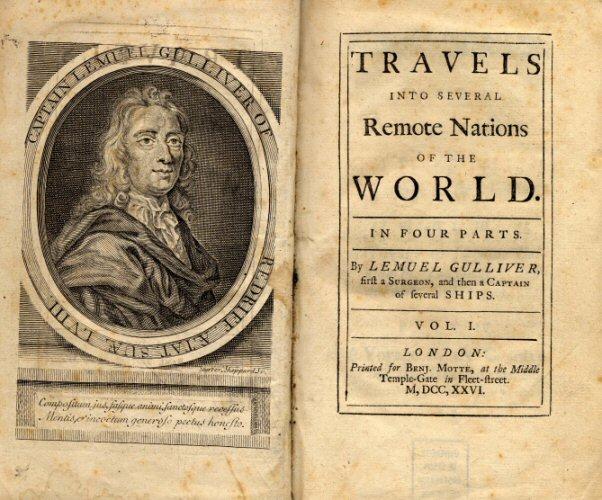 First edition of Gulliver's Travels by Jonathan Sw...
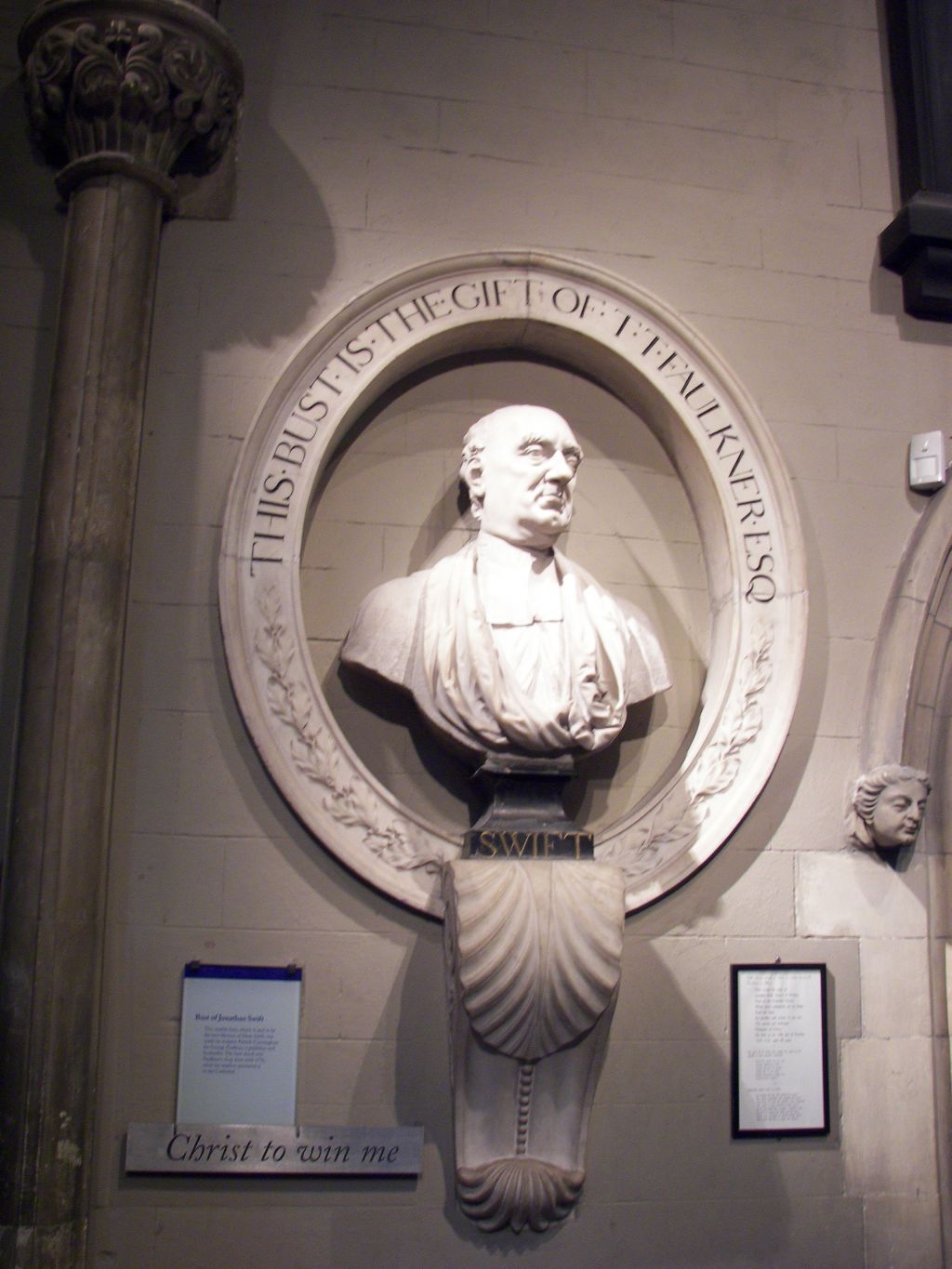 Bust of Jonathan Swift near his burial spot in St....
Jonathan Swift is falsely accused of heresy for attacking human life. Swift infuriates some critics for criticizing something that they feel must be divine since it is the chief instrument of God. These critics argue that human nature must be dignified if it is the key theme of Christianity. They, however, are wrong, and are guilty of being naive. Swift and his supporters counter their attacks by pointing out that it is hypocritical of them to revere such vices as corruption, greed, and immortality, and these critics need to take a serious look at this (Knowles 34-35). Swift himself has answered these charges of heresy, explaining that he has never been anti-Christian and only disagrees with the concept of original sin. Throughout his life and in his writings, Jonathan Swift has always been a devout man of religion (Tuveson 103, 3).
Critics falsely claim that Jonathan Swift sees God as much too great for humans (Dennis 58). Swift's writings prove that he has always been a firm believer that only God and Christ are capable of absolute moral perfection, but he also strongly believes that man is definitely capable of shortening the gap (Tuveson 129). Swift has said that he normally has no belief in theories or systems, due to the fact that they are driven by man and therefore cannot operate perfectly. Christianity, he feels, is an exception to this rule, because the system guides man just as man guides the system (Bloom, Swift 15). This belief also counters the allegations of heresy.
Jonathan Swift has often falsely been accused of being anti-government. One of Swift's many attackers, Leslie Stephen, assails him for tracing 'every existing evil to the impostures and corruptions . . . of government' (Bloom, Gulliver 33). While parts one, two and three of Gulliver's Travels are written partially as attacks on the Whigs, Swift only does so because of his allegiance with the Tories, an opposing party. It is a grim portrayal of officials, and Swift's supporters believe it is an accurate one (Knowles 33-34). It is written out of a hope for change, however, not of hate. Swift makes it clear that he is not opposed to government, and he looks down upon radicals and firmly supports government and 'established institutions' (Tuveson 5). Swift is an incredibly moral man, and would never believe that government could be a truly moral body. Nevertheless, he feels it can encourage virtue among its people, even if that is not its actual motive (Bloom, Swift 14). Swift sees a necessity for government if man is to ever realize good sensibility. With the help of government, people can be pushed in the direction of good sense through rules and regulations and eventually, after being forced to act wisely over and over, be able to make good decisions on their own (Tuveson 11).
Critics have claimed that Swift's chief goal is to free the world of passion. This is not the case, as a passionless society would render Swift incapable of satire, and he realizes this (Ward 6). Swift only wants man to realize that he is made up of two parts: passion and good sense (Knowles 36). Swift believes, as Kathleen Williams points out, that man's 'mind and body are at odds and must be, as far as possible, reconciled.' He attacks man's complexity because it prevents him from choosing rationally between passion and good sense and keeps him from maturing into a wholesome, sensible person (Bloom, Swift 15). Swift has no desires to eliminate passion. He only wants man to have some control over it (Knowles 36).
Critics incorrectly argue that much of Swift's work is simply absurd and overly imaginative (Knowles 36). Gulliver's Travels includes many 'absurdities,' such as gods being frightened by puppies, a jealous minister and meretricious maids of honor, but each of them are included for a reason (Bloom, Gulliver 43). Swift has inserted each of these absurdities to prove his theory that man is naive and ignorant of his problems, because the reader, like Gulliver, laughs at them instead of realizing that they are problems of his own. What many of Swift's critics do not realize is that his writings feature a dark, twisted sense of humor (Bloom, Gulliver 40, 43). He uses comedic undertones and then startles the reader into shock when these absurdities show just how evil man can truly be (Brady 71). He sets up readers with a flip-flop between reality and the imagination (Tuveson 58). What the reader at first fails to realize, and then is horrified to finally see, is that the joke is actually on him (Bloom, Gulliver 44).
Swift is criticized for Gulliver's ability to write three positive books in Gulliver's Travels, when it is said that Gulliver writes the story after his travels are completed and he is completely disgusted by the actions of mankind (Ward 124). These strange actions by Gulliver actually showcase man as over-anxious, someone who acts hurriedly and irrationally and as a result errs in his work (Bloom, Gulliver 45). The reader can roll his eyes at Gulliver's foibles, but when criticizing his writing the reader is criticizing himself for being incomplete and incoherent (Ward 125). Contrary to criticism, Gulliver's Travels is far more coherent than it is given credit for (Bloom, Gulliver 45).
Another misconception of critics is that the actions of Gulliver are intended to prove that people are less than human (Ward 8). This was never Swift's intention. Gulliver originally comes off as an intelligent fellow, and the reader can easily relate to him. Gulliver later acts foolishly with hubris pride, and the reader frowns upon Gulliver and, as a result, himself (Brady 72-73). Satire like this serves as a wake-up call for the reader. Swift constantly shifts the attitudes of his characters, such as Gulliver, to keep the reader from growing complacent. These shifts irritate the reader's views on life and he is forced to change (Ward 7, 15).
Jonathan Swift is once again unfairly attacked for his references to human excrement in several of his works. George Gilfillan was so offended that he referred to Swift as a 'minor Satan.' Gilfillan and others are bothered most by several mentions of feces in Gulliver's Travels, especially the spraying of Gulliver, and they fail to see the true significance of the excrement. Swift set out to inspire their anger to prove that man often becomes upset over everyday actions which are trivial compared to the bigger picture, which is sin such as pride (Knowles 38). William Hazlett defends Swift on this matter, claiming that those who attack Swift over the excremental references are ignorant hypocrites (Bloom, Gulliver 31).
Swift does not put himself above criticism as he has often been accused of doing. He attacks the fallacies of society and, as a member of society, is forced to attack the vices of himself (Ward 2). It has been a common criticism that Swift is foolish for using two different voices in one piece. However, this only points out that Swift does not put himself above criticism, as it showcases the fact that his thoughts and feelings are as incoherent as the rest of society's. Swift loves to mock society, but in so doing, he is also mocking himself (Tuveson 8).
Swift has unfairly been referred to as conceited. Critics claim his works are of an egotistical slant that makes simple people look cowardly and deceitful (Knowles 34). Swift cannot possibly be an egotist, as he has made it clear that his chief adversary is man's pride (Tuveson 102). He uses Gulliver as his chief means of conveying this. Gulliver lies early in Gulliver's Travels to defend his beliefs and reputation, refusing to take a shot to his ego in the name of honesty (Brady 6). In part one of Gulliver's Travels, Gulliver's vision is skewed by the rays of the sun. This represents man's blindness towards morality and values. Later, Gulliver is searched by the Lilliputans and they find glasses in his pockets. This proves that man's vision (meaning his views and beliefs) cannot be trusted because his pride gets in the way (Bloom, Gulliver 11-12). To accuse Swift of being self-conscious is as absurd as any other accusation that has been leveled against him. In Swift's time, society began to look at pride as not a vice but a virtue, and Swift felt it was his duty to change this (Brady 28).
Perhaps the most common criticism leveled against Jonathan Swift is that he is a misanthrope. Walter Scott, infuriated by Swift's attitude towards man, went so far as to call him an extreme misanthrope and said Swift was full of 'mental disease' (Knowles 37). David Ward goes just as far, claiming that Swift 'lacks completely that instinctive respect for the value of human life which is an essential part of humanity (9). As Ronald Knowles points out, these attacks on Swift prove that his critics agreed with what he was saying and they resorted to false accusations simply out of fear and paranoia (38). Swift does not hate man for lacking moral perfection. Man cannot be expected to have this (Dennis 49). Swift hates man's stupidity, folly and excessive pride, but he has never given up on his brethren (Brady 79). Swift is forced to use extreme pessimism to crack the smug self-confidence of the sinning optimist (Ward 13). He believes that humans, just as animals, are capable of evolving (Tuveson 11). Swift is not a misanthrope, he only wants to create awareness. His goal in works such as Gulliver's Travels is to change society, not to create hysteria or destroy it (Brady 23).
Several of Swift's critics go even farther than misanthropy, accusing him of sadism. He is accused by some of actually enjoying the pain he inflicts on his readers through his thick satire (Knowles 34). British poet John Gay was bothered greatly by Swift's work, and went so far as to beg Swift to take mercy on his readers, claiming that his writings are much too hard on human beings (Bloom, Gulliver 26). Just as Swift is unfairly labeled a misanthrope, he most certainly is not a sadist. The sole objective of his satire is to simply open people's eyes to the many problems of human nature. While his writings seem negative, Swift wants to help people, not hurt them. For example, Swift uses midgets and giants in Gulliver's Travels. Midgets and giants are still people, but they are by no means as frightening an image as the average human being. By using outlandish humans such as these midgets and giants, Swift allows man to examine the fallacies of himself without becoming overly frightened (Knowles 35-36). Swift never intends to hurt anyone through his writing, and he loves all 'individuals' (Tuveson 105).
Due to the immense popularity of works such as Gulliver's Travels and A Tale of a Tub, criticism of Jonathan Swift will probably continue on forever. And as more and more people read his bitter attacks on an eighteenth-century lifestyle that mirrors their own in immorality and decadence, more and more accusations such as heretic and misanthrope will be leveled. Swift's work will continue to force people to look themselves in the eyes, and as long as they refuse to accept the truths that Swift lays before them, the naive and ignorant allegations will continue to fly. Jonathan Swift, by his own admission, was not a perfect man nor a perfect writer, but the criticisms leveled against his beliefs and writings simply out of ignorance and naiveté will continue to be dismissed as misguided and incorrect.
Works Cited
Bloom, Harold, ed. Jonathan Swift. New York: Chelsea, 1986.
---, ed. Jonathan Swift's Gulliver's Travels. New York: Chelsea, 1996.
Brady, Frank, ed. Twentieth Century Interpretations of Gulliver's Travels. Englewood Cliffs: Prentice, 1968.
Dennis, Nigel. Jonathan Swift: A Short Character. New York: Macmillan, 1968.
Knowles, Ronald. Gulliver's Travels: The Politics of Satire. New York: Twayne, 1996.
Tuveson, Ernest, ed. Swift: A Collection of Critical Essays. Englewood Cliffs: Prentice, 1964.
Ward, David. Jonathan Swift: An Introductory Essay. London: Methuen, 1973.