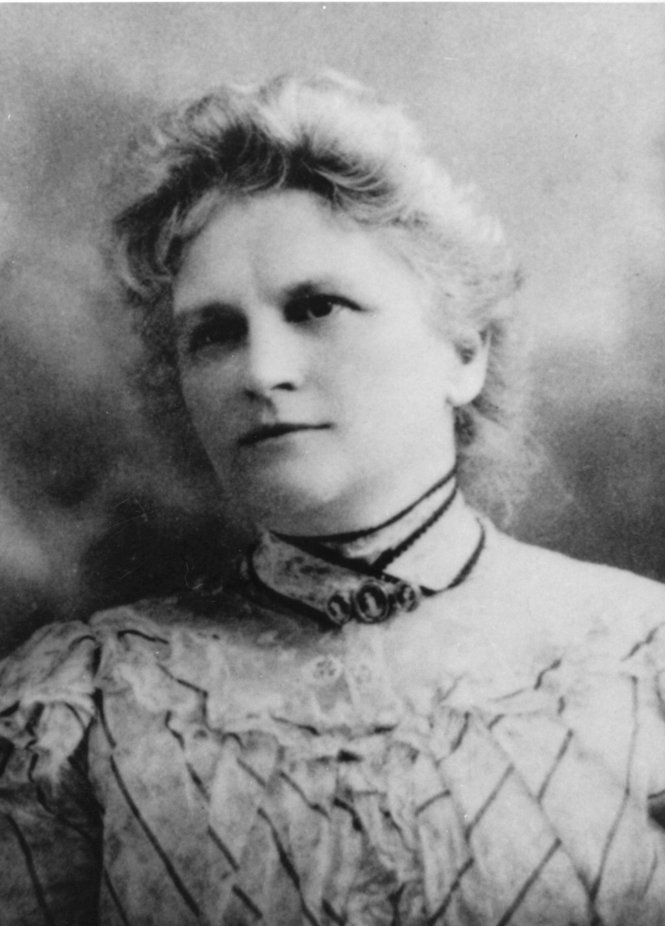
Kate Chopin and the Cult of True Womanhood. Brief essay in response to "What does Kate Chopin's 'The Storm' tell us about gender roles in the late 19th century?
While Kate Chopin's The Storm serves to juxtapose commonly herald viewpoints of 19th century gender roles, the story's themes and characters offer supposition regarding the true nature of sexual repression. During the time of this story's conception, the campaign of female inferiority held its greatest audience in what was commonly referred to as the Cult of True Womanhood. In The Storm, as well as in many other short stories, Chopin used the literary medium to counter, if not attack, the principle ideas behind the Cult of True Womanhood, often by twisting the syntax and semantics of etiquette with the nature of human emotion.
During the late 1800's, as a popularly accepted political agenda, the Cult of True Womanhood sought to define the gender roles throughout the paradigm shift of the (pre) Industrial Revolution. As the workload became more demanding, husbands began to spend more time away from the home. This, combined with the decreasing need for the individual family to supply its own raw materials, transferred the believed savage nature of physical labor to the cutthroat business world. Thus, women were meant for the home, as it was too brutal in the general world. This viewpoint differs from previously accepted gender role campaigns in that beforehand, women were thought to embody uncontrollable lustful impulses, which needed superior rational male guidance and authoritarianism to manage. The Cult of True Womanhood changed this perspective by initiating the belief that woman were the highest form of purity, void of impetuous sexual desires. In contrast, men actually possessed the uncontrollable lustful impulses. Therefore, woman, too gentle by nature, needed sanctuary (the home) to guard their susceptibility to the lust of men.
Four ideals cornered this new approach: Purity, Piety, Submissiveness, and Domesticity (Lavender, 2). According to the doctrine of the Cult of True Womanhood,
More North American
essays:
The Fate of the Indirect Feminist: Susanna Rowson's "Charlotte Temple"
... expressed human emotions that in the eyes of society at the time were ... soclinks/gender.html (November 18, 2005)Gibson, Charles Dana. No Time for Politics, 1910. The Cult of Domesticity and TrueWomanhood ...
Theory/Novel Paper: Challenging Barbara Welter's "The Cult of True Womanhood: 1820-1860" through Gloria Naylor's Mama Day
... the gender roles within George and Cocoas relationship, strong aberrations from stereotypes, and the re-conceptualization of matriarchal power. By taking these steps, Naylor efficiently casts aside the image of a docile, inferior, submissive ...
Analysis of Herbert Gorman's "The Absolved, the Redeemed, and the Damned: A Triangle", in response to Nathaniel Hawthorne's The Scarlet Letter".
... the emotions and hardships Hester and Dimmesdale face to matters occurring in present times. Personally ... ambiguity; and Hester symbolizes forbidden passion and the struggle of the individual vs ... minister and a married woman, but the story of the power of guilt and the nature of ...
The comparison of the author's use of imagery of trees in "Heirs to the Past" and "The Dark Child" by Camara Laye
... his families' traditions. This is a reoccurring image of the cyclic process of life, however the trees also act as a connection between the environment and human beings ... the role of the Seigneur in Driss' life, Driss' emotions towards the Seigneur, and as ...
"Whose afraid of Virginia Woolf?"-'What this play demonstrates is that power ultimately lies neither in physical strength nor in emotional pressure,but in communication'.To what extent do you agree?
... the time when true power is shown to lie in communication and in immense emotional pressure ... succeed and demonstrates how the same desire can destroy one's self-esteem and individuality i ...
What does the novel "Wise Children" have to tell us about paternity and maternity?
... the role of their mother. Carter criticises the irresponsibility of fathers through her choice of narrator, Dora, whose father, Melchior denies the twins as his children and regards them as his nieces. His selfish and insensitive nature is ...
Reader Response to "The Awakening"
... the family". I have always tried to be true to myself and never ... that Edna saw it as a place to seek sanity away from the distractions of the people she cared for. After ...
In the following essay, I will examine the development of Plath's poetry through analysis of major themes and imagery found in her description of landscapes, seascapes, and the natural world.
... such literary conventions and created a personal verse form which still retained some of the basic elements of her earlier 'academic' style. She turned the three-line stanza of the villanelle into a highly flexible medium. Freed ...