Lee's Conveyance of the Truth.
The themes of a novel are the main ideas that the author presents. In "To Kill a Mockingbird", Harper Lee explores several themes, besides the dominant issue of racial prejudice. The author takes the reader through the childhood of Scout, the narrator, and her brother Jem, in Alabama during the 1930s. The reader analyzes the innocence of children as they grow and develop to maturity, while learning painful, important lessons in life. As they develop, Scout and Jem put their lesson to practice and discover adult prejudices and the cruelty of one man toward another.
"Everyone is born innocent, it is society that corrupts him". Jean-Jacques Rousseau, a French philosopher, proposes this explanation of the evils of human beings. In "To Kill a Mockingbird", the story is narrated through the eyes of Jean-Louis Finch, a young, naturally impulsive girl, from a perspective of childhood innocence.
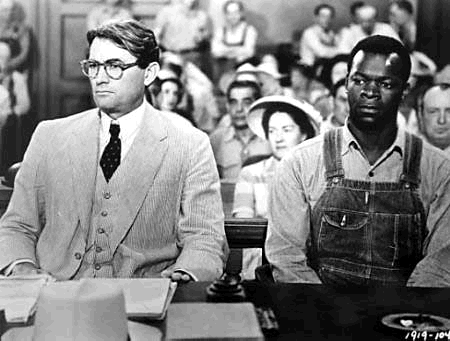 Screenshot of To Kill a Mockingbird(an American mo...
 President George W. Bush awards the Presidential M...
 Film producer Alan J. Pakula with Lee; Lee spent t...
In Part I, Scout, Jem, and their summer friend Dill, assume that people are good because they have never seen evil. In Part II, the children confront evil, more specifically racism, and must incorporate it into their understanding of the world. Harper Lee shows respect for children and their goodness. According to the author, they are incapable of understanding adult prejudices and cruelty. During Mr. Gilmer's cross-examination, Dill is shocked and disgusted by the unfair way Mr. Gilmer treats the innocent Tom Robinson, a black, honest man. Mr. Raymond, an unpopular man with mixed children, comforts the crying Dill, " 'you're children and you can understand it,' he said. 'Things haven't caught up with that one's instinct yet. Let him get a little older and he won't get sick and cry. Maybe things'll strike him as being-not quite right, say, but he won't cry, not when he gets a few...