King Oedipus, not the hero everyone thinks he is.
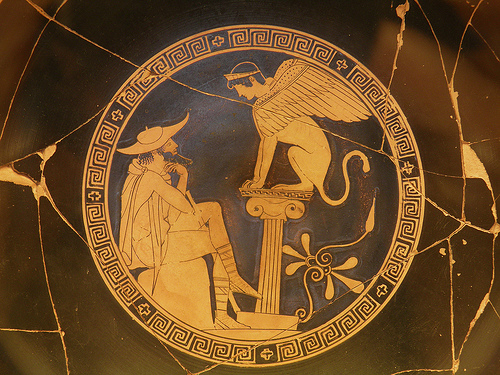
'It was you, we remember, a newcomer to Cadmus' town, that broke our bondage to the vile Enchantress. With no foreknowledge or hint that we could give, But, as we truly believe, with the help of God, You gave us back our life. Now, Oedipus great and glorious, we seek your help again.' King Oedipus, the greatest and noblest of all men, is once again being called upon by the Thebans to save the polis from disaster. The Chorus holds Oedipus as the object of universal adoration, but is he really the greatest Theban king ever? Why is it that the chorus neglects to mention any of Oedipus' great contributions to Thebes, except that of defeating the Sphinx. If he were an excellent leader, it seems curious that the only notable thing about his kingship was an act that took place fifteen years and four of his children ago. Was it really Sophocles' intention that we regard Oedipus as a 'good' man? Oedipus accuses Tiresias and Creon, two innocent men, of conspiring to dethrone him and take over the country. Would a 'good' man do this, lacking any evidence but his own suspicions? Would a 'good' man wish his own brother-in-law dead when no one could even testify to his guilt? Would a 'good' man threaten a timid shepherd with pain and death merely because he was hesitant to reveal the harsh realities of Oedipus' life? Oedipus' tale of meeting Laius is another troubling point. In Colonus he states in plain terms that King Laius would have murdered him had he not killed Laius. In his initial speech to Jocasta on Laius' death he tells a different story. It sounds as though he provoked, or at least escalated, the attack on him, striking the first real blow instead of going...
More Mythology
essays:
Gilgamesh, the epic of
... city, great and small, are not silent; they lift up the lament, all men of flesh and blood lift up the lament. Fate has spoken..."(p. 119) This shows that the King was ... not grant. Enlil said to Gilgamesh "you were given the Kingship, such was your destiny, everlasting life was not your destiny ...
Oedipus the king, all about how the events of Oedipus the King prove that God's will overcomes men.
... The King Oedipus, the king of Thebes, is the main character of Oedipus The King. Creon is the brother of Jocasta and next in line to be king. Tiresias is a blind prophet summoned by Oedipus and can ... control the fate of man. The events of Oedipus the King prove that God's will overcomes men. "...YOU ...
Literary Analysis of Sophocles', Oedipus the King
... beginning Tiresias attempts to tell him that he is responsible Oedipus refuses in his pride and self-confidence to believe him and accuses him and Creon of conspiracy and treason ... aptitude and intelligence has conquered the Sphinx and earned the throne of Thebes. His determination and unwillingness ...
Tragic Heroes vs. Mythic Heroes.
... of Thebes (Sophocles 591-592). He later accuses Creon and the old prophet Tiresias of treason after they warn him to stop his search (600-602). Even later, Oedipus ignores ...
Oedipus' Diary entry at the end of Oedipus REx
... country and killed our people? It was I, Oedipus that solved the sphinx's riddle and saved Thebes. It was Oedipus not ... the king was in a simple horse drawn carriage and that there were only five men in ... safe. Creon and Teiresias must have stumbled on this prophecy and decided ...
How Oedipus causes his own self-destruction in "Oedipus the King" by Sophocles
... play "Oedipus Rex" by Sophocles is a tragedy in which the main character, Oedipus Rex, killed his father and married his mother. Approaching the end of the play, Creon, now the King of Thebes, said to Oedipus, "Think ...
Oedipus' dislikeable qualities do not change throughout the books Oedipus Rex and Oedipus at Colonuss
... downfall. Tiresias and Creon bear the wrath of Oedipus' temper once he first hears what Tiresias says. This defilement of the word of Tiresias, who ...
Oedipus Rex is filled with many moral themes that question the ideas of sin, guilt, and destiny.
... destruction./Men of Thebes: look upon Oedipus. This is the king who solved the famous riddle and towered up, most powerful of men. No ... of his life the number of plays totaled over 120. Sophocles died in 406 BC and seven of his plays have survived in their entirety. One ...