Essay on Knowledge Management.
This essay will attempt to illustrate Knowledge Management theories provided by researchers and give evidence on how organisations attempt to utilise these theories to gain a competitive advantage in order to critically appraise the following statement: "Despite the widely recognised importance of knowledge as a vital source of competitive advantage, there is little understanding of how organisations actually create and manage knowledge dynamically" (Nonaka et al 2000).
Knowledge management (KM) is emerging as the new discipline that provides the mechanisms for systematically managing the knowledge that evolves with the enterprise. Most large organisations have been experimenting with knowledge management with a view to improving profits, being competitively innovative, or simply to survive (Nonaka and Takeuchi 1995, Prusak 1997, Wigg 1997, Hendriks and Virens 1999, Loucopoulos and Kavakli 1999, Davenport and Prusak 2000, Gao et al. 2002). Furthermore, exploiting technology enables organisations to derive knowledge from data and information collected as the business proceeds.
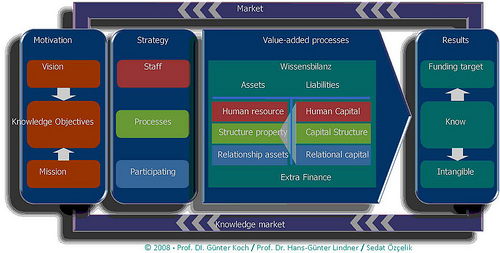 Knowledge balance sheet - accounting knowledge
 English: Msheireb Enrichment Centre, moored off Do...
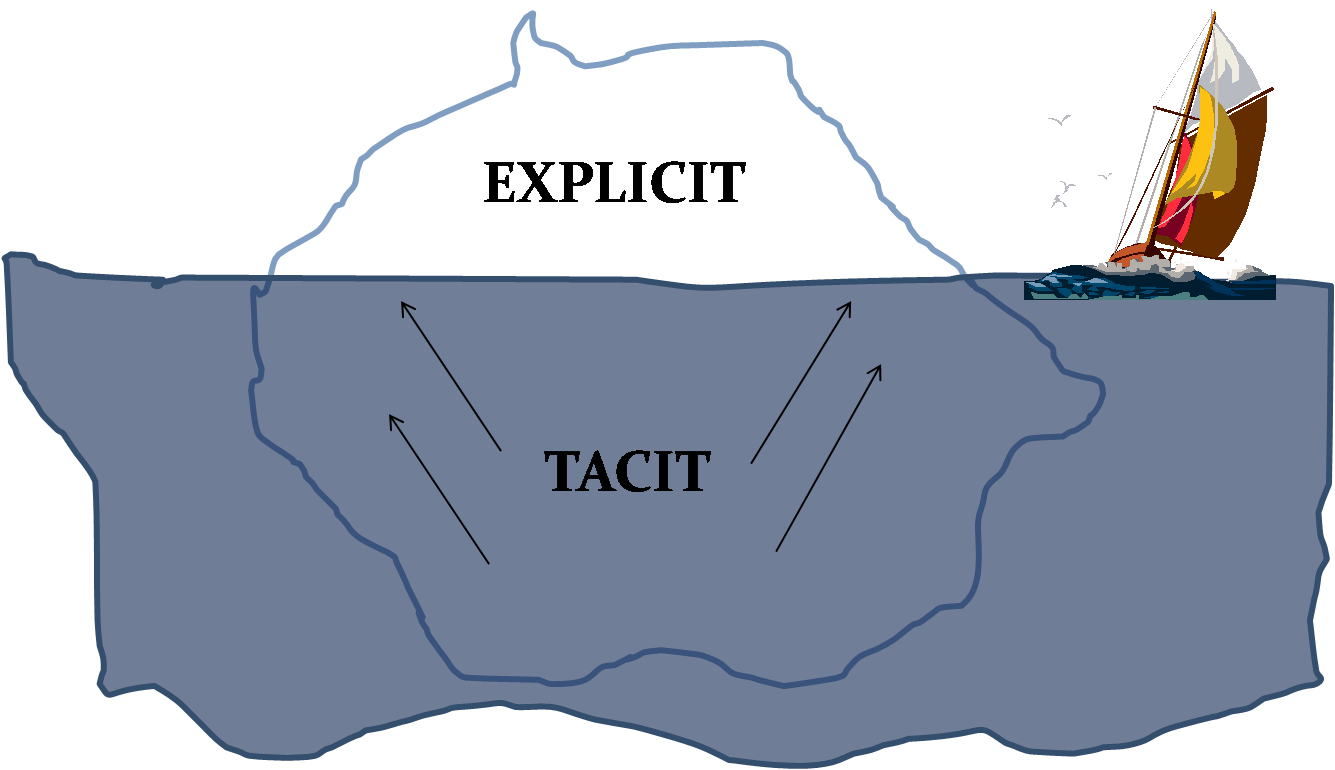 English: Tacit knowledge vs. Explicit knowledge Ro...
Knowledge may then be exploited in decision-making, product development, human resourcing, customer relationships, the supply chain and so on. Clearly, knowledge management needs to infiltrate every aspect of the enterprise to improve business efficiency.
"Knowledge is a fluid mix of framed experience, values, contextual information,
and expert insight that provides a framework for evaluating and incorporating
new experiences and information. It originates and is applied in the minds of
knowers. In organisations, it often becomes embedded not only in documents or
repositories but also in organisational routines, processes, practices, and
norms".
Davenport and Prusak (2000)
In the literature on KM, there is much debate about what constitutes knowledge, what is data and what is information. Most literature on KM classifies knowledge into two main categories: explicit knowledge and tacit knowledge. Explicit knowledge can be defined as things that are clearly stated or defined,
intext citation
a lot of references in the reference list are not incite for eg kingston (2002) this is just one exmaple.
0 out of 0 people found this comment useful.