Korean Brief Economic History and Government Policy
Brief Economic History and Government Policy
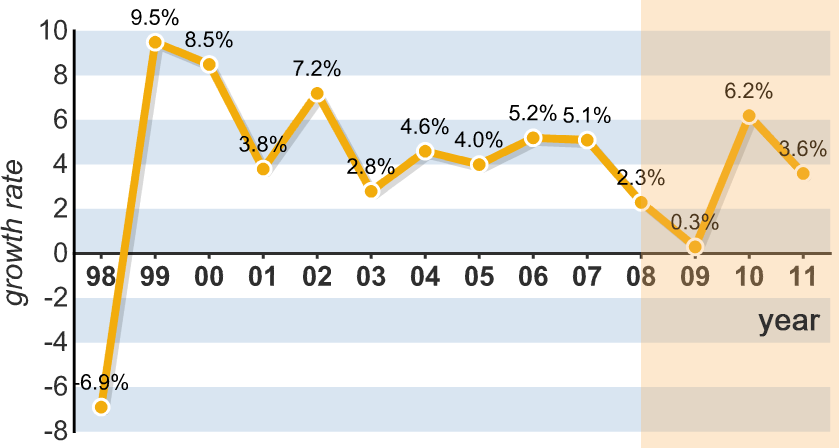
Korea was one of the poorest countries in world after experiencing two wars. World War II and Korean war (1950 ~ 1953). The country even experienced a food shortage so that it had to heavily rely on the foreign aid. Yearly per capita consumption was a mere $88 as late as 1965. However, since 1965, Korea has been transformed from its underdeveloped agricultural economy to a leading Newly Industrializing Country. Between 1965 and 1981, its gross national product GNP multiplied twenty times from $3 billion to $63 billion and per capita GNP increased sixteen times from $88 to $1,554. There have been many explanations for Korea's successful story. Among those, the strong role of government would be probably the most important one. At the same time, this would be also responsible for current recession. After Koran war, the government in fact had no sense of direction and also due to the unstable political situation, the country didn't have specific economic policy until 1961 when military government came to power and established the major institution guiding its economic planning called Economic Planing Board (EPB). This government set economic development as the top national priority and recognized the financial system in support of economic development plan. To achieve this purpose, it focused its policies mainly on export expansion moving its emphasis from import substitution. The result was considered quite successful for economic growth. Between 1965 and 1973, exports grew at average annual rate of 45%, from $175 million to $3,271 million. The success of the expansion was due primary to three factors (Kwack, 72). The first was a favorable international economic environment, which saw total world imports expand from $175 billion in 1965 to $536 billion by 1973. This boom in imports of the world reflected...
Reviews of: "Korean Brief Economic History and Government Policy"
:
More Economic History
essays:
Korean Economic History and Government Policy
... per capita consumption was a mere $88 as late as 1965. However, since 1965, Korea has been transformed from its underdeveloped agricultural economy to a leading Newly Industrializing Country. Between 1965 and 1981, its gross national product GNP multiplied twenty times ...
China: Economic growth and Regional Development.
... features of capitalist economies. The communist party gives several ideological justifications for these changes. APPENDIX Exhibit 1: Ranking of Chinese provinces by GDP per capita Exhibit 2: Share of Agriculture, Industry ...
Mercantilist economic theory and policy, interconnected with wider political issues.
... Mercantilist economic policy would also dictate that through an understanding of The Balance Of Trade Doctrine, states aiming to build a strong and wealthy nation would require a close association between governmental authority and merchant interest. This would require government to ...
An essay on socialism with basic history and overview of different types of socialism including marxism, anarchism, and utopian societies
... Second World War and the cold war lead to the founding of a Socialist Superpower of the USSR. After the fall of the Soviet Union, new socialist democracies appeared in formerly capitalistic countries such ...
Russian economic situation before 1917 and nowadays.
... independent of government. But in general, limitations to entrepreneurship remained very important on this period, especially for private companies, which had still many difficulties to compete with state owned companies that kept managing strong businesses. So, to sum up economic situation ...
The Neo-Malthusian Population theory assumes that poor nations will never be able to rise much above subsistence levels unless they engage in preventive population checks, if not positive checks.
... over time hence giving a chance to all countries in escaping the Malthusian population trap. The second criticism of the trap is that he assumes that national rates of population increase are directly related to national per capita income ...
India (emerging market).
... independent nations. The apparent success of communist countries like the Soviet Union and China seemed to show the way. Like the Soviet Union, India had used central planning (is an economy where all economic decisions are made by the government, eg ...
Capitalism
... prosperous nations. USA, a capitalist nation has the worlds biggest gross national product. After World War II Germany was divided into West Germany and East Germany. This land had same of everything ...
Informative, but..
Format it, please. A bit tiring, isn't it, to have to read through over 2500 words? :)
0 out of 0 people found this comment useful.