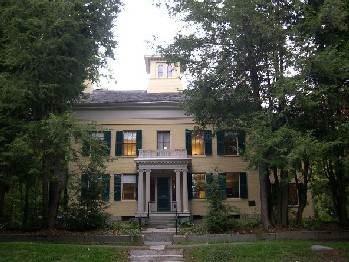
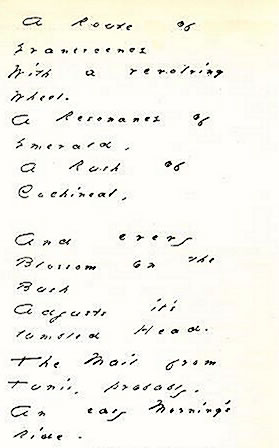
The Life and works of Emily Dickenson.
One of America's most well respected poets is Emily Dickinson. Although she never personally received credit for her work, it continues to receive great recognition today. Through her successful poems we get a better idea of her life, views on religion, and feelings about love.
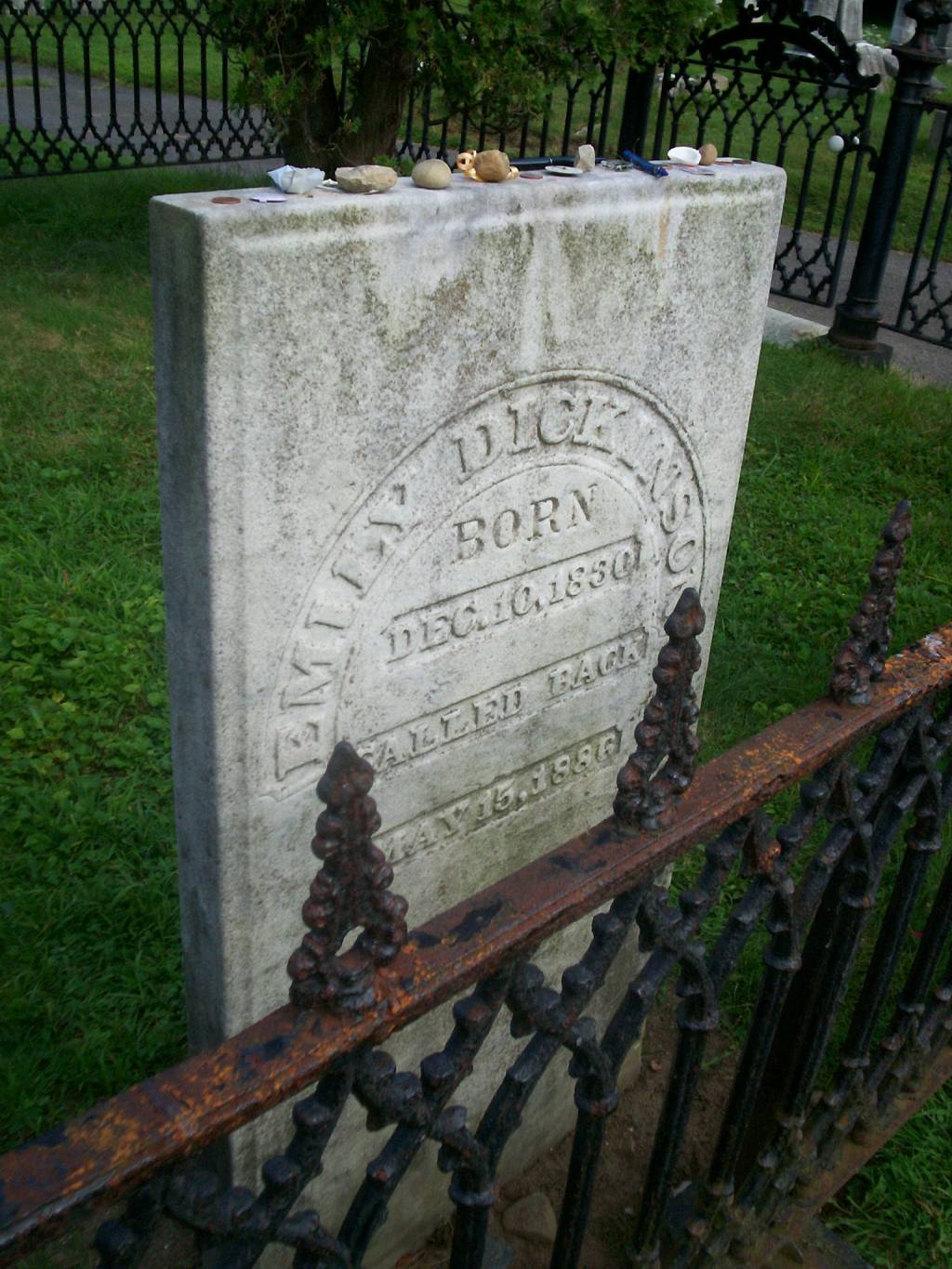
Emily Dickinson was born on December 10, 1830 in Amherst, Massachusetts. Her father, Edward, was a lawyer, legislator, and Calvinist. He was a stern religious man who required his family to attend Sunday School. In her late teens, Dickinson refused to call herself a believing Christian. She spent numerous years at a primary school and also studied classics at Amherst Academy. As a youthful teen, she lived an average and active life. This is when she began writing poetry consisting of occasional verses and valentines. She enrolled at South Hadley Seminary for Women, but withdrew within a year due to ill health. After her departure from school she returned home to spend the rest of her life maintaining family and household duties.
Several of Emily Dickinson's friends were men. In 1848 she met Benjamin Newton and he became her guide for reading. That soon ended due to his marriage and sudden death from Tuberculosis in 1853. She then met Reverend Charles Wadsworth in 1854, which she referred to as her "dearest earthly friend." Over the eight years she was in close contact with him her writing increased, but it grew drastically after he moved to
Reynolds 2
San Francisco in 1862. Soon after Wadsworth's exit from her life, Dickinson began spending time with Thomas Higginson. He was a Civil War hero and literary critic who she sent some of her writings to. He began to make her feel as though he was ridiculing her work. Some critics believe that his pessimistic response to her work...
Reviews of: "The Life and works of Emily Dickenson."
:
More Poetry
essays:
The similarities and differences of four poems: "Lucinda Matlock" by Masters, "Chicago" by Sandburg, "Richard Cory" by Robinson, and "We Wear the Mask" by Dunbar
... a poem about an aristocratic man that under- appreciates life, and, as a result commits suicide. The narrator talks about how envious he/she is of Richard Cory ... inner selves behind a barrier of a fake personality. In the poem, Dunbar writes: "Nay, let them only see us while/ We wear the mask/ We ...
The Life And Times Of Grace Marks
... complete her job and please her employers. To Grace, life was about being a servant, for this is all she has ever known. Serving others and making them content was her primary goal. While in prison, Grace was able to reflect ...
Comparison of Blake's "Songs of Innocence and Songs of Experience" both poems included
... of life. The bard may ask him to 'return' but that simple act of 'returning' will not erase his memory. He has seen the experience, the 'starry pole'. No matter what happens, he will now always know experience. The next poem ...
The Causes And Effects Of A Fairy Tale Called "Rum
... servants to be worried and help her out by looking for new names all over the kingdom. By doing this she got a great effect and was able to guess his name. When the miller’s daughter said his name he ...
This essay compares the common theme of death in two poems by Emily Dickinson, the poems are "I hear a fly buzz when i died" and "because i could not stop for death"
... American poets is Emily Dickinson. Dickinson deals with many themes and tones in her poetry however ... the poem "Because I Could Not Stop For Death" Dickinson is again writing in the first person and she also ...
Robert Frost's life and how it affected the writing of his poem "design"
... high school that he became interested in reading and writing, and although he attended both Dartmouth and Harvard he never earned a formal degree. Frost married and had four children. He wanted to write poetry, but ...
Emily Dickinson's "Because I Could not Stop For Death" "Write a poetry response, noting the imagery and language of the text
... Emily Dickinson- Because I could not stop for Death This tranquil and nostalgic poem has a slight eerie feeling to it and shows how the writer of the poem is so accepting of death. Many parts of this poem include ...
How Robert Blake writes of innocence by using biblical allusions, symbolism, and rhythm to convey a child's view of the world and religion in his poem "The Lamb"
... his poem, "The Lamb," Robert Blake writes of innocence by using biblical allusions, symbolism, and rhythm to convey a child's view of ...
Hey
don't waste space putting this in your website is has no use
1 out of 1 people found this comment useful.