Abstract
This research examined the media and how it affects fitness and body image. This was assessed by collecting data from surveys taken by three groups of ten high school students, five of each sex. Two of the three groups were exposed to different media packages, one depicted images of unnaturally thin individuals, the other depicted athletic figures, while the third group was exposed to no prior data. The results indicate the students attitudes towards social fitness views and self-acceptance. It was my hypothesis that a correlation between media and the fitness concept will be found but the idea of a personal body image will remain fixed as body image is a determined part of one's psyche. A significant correlation was discovered between those who viewed the thin package and their attitudes on social fitness. However a low score in the self-acceptance scale in all three groups suggests a low self-concept within all participants.
 individual -v- group
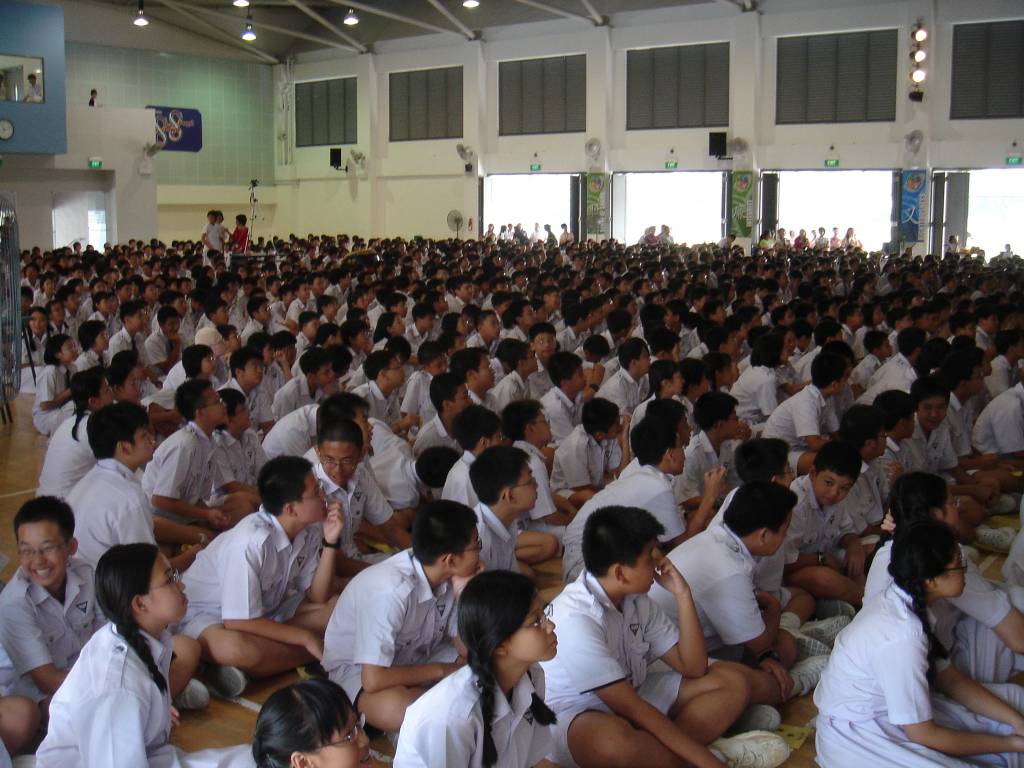 Students of Nan Hua High School gathering in the S...
 Japanese school uniform, Yohohama, Japan
This supports my statement that there would be a connection between the fitness concept and the media packages as well as a constant self-concept maintained by all participants.
Linking Media with Fitness Perceptions:
A Study on the Affect of Media on
Fitness and Body Image
In assessing personal attitudes it is often important to measure not only what an individual feels towards others but also his/herself. Prior research indicates this is especially important when measuring attitudes towards physical issues. It has been found that opposing views may be held simultaneously by individuals in regards to themselves and others. Also concern for how a response will reflect upon his/herself may negate an individual expressing his or her true attitudes. This research sought to assess the attitudes of high school students towards fitness and body image in the presence of different physical media icons. By monitoring the...