At a young age, John Milton was convinced that he was
destined for greatness. He thought that he 'might perhaps leave
something so written to aftertimes as they should not willingly
let it die'(Text 414). For this reason he thought that his life
was very important to himself and to others. He often wrote
directly about himself, and he used his life experiences as roots
for his literature. In Paradise Lost and in a sonnet entitled
'On His Blindness,' Milton speaks indirectly and directly of his
loss of vision. Also in Paradise Lost, he uses the political
situation of his time as a base for the plot, and he incorporates
elements of his own character into the character of Satan. In
'On Having Arrived at the Age of Twenty-Three', he speaks plainly
about the course of his life.
In the latter part of his life, Milton lost his vision.
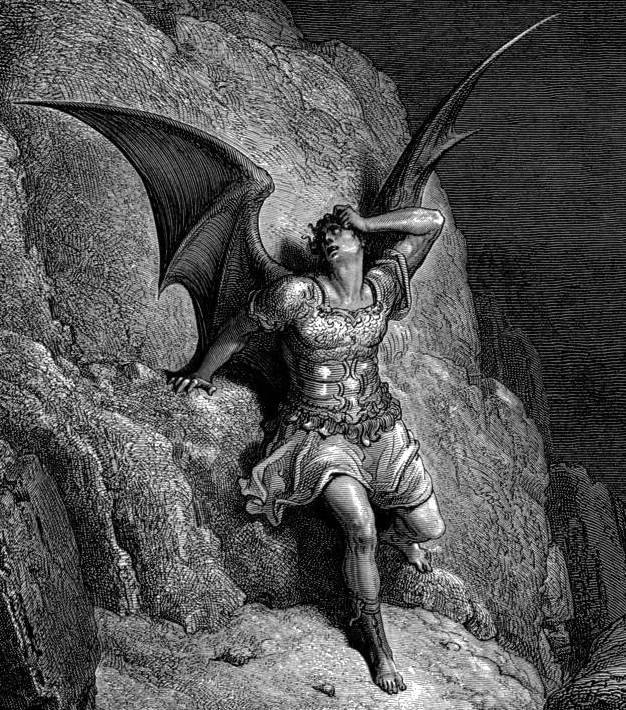 Gustave Doré, Depiction of Satan, the antagonist ...
 Satan on his way to bring about the downfall of Ad...
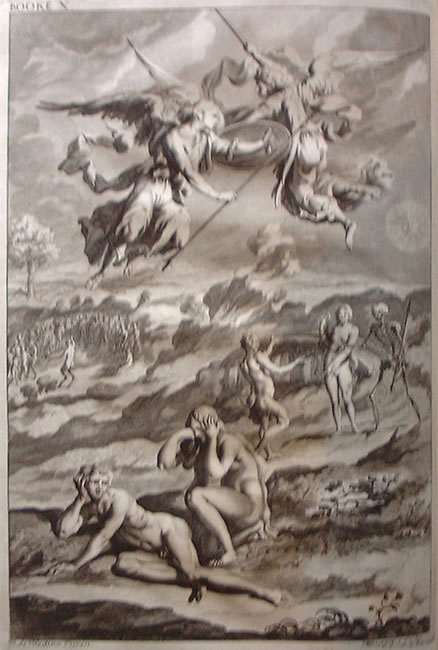 Engraving by Michael Burgesse after John Baptist M...
This loss was very traumatic for him because he had not yet
completed his mission of writing a memorable work of literature.
Soon after, he continued his work with the help of his daughters.
He dictated to them a sonnet he called 'On His Blindness' in
which he asks how God expects him to do his work blind. Milton's
ambitious side says that his writing talent is 'lodged with [him]
useless'(Text 417). His religious side soon realizes that he is
'complaining' to God and he takes it back. He discovers that God
will not look down on him if he does not write a masterpiece. He
granted Milton a great talent, and he expects Milton to be happy.
He has to learn to do his work in a dark world. This poem was
not the last time Milton referred to his condition in his
writing. In book one of Paradise Lost, while invoking the Muse,
Milton says 'what in me is dark illumine'(Hndout 22). He asks to
be granted the power to work through his blindness. He obviously
thinks of his blindness as a major weakness. Later in the text,
he describes Hell as having 'no light, but rather darkness
visible'(Hndout 270). It is Milton's way of almost subliminally
implying that his condition is comparable to being damned to the
underworld. His blindness was something that he constantly had
to deal with and he managed to include it in most of his works.
At the prime of Milton's life, the political situation in
England was very unsteady. Charles I was overthrown, and the
Puritan dictator Oliver Cromwell installed himself as the 'Lord
Protector.' Being a Puritan himself, Milton supported this new
government, and he even held a job within it. But, England
became tired of the strict Puritan rule, and Cromwell's son was
defeated, and hastily replaced by Charles II. Everyone who
supported Cromwell and the civil war was sentenced to death.
Because of his standing in the community, Milton was allowed to
retire in peace. As punishment he lost everything he had
including his reputation. He would use the events of his life to
help him form the story for book one of Paradise Lost. In his
greatest work, Milton begins with a civil war in Heaven during
which Lucifer and Beelzebub are defeated and banished to Hell.
This event parallels the civil war within England with the
Puritans as Lucifer, and the rest of England as God. The
Puritans tried to take over England, but they were defeated after
a number of years. Most of the Puritan's were killed, Milton was
banished from society. Lucifer was banished to Hell, and he
would forever lose his reputation as an archangel. These
similarities lead scholars to believe that Satan is Milton.
Lucifer says that they should make a 'Heaven of Hell'(Hndout
280). This line shows that Satan had the will to work through
the bad times and make the best of it. Milton acted the same way
with his blindness. Milton seems to be a part of Satan's
character.
In book nine of Paradise Lost, Milton tells the story of the
temptation of Eve. Satan's argument with Eve reflects beliefs of
Milton. In deciding whether to convince Adam or Eve to eat from
the tree of knowledge, he does not choose Adam because he has a
'higher intellectual' capacity. At the time Milton lived, women
were considered inferior to men. Milton obviously supported this
belief. By modern standards he would have been considered
sexist, by seventeenth century standards he was not.
Also in book nine, concerning the forbidden tree, Milton
emphasizes the great knowledge that can be gained from eating its
fruit. Throughout his life, he thought that continually learning
was very important. He spent part of his life living at home
reading. Satan tells Eve that God does not want them to become
as knowledgable as he is. If she eats the fruit, he tells her
that she will know 'both good and evil'(Text 293). Milton's
emphasis on the acquisition of knowledge implies that if he was
put into Eve's position, he would also betray God. Milton
formulated an argument that would have convinced himself.
In the earlier part of his life, Milton was often worried
that he would not do the work that he was destined to do. To
express this feeling, he wrote a sonnet called 'On Having Arrived
at the Age of Twenty-Three.' In it, he explains how he is
getting older and he still does not have any work done. He was
concerned because he did not have an idea for what to write.
This work reflects his character because he could not think of
anything else but his life-long goal. He was very focused. It
also shows how he was egotistical. In his time, he was not well
liked. Due to his Puritan background and his egocentric
personality, he was not respected by more than a select few.
Throughout his life, John Milton believed that he would be
remembered as great. He was so self-absorbed that he was a major
part of a lot of his work. Also, he used his life and character
to formulate Satan and Paradise Lost. He thought he would be
remembered and he was correct.
This is certainly interesting....
Well, this was certainly interesting. I don't think that I agree with it completley. I am not versed in Milton's other works, but I do know a bit about Paradise Lost. I don't think that Milton intended his life to parallel Satan. The description of hell as utter darkness is because Heaven is seen as full of light; therefore, to have the complete opposite of Heaven is hell. Also, Heaven's light is joyous and darkness implies a sadness, a lack of joy... so this, I think, is a reason why hell is dark. I don't think Milton pitied himself over his blindness espeically considering he dictated to his daughter most of Paradise Lost. Anyways, that is just my opinion. This essay was well written though. You did a good job!
3 out of 3 people found this comment useful.