Math And Music
Math and Music. In thinking of these concepts, many people do not see any relation between the two. In reality, however, mathematics has a tremendous effect on music and they are closely intertwined. The relationship between these two arts, though it might be hard to connect at first, is, after a bit of study, unmistakable.
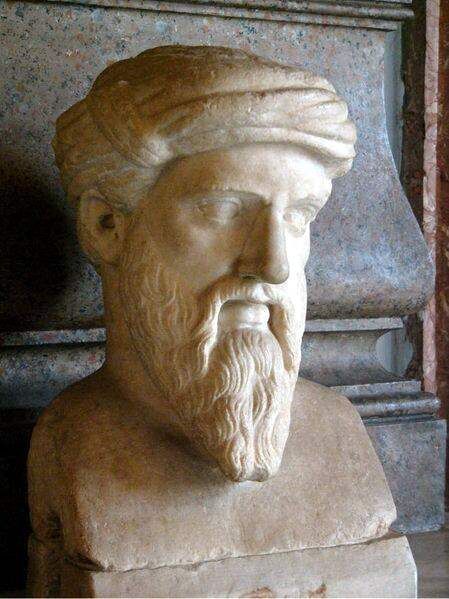
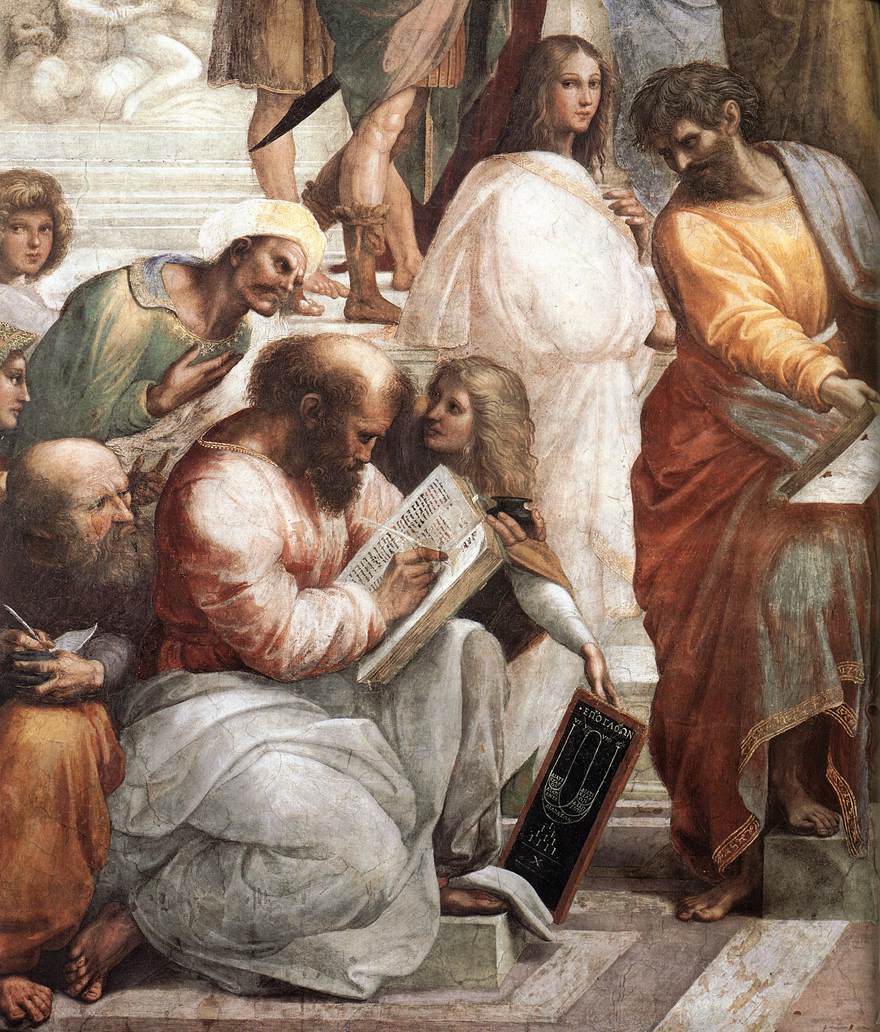
Pythagoras was the first to discover the mathematical basis for music. He discovered that there was a connection between the length of a string (such as on a guitar) and the pitch of its vibrating note. By conducting experiments with a musical instrument called a monochord, a stretched string with a movable bridge, Pythagoras found that the shorter the string, the higher the pitch (frequency). He then moved the bridge to shorten the string to half of its original length. He found that the frequency of the second note (shorter string) divided by the frequency of the first note (longer string) equaled a ratio of 2:1, and that string-length of the second note divided by the string-length of the first note the equaled a ratio of 1:2. Thus, he found that an octave (a note eight full tones above a given note) is obtained by shortening the string to one half of its original length, thereby doubling the frequency. Pythagoras also found that in addition to the octave, the fifth and fourth notes of the octave produce harmony, or are pleasing to the ear. To obtain these notes, the ratio of new length to original length should be 2:3 for a fifth and 3:4 for a fourth.
Interestingly, the strings of a violin are tuned a fifth apart, men and women often sing a fifth apart, and most harmony singing involves octaves and fifths. Another way to look at this is if you blow across a coke bottle and it produces the note F, and you drink enough so that the...
More Music History & Studies
essays:
Exploring the world of music: Music, sound & the environment
... in the characteristic sounds of musical instruments. And duration wich is how long a sound lasts. Music in the western society can categorize into four categories. Melody, rhythm, harmony and texture. Melody is a succession of pitches; it can be composed ...
Jazz & Popular Music.
... Also, musical instruments became more available. High quality instruments with wide ranges, consistent tone throughout the spectrum of pitch, good ... the culture, regardless of whether there is cause and effect relationship. And even when certain attitudes are predominant, there are always ...
Analyzing Music.
... The musical instruments used in each piece vary with each type of country music, but ...
Paper on The History of the Stringed Instrument to 1800
... four-stringed lute, one of the oldest Chinese musical instruments which ... and stretched over the bridge, fingerboard and to the pegbox, which houses four tuning pegs that are turned in order to raise or lower the pitch of each individual string. The strings were ...
This is a nice history of the guitar.
... a movable bridge with strings anchored by a tailpiece; and it was played with a quill or plectrum(pick). But this modern instrument soon ... time two new innovations in related fields were changing the musical instrument dramatically. The first advance the phonograph, actually dates back to ...
The History of the Guitar.
... a movable bridge with strings anchored by a tailpiece; and it was played with a quill or plectrum(pick). But this modern instrument soon ... time two new innovations in related fields were changing the musical instrument dramatically. The first advance the phonograph, actually dates back to ...
Math+Vibrations=Music.
... is math and so is the equation of a metronome. "Music is an expression of universal harmony, which is also realized in mathematics and astronomy," Pythagoras once ...
-Poulenc's adaptation of Gamelan Music- How far does inspiration reach?
... flute, strings and pianos. Obviously none of these instruments can be called percussive, however - as mentioned previously - Poulenc has managed to adapt the instruments he chose to the type of music he ...