The History of Federalism
The United States system of government is very important to the people of the United States of America, but many citizens do not know about the actual system of how our government works. The form that controls this country, allows the states and the federal government to share their powers equally, and allows our senators, governors, and even the President to be elected by the people that live within the United States is called Federalism.
According to Webster's Dictionary, "Federalism" is defined as "a system of government in which power and control is divided between a central authority and constituent political units." In the United States Federalism system, the states' governments would be the constituent political units (Berube 500). In lamens terms, the central federal government and all the states' governments are just about equally powered compared to each other.
The origins of the United States Federalism system dates back to the end of the Revolutionary War between the thirteen original colonies and the country of Great Britain.
 The Articles of Conferderation, ratified in 1781. ...
 The Articles of Confederation, ratified in 1781. T...
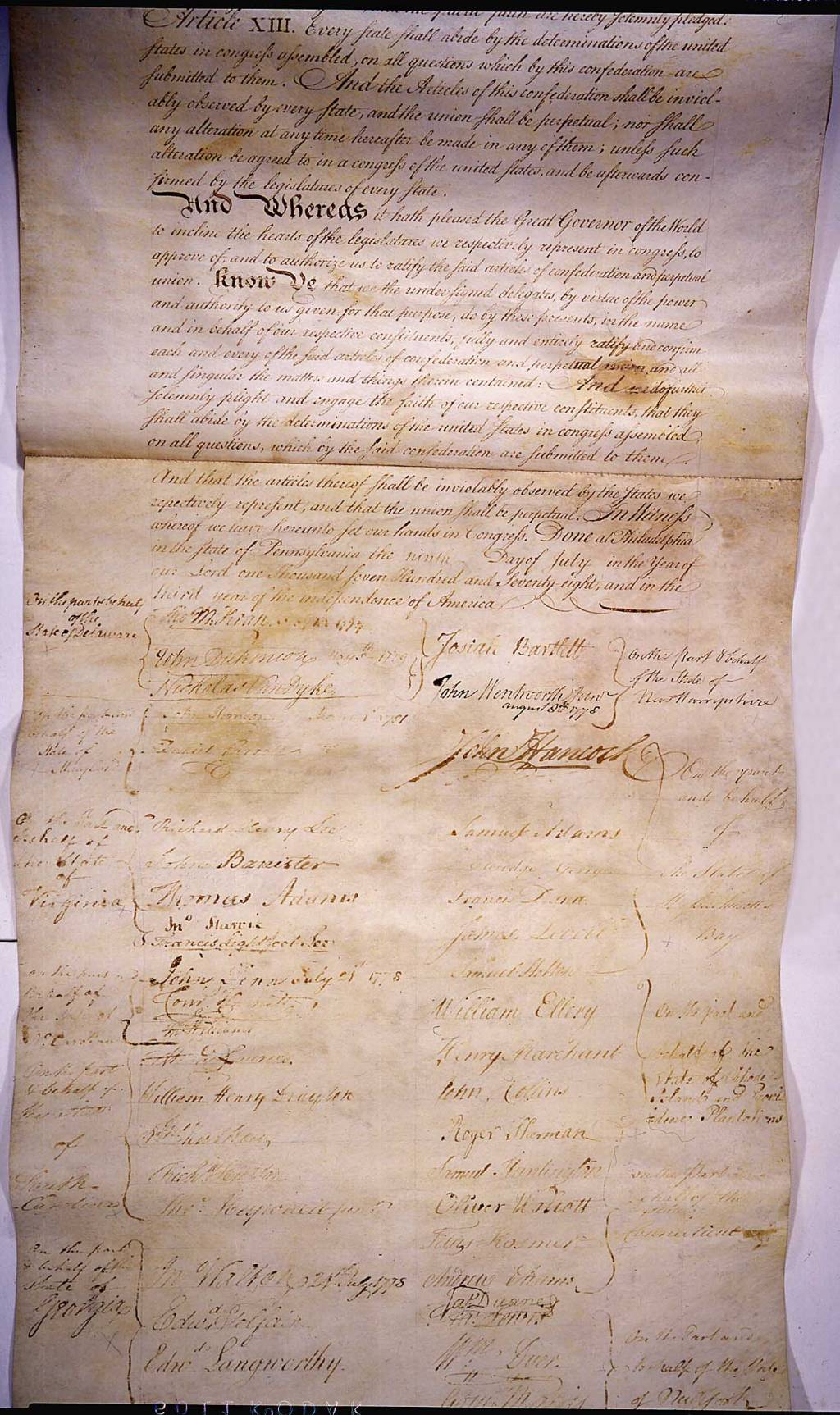 The Articles of Conferderation, ratified in 1781. ...
After the Revolutionary War, the new born country, the United States of America, began as a confederation, a loosely joined coalition where the states would have supreme power over all, even over the federal government. From 1783 to 1789, a weak federal government controlled the United States under the authority of the Articles of Confederation. The Articles of Confederation is actually the first document the United States had to use as a right of controlling the Republic. The Congress under the authority of the Articles of Confederation was so weak that it could not collect taxes. Congress could not collect taxes because the people feared of having another system of government that would be like Britain. All states, large or small, had only one vote each to decide...