Mitosis explanation, plain and simple....maybe write more about cytokinesis???
Mitosis
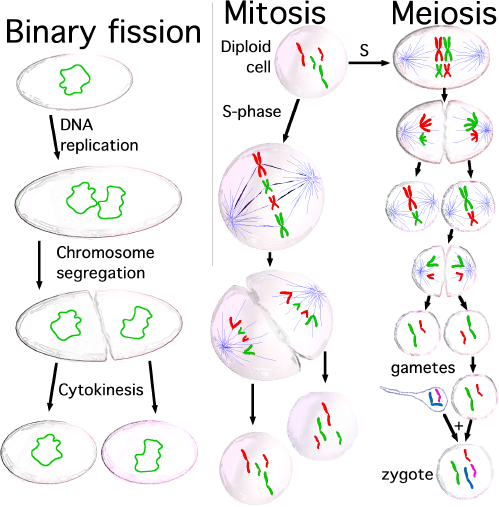
Mitosis is the process of a cell dividing. A parent cell divides to create two identical daughter cells, which are exact replicas of the original parent cell. DNA is replicated, and each daughter cell receives one copy of the original DNA and the cell goes through a process consisting of 4 steps called mitosis.
Interphase, which isn't part of mitosis, is the "stage" when the cell is not in the process of dividing, but DNA is being replicated. Interphase itself has its three phases, G1 phase, S phase, G2 phase. During G1 phase, the cell grows in size in preparation for cell division. During S phase DNA is synthesized and copied for cell division. In G2 phase, DNA has already been synthesized and the cell continues to make proteins and grow for cell division.
Prophase, the first stage of mitosis, is when the proteins begin to condense in the cell and the replicated DNA prepares for division. During early prophase, the nucleus disappears. Also the chromatin (DNA) coils into chromosomes, with each identical pair of chromosomes being attached in the center by a centromere. Centrioles move to the poles of the cell. During late prophase, the nuclear envelope disappears and the centrioles at the poles of the cell release spindles which will go to attach to the kinetochores, which are small specific regions of a centromere designed for attachment to the spindle apparatus.
In metaphase, the centrioles are aligned with each other at the top and bottom of the cell, and the pairs of chromosomes are aligned in the middle of the cell, known as the metaphase plate. The chromosomes move around until their kinetochores attach a spindle fiber to each chromosome.
During anaphase, the sister chromatids split and migrate to the poles of the cells. Each chromosome is...
Reviews of: "Mitosis explanation, plain and simple....maybe write more about cytokinesis???"
:
More Human Biology
essays:
Genetic Disorders and they become what they are.
... the early stages of embryo development. When this happens some of the cells in ... percent of cases. Mosaics only occurs in one percent of all Down syndrome cases. It is when cell division in faulty in one of its earlier stages after ...
The Endocrine System and its role in life: Summarized blood glucose, adrenaline rush and sex hormones
... that is a lack of glucose. The Sex HormonesEarly stages of male hypothalamic maturation seem to be very similar to the early stages of female puberty, ... glucose into glycogen. This is known as glycogenesis. It forces most of the bodys cells to take glucose from the blood which decreases the glucose ...
Transitional cell carcinoma of the bladder. causes, treatment, staging, metabolism, extracellular matrix's role, angiogenesis, cell cycle, gene regulation, tumor suppressor genes, and oncogenes
... copies of the genome into the daughter cells and then divide. This cycle must be regulated by complex molecular interactions. Each phase is executed through a precise predetermine timetable. The cycle is divided into 4 phases, namely G1-a ...
How to make a human
... and Mitosis are methods of cell division in human cellsMitosis occurs in body cells forming identical daughter cells from a parent cell both with the full number of chromosomes. Meiosis occurs in sexual reproduction forming 4 daughter cells each ...
All about cancer.
... overgrown nucleus with less or more chromosomes or abnormal genes. 1 Cell Division (Mitosis) Steps: Division begins: one pair of centrioles duplicate. Division begins: one pair of centrioles ...
The humane genome project
... DNA in a sperm or egg of a future embryo. This could be to add or take away the sequence of a gene, or to add an entire artificial chromosome. Intervention at the egg or sperm stage means that every cell ...
Mitosis & Meiosis
... new cell, resulting in two daughter cells. The cytoplasm then begins to divide, called cytokinesis. The difference between mitosis and meiosis I is the pairing up of homologous ... In mitosis, cells divide in four steps. First, they go through prophase. In prophase, the centrioles begin to move apart ...
Mitosis and Meiosis
... mother cell is maintained in both the daughter cells. Therefore it is an equational division. Original characters of the chromosomes are maintained in the daughter cells. Daughter cells are ...
Pretty good
It's a quite good and simple explanation of mitosis, but since we are talikng about mitosis you might want to explain meiosis as well.
Since you had a little intro before going to interphase, you could have a small conclusion as well.
Otherwise it was very good. Easy to understand.
1 out of 1 people found this comment useful.