Obediance and Deindividuation
Abstract
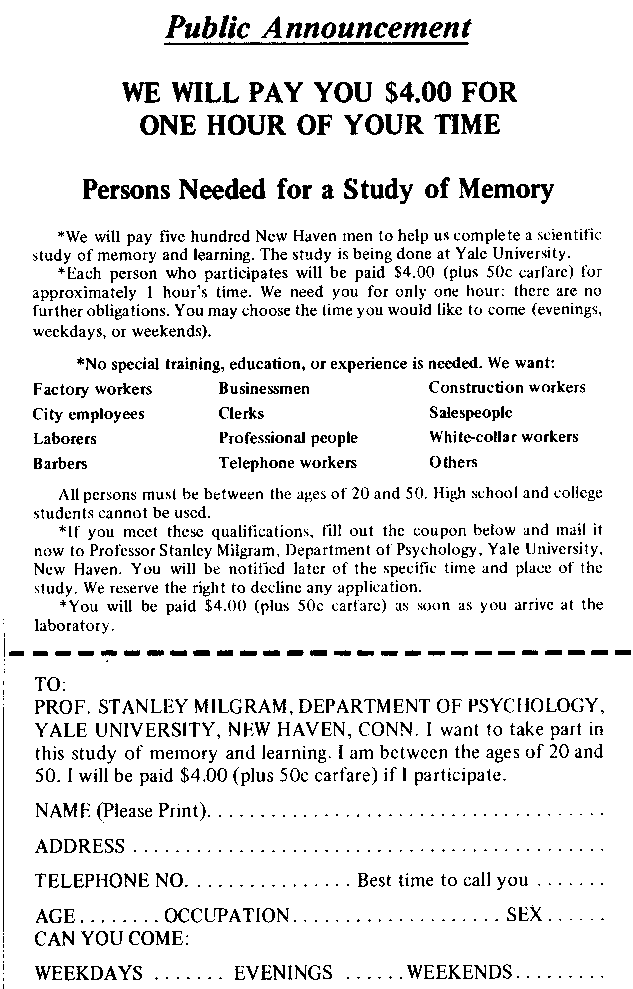
Most, if not all humans, have some ethics and morals, which help the individual make distinctions between right and wrong. Therefore, in most situations human beings behave in accordance with their morality. Studies on notions such as obedience to authority and deindividuation have shown that in some cases, an individual can be made to act in direct opposition to their morals and ethics. Studies conducted by Milgram (1963) on obedience have shown that if an individual is ordered to do something by someone who is perceived to be in power, it is possible that they will do it, even if it is something the person does not believe is right. Also, studies conducted by Zimbardo (1973) on deindividuation have shown that a normally healthy, intelligent person can lose their identity in a crowd, and commit acts of violence and aggression which they would not normally commit. According to the deindividuation theory, this is because the individual feels that they can no longer be singled out and held personally responsible for behaviour. The studies conducted by Zimbardo (1973) and Milgram (1963) have been examined and compared in this essay.
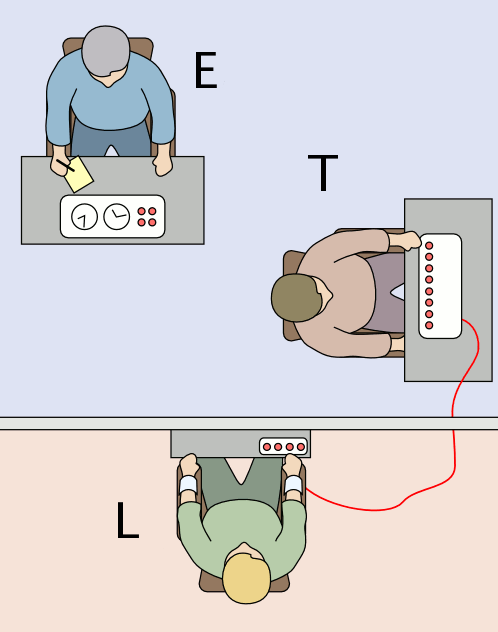
The notions of obedience and deindividuation have been the subject of some very informative and sometimes disturbing research by social psychologists. Obedience is defined by Moghaddam (1998) as: "changes in behaviour that arise when people follow the instructions of persons in authority." Our tendency to comply with authority figures can be surprisingly strong (Bourne & Russo, 1998). Experiments on the subject, particularly those conducted by Milgram (1963) have shown that though obedience is, in many forms positive, it can also be extremely negative, instigating individuals to commit acts of violence or aggression, of which they would not normally partake.
Deindividuation is defined by Moghaddam (1998) as: "The loss of one's sense...
More Psychology
essays:
Relationship between Optimism and Subjective Well-Being
... minutes of their time, therefore, there would be little to no interference with their daily lives. Every subject was treated ethically and most ...
Aggression-Discuss the Three Psychological Approaches According to Freud, Skinner and Rogers(Psychodynamic, Behaviourist and Humanistic Theories)
... begins, and the superego, which represents the moral aspect of humans according to society's standards and values. He believed that we are born with these inner feelings of aggression, which ...
This essay will aim to discuss Durkheim and Marx in the context of sociology of religion.
... the moral commandments such as The Golden Rule and The Ten Commandments are primarily social rules. These rules control humans behaviour towards each other and serve to maintain a sense of social ...
Common Causes of Poor Mathematics Achievement for Children and Adolescents and Strategies for Teaching.
... basic notions of arithmetic" and this attitude is easy to adopt if a person has had earlier problems with elementary mathematics. (Dedyna 2002). Emphasis on speed on math classes may also be a ... some of the problems. All authors believe that teachers should use a variety of representations and even ...
Maternal Deprivation This essay intends to define 'Maternal' and 'Deprivation' and Bowlby's Maternal Deprivation Hypothesis (1953).
... result of this study, Rutter went on to expand Bowlby's initial theory by introducing the distinctions of separation, deprivation and privation ...
Discussion of Former Child Soldiers With Ptsd and the Available Treatment Methods
... destruction of their village and possibly the murder of their family, allows warlords to brainwash them and force them to perform sinister acts of violence. While being enslaved ...
What is the origin of aggressive behavior?
... implies aggression is innate and unavoidable. So if society attempts to suppress all forms of aggression the reservoir will simply overflow resulting in random acts of violence, this ...
In this paper there are five questions asked and answered about the Stanford Experiment conducted in 1971. The questions are about the ethics of the experiment.
... related? Milgram explains that obedience is a natural occurring behavior, which acts on instinct ignoring a person's ethics, sympathy, and moral conduct. In this experiment two people come into the laboratory where they are told they will be taking ...