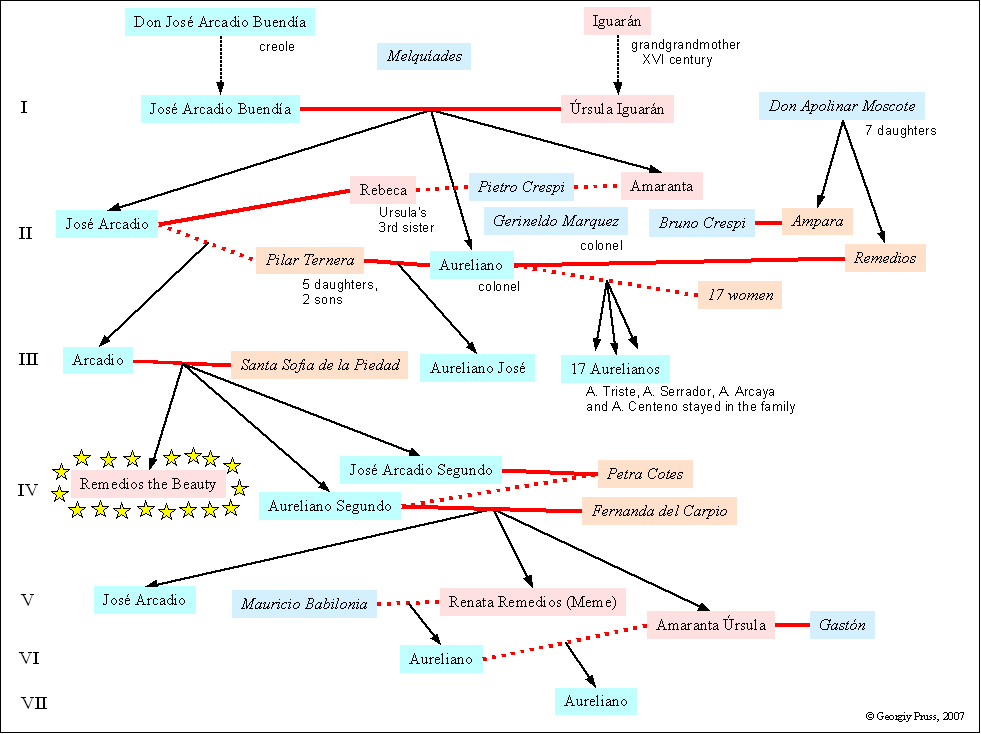
"One Hundred Years of Solitude" by Gabriel García Márquez.
Gabriel García Márquez's masterpiece, One Hundred Years of Solitude, is sad story of the loves, tragedies, and everyday lives of the Buendía family. Throughout the generations, there are many themes, character types, and events that are always present and repeating. It is their fate to be stuck in a never-ending cycle.
José Arcadio Buendía represents Adam in a biblical sense in "One Hundred Years of Solitude". He is the founder and leader of Macondo, and during his life he never stops striving for knowledge. Some time after founding Macondo, a mythical yet intensely real town, José Arcadio Buendía discovers the wonders of science. The Gypsies that frequent the town every few years first introduce José Arcadio Buendía to the idea of magic and new wonders of the world, and they even give him a lab to mess around in. José Arcadio Buendía eventually abandons the magical effects of the Gypsies for true scientific study. One day in his lab he thinks he has discovered perpetual motion. Because perpetual motion is imposible to achieve, he goes crazy. He is convinced the same day is repeating itself over and over again. In a sense, his discovery made the world timeless for him. Time begins to change and the past, present, and future start to overlap. He is able to visit his descendants throughout out the book even after he is dead. With this repetition Márquez is hinting that the real world never moves forward or backwards, but is generally all the same. This sense that time is repeating sets up the rest of the family to just repeat the same story over and over.
Colonel Aureliano Buendía is the military figure head of the Buendía family. He inherited his will and reclusiveness from his father José Arcadio Buendía. He leads the liberal...
More World Literature
essays:
"Chronicle of a Death Foretold" by Gabriel Garcia Marquez.
... warn Nasar that two men were out to kill him. Instead they all gathered round to watch the exciting event. Gabriel García Márquez is known for his use of magic realism, a style that blends fantastic elements with realistic ... dominoes that night, and by then it was too late. Similarly, few of the villagers did anything to try to warn Nasar that two men were out to kill him. Instead they all gathered round to watch the exciting event. Gabriel ...
Religion in Gabriel Garcis Marquez's "One Hundred Years of Solitude"
... Solitude, in all of its greatness, can only exhibit a small part in the entire complex history of Latin America. Gabriel García Márquez makes use of this book to communicate the negative effects he sees of organized religion in ... In "One Hundred Years of Solitude", one largely recognizable theme that Gabriel García Márquez presents is the role of religion. García Márquez repeatedly ridicules the extreme value Latin American culture has placed in organized religion. He also ...
Gabriel Garcia Marquez and "One Hundred Years of Solitude"
... Considered by many to be the greatest Latin American author, Gabriel García Márquez encompasses the imagination of peasant settlers and the talent of nomadic gypsies in his writing. Most famous for his celebrated epic novel One Hundred Years of ... evident advancement in time and activity, the characters are nonetheless condemned to repeat the mistakes and experiences of previous generations. García Márquez also intertwines political situations with his characters' conflicts to convey a sense of chronic mirroring. In One ...
The Silence that led to Tragedy: "Chronicle of a Death Foretold" by Gabriel Garcia Marquez
... killed by his own town - a town that has transformed into an empty shell. (Marquez 76). Works Cited Márquez, Gabriel García. Chronicle of a Death Foretold. 1982. New York: Vintage Books, 1983. Alonso, Carlos J. "Writing and Ritual in ... Death Foretold. 1982. New York: Vintage Books, 1983. Alonso, Carlos J. "Writing and Ritual in Chronicle of a Death Foretold." Gabriel Garcia Marquez. Ed. Harold Bloom. New York: Chelsea House, 1989. Alvarez-Borland, Isabel. "From Mystery to Parody: (Re) Readings of ...
Role of Fate in 'The House of the Spirits' by Isabel Allende and 'The Chronicles of a Death Foretold'by Gabriel Garcia Marquez.
... the twists and turns of fate which is the result of their own actions while in the murder mystery of Gabriel García Marquez, 'The Chronicles of a Death Foretold' the whole town needs to be blamed for the Santiago's ... and vital role in 'The House of the Spirits' by Isabel Allende and 'The Chronicles of a Death Foretold' by Gabriel Garcia Marquez. On the first insight into the 'The House of the Spirits,' it clearly shows that the characters are ...
An examination of the kitchen motif in Gabriel Garcia Marquez' Chronicles of a Death Foretold
... faulted society. Such authority is often manifested in an authors whos work depicts the underlying corruption in the community. Gabriel García Márquez illustrates the flaws of his home country; Columbia in the Chronicles of a Death Foretold through ... essence the prevalent binary nature of a kitchen with the inherent human disposition is re-emphasized. The intrinsic corruption in Gabriel Garcia Márquezs Chronicles of a Death Foretold is exhibited through the kitchen motif. Akin to a kitchen, M ...
Gabriel Garcia Marquez
... , and publicist in Mexico City. Mercedes promised to wait for Gabriel and his trips to pursue his career and Gabriel returned to Colombia and married Mercedes Barcha Pardo. In 1959 García Márquez's first son, Rodrigo, was born, and ... with numerous amounts of family members and legends of ghosts and ghouls. Garcia's parents, Luisa Santiaga Marquez Iguran and Gabriel Eligio Garcia, were both madly in love with each other despite the disapprovement of her father. Finally, after "wooing her ...
"Of Love and Other Demons", by Gabriel Garcia Marquez.
... . When people give one another love it gives them strength and confidence in themselves. Of Love and Other Demons, by Gabriel Garcia Marquez is about a twelve-year-old girl, Sierva Maria, who has the absence of love. She is bitten ...